Parable of the Barren Fig Tree—William Barclay


Barren fig tree

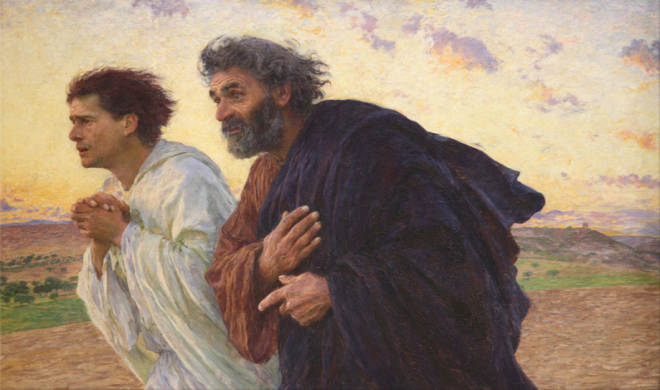
The Barren Fig Tree—Eugene Burnand

Gospel of the Other Chance and Threat of the Last Chance (Luke 13:6-9)
Jesus spoke this parable, “A man had a fig-tree planted in his vineyard. He came looking for fruit on it and did not find it. He said to the keeper of the vineyard, ‘Look you—for the last three years I have been coming and looking for fruit on this fig-tree, and I still am not finding any. Cut it down! Why should it use up the ground’ ‘Lord,’ he answered him, ‘let it be this year too, until I dig round about it and manure it, and if it bears fruit in the coming year, well and good; but if not, you will cut it down.'”**
Here is a parable at one and the same time lit by grace and close packed with warnings.
(i) The fig-tree occupied a specially favoured position. It was not unusual to see fig-trees, thorn-trees and apple-trees in vineyards. The soil was so shallow and poor that trees were grown wherever there was soil to grow them; but the fig-tree had a more than average chance; and it had not proved worthy of it. Repeatedly, directly and by implication, Jesus reminded men that they would be judged according to the opportunities they had. C. E. M. Joad once said, “We have the powers of gods and we use them like irresponsible schoolboys.” Never was a generation entrusted with so much as ours and, therefore, never was a generation so answerable to God.
(ii) The parable teaches that uselessness invites disaster. It has been claimed that the whole process of evolution in this world is to produce useful things, and that what is useful will go on from strength to strength, while what is useless will be eliminated. The most searching question we can be asked is, “Of what use were you in this world?”
(iii) Further, the parable teaches that nothing which only takes out can survive. The fig-tree was drawing strength and sustenance from the soil; and in return was producing nothing. That was precisely its sin. In the last analysis, there are two kinds of people in this world—those who take out more than they put in, and those who put in more than they take out.
In one sense we are all in debt to life. We came into it at the peril of someone else’s life; and we would never have survived without the care of those who loved us. We have inherited a Christian civilization and a freedom which we did not create. There is laid on us the duty of handing things on better than we found them.
“Die when I may,” said Abraham Lincoln, “I want it said of me that I plucked a weed and planted a flower wherever I thought a flower would grow.” Once a student was being shown bacteria under the microscope. He could actually see one generation of these microscopic living things being born and dying and another being born to take its place. He saw, as he had never seen before, how one generation succeeds another. “After what I have seen,” he said, “I pledge myself never to be a weak link.”
If we take that pledge we will fulfil the obligation of putting into life at least as much as we take out.
(iv) The parable tells us of the gospel of the second chance. A fig-tree normally takes three years to reach maturity. If it is not fruiting by that time it is not likely to fruit at all. But this fig-tree was given another chance.
It is always Jesus’ way to give a man chance after chance. Peter and Mark and Paul would all gladly have witnessed to that. God is infinitely kind to the man who falls and rises again.
(v) But the parable also makes it quite clear that there is a final chance. If we refuse chance after chance, if God’s appeal and challenge come again and again in vain, the day finally comes, not when God has shut us out, but when we by deliberate choice have shut ourselves out. God save us from that!
Gospel of Luke, Barclay’s Daily Study Bible (NT).

** William Barclay’s own translation.

Reasons To Believe : Are There Transitional Intermediates in the Fossil Record?


FuzBy Dr. Fazale Rana


fossil-dino-fish-1

via Reasons To Believe : Q&A: Are There Transitional Intermediates in the Fossil Record?.

Prosperity Gospel – Femi Adeleye – Cape Town 2010 – YouTube


Plenary 2: Prosperity Gospel – Femi Adeleye – Cape Town 2010 – YouTube.

The Heart is the Core of a Person’s Being–Harold Eberle


Harold R. Eberle

Harold R. Eberle

The Western worldview leads people to think that the mind with all of its intelligence and thought processes is the core of our being. In contrast, the ancient Hebrew worldview recognized the heart as the governing center of a person’s being.

As the writer of Proverbs said: Watch over your heart with all diligence, for from it flow the springs of life (Proverbs 4: 23).

Where the heart is pointed determines where a person’s life will go. A person’s future, destiny , relationships, victories, and failures are all determined by where his or her heart is pointed.

If their heart is oriented strongly enough then they will obtain the training, experience, and knowledge necessary to accomplish what they desire. On the other hand, if their heart is timid, filled with doubt, undetermined or undirected , then they will not succeed no matter how much knowledge they possess.

The heart also determines what strengths and weaknesses will be drawn from other people. This is true because wherever the heart is pointed determines to whom a person is bonded. Those to whom we open our heart become anchors for our life. To some degree, their strengths become our strengths and their weaknesses become our weaknesses. We become like the people with whom we associate. Therefore, our heart is a doorway for the character we develop in the future. Because the heart determines the life of a person, it is more important for a person to develop their heart than it is for them to develop their intellect. This truth is foreign to the Western mind, but central to ancient Hebrew thought. Further elevating the importance of the heart is the understanding that the heart is what accesses the spiritual realm. With the heart a person senses things in the spiritual realm. With the heart a person believes and anchors his or her life in God.

Eberle, Harold (2009-12-28). Christianity Unshackled: Are You A Truth Seeker (pp. 219-220). Destiny Image, Inc.. Kindle Edition.

Reasons To Believe : Was the Origin of Life an Instantaneous Event?


team-member-hugh-rossReasons To Believe : Was the Origin of Life an Instantaneous Event?.

By Dr. Hugh Ross

An Incredible Time of Peace – Kris Vallotton, Bethel Church – YouTube


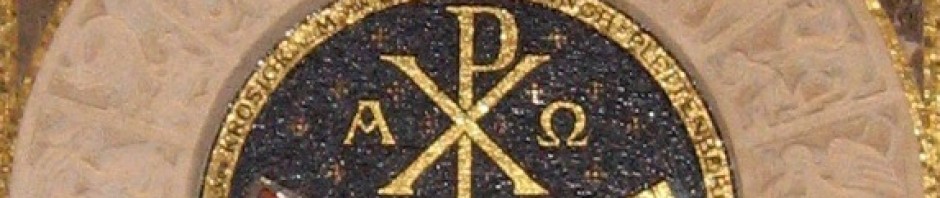
Greek Initials ‘XP’–What did they stand for?


  “XP“Chi-Rho    Christ – the 1st 2 letters of Christos in Greek “P” in Greek is “r” in English

Greek Initials. cropped-xp.jpg

 “Α Ω““A w”(Alpha-Omega) 

The first and last letters of the Greek alphabet,

   Represents that God is eternal – spanning the beginning and the end.


A Letter to the Church


Doctrina Stabilitas's avatarDefined Faith

Dear Evangelical Church,

I wanted to write to you because of my mixed feelings about you. I must admit that I find myself so often really, really not liking you. And though you claim to be the source of joy by virtue of a membership in the Body of Christ, I find that euphoria I once had at the knowledge of truth jaded by your failures and lackings.

Church, I hate how you value truth over all else. I hate how even though the heavens declare the glory of God, you still treat science as an invalid tool for studying God’s ordered world. I hate how you have marginalized the gift of human reason by banishing those with doubt as people of weak faith, forgetting how perfect love casts out fear. I despise how you have politicized theology by linking politics with a national notion of Christianity.

I hate how…

View original post 402 more words

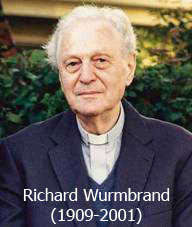
“Two men enter a house through the chimney. ” Richard Wurmbrand


richardAs early as 1912, Lenin wrote the following in a letter to Russian author Maxim Gorki: “Millions of acts of violence, of illnesses and epidemics, are much less dangerous than the most purified, the slightest idea of a God…. God is the personal enemy of the Communist society.”

He also wrote, “Religion is a kind of spiritual vodka, in which the slaves of capital drown their human features and their reverence for a somehow dignified human life.”

There are those who choose to think like Lenin; but there are also multitudes who choose to believe in God.

To you it might be doubtful if God exists, but the following Jewish story surely exists:

A rabbi put the following question to a man in his congregation: “Two men enter a house through the chimney. The one is dirty, the other clean. Which of them washes himself?”

The Jew replies, “Surely, the dirty one.”

“No,” says the rabbi, “because the dirty man sees that the other is clean, so he presumes he is clean, too. The clean man, seeing the dirt on the other, believes he is dirty also and washes himself.

“Now I have a second question,” continues the rabbi. “Two men enter a house through the chimney. One is dirty, the other clean. Which one washes himself?”

The Jew answers, “Now I know: the clean one.”

“No,” says the rabbi. “The clean man looks at his hands and clothes and sees they are clean, so why should he wash? The other man sees that he is dirty all over, so he washes.”

The rabbi put a third question: “Two men enter a house through the chimney. One is clean, the other dirty. Which one washes himself?”

In despair, the Jew shouts, “Both!”

“Wrong,” says the rabbi.“If two men enter through a chimney, how can one remain clean? Did you not see that the question is foolish?”

So any human questioning of God is foolish. If there were no intelligent Creator, there would be no intelligent being to put questions or to deny the intelligent Creator. God simply exists. Even the assertion that He exists is a condescension to the unreasonableness of ordinary thinking.

Wurmbrand, Richard (2011-05-24). Proofs of God’s Existence (Kindle Locations 325-341). Living Sacrifice Book Company. Kindle Edition.