Category / Religion
“Two men enter a house through the chimney. ” Richard Wurmbrand
As early as 1912, Lenin wrote the following in a letter to Russian author Maxim Gorki: “Millions of acts of violence, of illnesses and epidemics, are much less dangerous than the most purified, the slightest idea of a God…. God is the personal enemy of the Communist society.”
He also wrote, “Religion is a kind of spiritual vodka, in which the slaves of capital drown their human features and their reverence for a somehow dignified human life.”
There are those who choose to think like Lenin; but there are also multitudes who choose to believe in God.
To you it might be doubtful if God exists, but the following Jewish story surely exists:
A rabbi put the following question to a man in his congregation: “Two men enter a house through the chimney. The one is dirty, the other clean. Which of them washes himself?”
The Jew replies, “Surely, the dirty one.”
“No,” says the rabbi, “because the dirty man sees that the other is clean, so he presumes he is clean, too. The clean man, seeing the dirt on the other, believes he is dirty also and washes himself.
“Now I have a second question,” continues the rabbi. “Two men enter a house through the chimney. One is dirty, the other clean. Which one washes himself?”
The Jew answers, “Now I know: the clean one.”
“No,” says the rabbi. “The clean man looks at his hands and clothes and sees they are clean, so why should he wash? The other man sees that he is dirty all over, so he washes.”
The rabbi put a third question: “Two men enter a house through the chimney. One is clean, the other dirty. Which one washes himself?”
In despair, the Jew shouts, “Both!”
“Wrong,” says the rabbi.“If two men enter through a chimney, how can one remain clean? Did you not see that the question is foolish?”
So any human questioning of God is foolish. If there were no intelligent Creator, there would be no intelligent being to put questions or to deny the intelligent Creator. God simply exists. Even the assertion that He exists is a condescension to the unreasonableness of ordinary thinking.
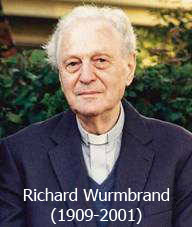
Wurmbrand, Richard (2011-05-24). Proofs of God’s Existence (Kindle Locations 325-341). Living Sacrifice Book Company. Kindle Edition.
Green Scholars Initiative – greenscholarsinitiative.org
Watch “Jesus Among Other gods – Ravi Zacharias” on YouTube
Can We Still Believe the Bible?


Craig Blomberg, Distinguished Professor of New Testament at Denver Seminary, has written another outstanding volume. Blomberg is a committed evangelical, but not one with a closed mind. As he says in his preface about the environment of Denver Seminary (quoting Vernon Grounds, former president of the school), “Here is no unanchored liberalism—freedom to think without commitment. Here is no encrusted dogmatism—commitment without freedom to think. Here is a vibrant evangelicalism—commitment with freedom to think within the limits laid down by Scripture.” Blomberg’s writings have always emulated this philosophy. His research in the secondary literature is consistently of superb quality, and his discussions of problem passages and issues, especially in the Gospels, is always well informed. Rather than clutter the narrative with documentation, Blomberg has wisely used endnotes instead of footnotes (though I personally prefer footnotes, I understand that most readers see them as a distraction). This book has nearly…
View original post 3,073 more words
Science Set Free Podcast

Watch “Did Jesus Really Rise from the Dead? Dr. N.T. Wright” (begins at 8:45)
Watch “Image of God: Ruined and Restored – N. T. Wright” on YouTube
Through the house the child would shout ‘Abba!’—William Barclay

William Barclay 1907-1978
Like most people brought up in an evangelical home I did not at first know that there was any other way of thinking of the Atonement except in terms of God laying on Jesus the punishment that should have been laid on me… It seemed to me that the whole conception starts from the wrath of God, while the New Testament starts from the love of God. It was because he so loved the world that God sent his Son into the world (John 3:16). It was his love that God showed to us in the death of Christ for us while we were still sinners (Romans 5:8). Never in the New Testament, never once, is God said to be reconciled to man; it is always man who is reconciled to God. We plead with you, says Paul, on behalf of Christ, be reconciled to God (2 Corinthians 5:20).
Slowly it began to dawn on me that apart from the love of God there would have been no Atonement at all. And then I began to see this tremendous thing, the fact that Jesus came, not to change God’s attitude to men, but to demonstrate God’s attitude to men, to show men at the cost of the Cross what God is like. And then still later when I had to study the New Testament, I came to see that this is precisely what John is saying [John 1:14] — and what a difference! The God of terror became the God of love. It became the most natural thing in the world to seek the presence of God instead of running away from God.
Let us see this difference in operation. I have written of this again and again because I do not think that it can be stated too often. First of all, let us see the thing in Judaism. The angel of the Lord came to Manoah and his wife to tell them that their son Samson was to be born, and when Manoah realized who their heavenly visitor had been he said in terror: ‘We shall surely die, for we have seen God’ (Judg. 13:22). In Judaism to see God was, so they believed, [would be] to die. Now let us turn to the New Testament. No one has seen God; it is the only Son who has revealed Him (John 1:18). And revealed him as what? ‘He who has seen me has seen the Father’ (John 14:9). And in what sense? Jesus called God Abba (Mark 14:36). It is but that name that we too may call God, that we are invited to call him, says Paul (Rom.8:15; Gal. 4:6). And what does this word Abba mean? Abba is the word—to this day—by which a little Jewish boy or girl addresses his father in the home circle, in the family. Through the house the child would shout ‘Abba!’—Daddy.
Second, let us take the early Greek conception of God. In the old Greek mythology Prometheus was the supreme benefactor of man; he instructed man in architecture, astronomy, mathematics, writing, rearing cattle, navigation, medicine, the art of prophecy, working in metal and in every other art. The myth said that Prometheus had made man of clay, and, to give his clay life, [Prometheus] stole fire from heaven to put into it. The result was that Zeus chained him to a rock in the middle of the ocean and prepared a vulture to tear out his liver, which grew again each night to be torn out again each day. The gods grudged man everything, and any god who became a benefactor of men incurred the divine wrath in its most savage manifestation. What a difference between that and the God and Father of our Lord Jesus Christ!
Third, let us take the conception of the God of Greek philosophy with the New Testament. Both the great school of philosophy, the Stoics and the Epicureans, held that the supreme good in life is ataraxia, which means serenity. If that is true for man, how much more must it be true of God? In order to provide God with this ataraxia, the held that God must have apatheia. Apatheia is not apathy in the sense of indifference; it is the complete inability to feel anything at all. The being who has apatheia cannot know love or hate, but remains forever completely insulated against all feeling. If anyone can cause us sorrow or joy, it means that for that moment that person is greater than we are, because that person can have some influence over us. So the way to complete serenity is insulation against all feeling. When the countess of Lyttelton’s husband died, J. M. Barrie wrote to her: ‘If you had cared for him less, if he had been less worth caring for, the road would be less heavy-going. Joy has to be paid for.’ Sorrow is the price of love. If we never allowed ourselves to care for any one then there would be no such thing as sorrow. So the Greeks conceived of a God who essentially was unable to care. What a difference from the God who so loved the world, from the Jesus who could be moved with compassion, who wept! The difference between the apathetic Greek God and the Christian God of love is as wide as infinity.
I believe in Jesus, because it is only through Jesus that I know God as the Friend and Father, in whose presence I can be at home without fear, as a child with his father.
[from William Barclay: A Spiritual Autobiography, pg 51-54, William B Eerdmans Publishing Company, Grand Rapids, 1975.]
Professor of Divinity and Biblical Criticism at Glasgow University and the author of many Biblical commentaries and books, including a translation of the New Testament, Barclay New Testament, and The Daily Study Bible Series.

 St. John One: One