Measured vs. Universally Immeasurable
The visions of Ezekiel and John, separated by centuries, describe two of the most striking sacred architectures in the Bible. Ezekiel’s Temple is exact, measurable, and earthly — a restoration of divine order after exile. The New Jerusalem in Revelation, by contrast, is immeasurable, luminous, and cosmic — a city that is itself the Holy of Holies. Together they trace the evolution of divine presence: from dwelling among a nation to encompassing all creation.
Ezekiel’s Temple: Measured and Earthly
In Ezekiel chapters 40–48, the prophet describes a vast temple complex shown to him by an angelic guide with a measuring reed. The reed was six long cubits, roughly ten and a half feet. The entire compound measured five hundred reeds on each side — about one mile square (1.6 km), or roughly 640 acres. Within it lay an outer court (175 × 175 cubits), an inner court (100 × 100 cubits), and the sanctuary itself, containing the Holy of Holies. The temple stood as a symbol of restoration: God returning to dwell among His people in holiness after judgment and exile.
Its geometry was orderly, its hierarchy strict — priests, Levites, prince, people. The outer walls and gates divided sacred from profane. The glory of the Lord returned from the east to fill the house, fulfilling the vision of divine presence once lost. The entire landscape of Israel was redrawn around this perfect square, each tribe allotted its place in balance. It was, at its heart, a promise of a new beginning under divine law and covenantal order.
The New Jerusalem: Infinite and Heavenly
The Book of Revelation (chapters 21–22) opens the final vision: the New Jerusalem descending out of heaven from God. Its measurements defy comprehension — a perfect cube, twelve thousand stadia in length, breadth, and height, roughly 1,380 miles (2,220 km) per side. The city’s radiance was like jasper and gold so pure it was transparent. Its foundations were adorned with precious stones, and its gates — twelve in all — each formed from a single pearl.
John writes that there was ‘no temple in the city, for the Lord God Almighty and the Lamb are its temple.’ In this new order, the temple is no longer a building but a person — God Himself dwelling with humanity. The cube form deliberately recalls the Holy of Holies in Solomon’s and Ezekiel’s temples. Now, the Holy of Holies has expanded to encompass the cosmos. The river of life flows from the throne of God and of the Lamb, and the Tree of Life stands for the healing of the nations. The geometry of holiness has become the architecture of eternity.
Symbolism and Theological Contrast
Ezekiel’s Temple restores what was lost: holiness returning to the land. The New Jerusalem transcends that boundary altogether: the entire creation becomes holy. In Ezekiel, worship requires distance — sacred precincts, altars, purification. In Revelation, worship requires union — no more night, no more temple, no more separation.
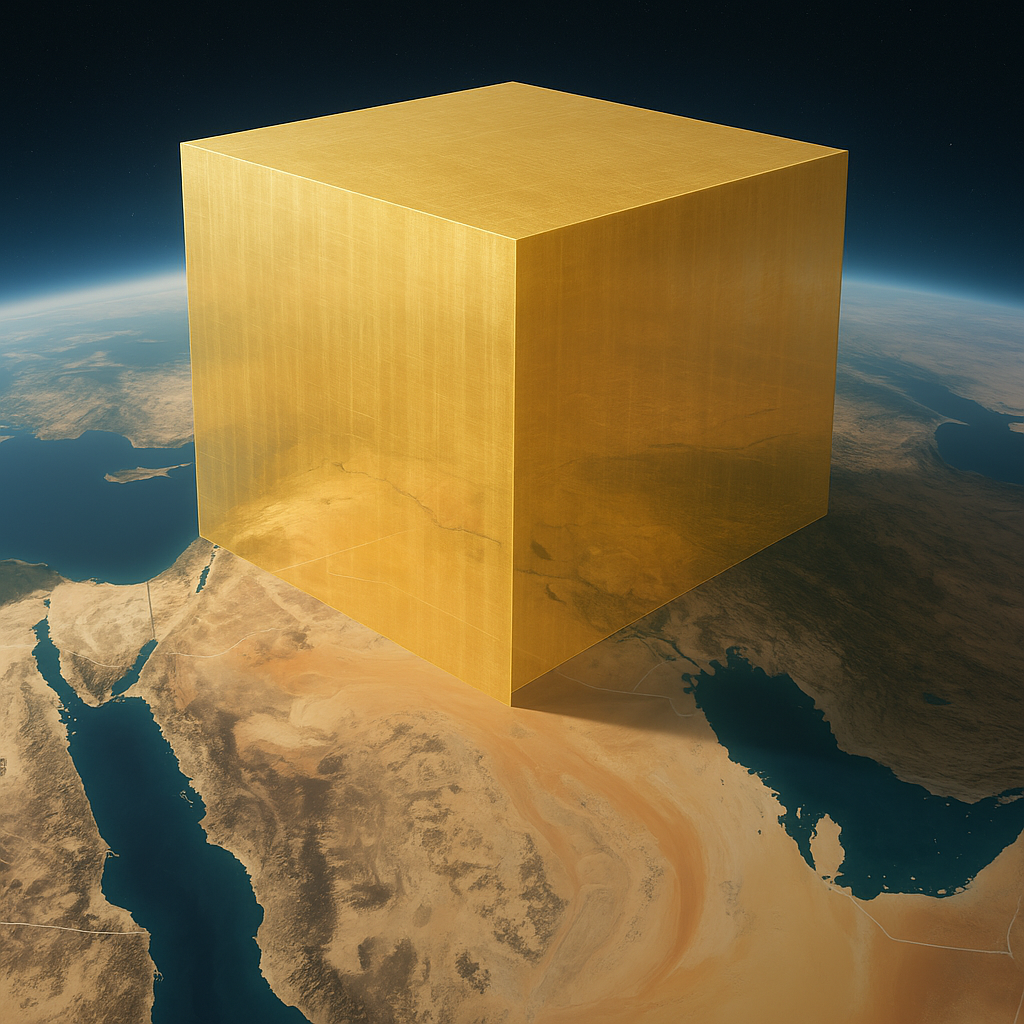
If Ezekiel’s vision is about rebuilding holiness, John’s vision is about abolishing distance. Ezekiel’s temple fits neatly in a square mile of earth; John’s city would engulf continents, rising higher than the atmosphere — a cosmic, impossible geometry proclaiming that heaven and earth are now one. The cube symbolizes perfection, equality, and permanence, a shape that mirrors divine order made complete.
The Physical Impossibility and Spiritual Intention
Placed on a map, the New Jerusalem would cover the Middle East from Egypt to Iran, its height reaching far beyond low-Earth orbit. It could not be a natural object. Whether literal or symbolic, its immensity implies divine creation — a city of light existing beyond physics. The number 12,000 stadia (twelve tribes, twelve apostles, multiplied by completeness) encodes universality rather than measurement. The scale forces the reader to imagine a creation remade, not simply repaired.
From Measured Restoration to Infinite Communion
The contrast between Ezekiel’s Temple and the New Jerusalem captures the arc of redemption. Ezekiel’s measured courts remind humanity of holiness within boundaries; Revelation’s immeasurable cube declares holiness without end. Where one restores covenant, the other fulfills it. The God who returned to dwell in a temple now dwells in all creation — and creation itself becomes His dwelling place.





 St. John One: One