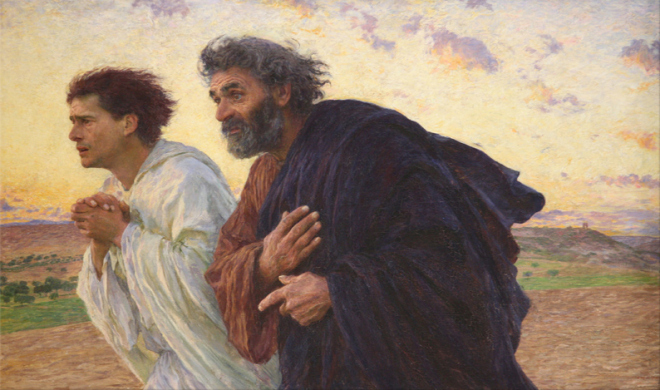
Tag / Jesus
The Resurrection and the Life– by William Barclay
The Resurrection and the Life (Jn 11:20-27)
11:20-27 So when Martha heard that Jesus was coming, she went to meet him, but Mary remained sitting in the house. So Martha said to Jesus: “Lord, if you had been here, my brother would not have died. And even as things are, I know that whatever you ask God, God will give you.” Jesus said to her: “Your brother will rise again.” Martha said to him: “I know that he will rise at the resurrection on the last day.” Jesus said to her: “I am the Resurrection and the Life. He who believes in me will live even if he has died; and everyone who lives and believes in me shall never die. Do you believe this?” She said to him; “Yes, Lord. I am convinced that you are God’s Anointed One, the Son of God, the One who is to come into the world.”

William Barclay 1907-1978
In this story, too, Martha is true to character. When Luke tells us about Martha and Mary (Lk 10:38-42), he shows us Martha as the one who loved action, and Mary as the one whose instinct was to sit still. It is so here. As soon as it was announced that Jesus was coming near, Martha was up to meet him, for she could not sit still, but Mary lingered behind.
When Martha met Jesus her heart spoke through her lips. Here is one of the most human speeches in all the Bible, for Martha spoke, half with a reproach that she could not keep back, and half with a faith that nothing could shake. “If you had been here.” she said, “my brother would not have died.” Through the words we read her mind. Martha would have liked to say: “When you got our message, why didn’t you come at once? And now you have left it too late.” No sooner are the words out than there follow the words of faith, faith which defied the facts and defied experience: “Even yet,” she said with a kind of desperate hope, “even yet, I know that God will give you whatever you ask.”
Jesus said “Your brother will rise again.” Martha answered: “I know quite well that he will rise in the general resurrection on the last day.” Now that is a notable saying. One of the strangest things in scripture is the fact that the saints of the Old Testament had practically no belief in any real life after death. In the early days, the Hebrews believed that the soul of every man, good and bad alike, went to Sheol. Sheol is wrongly translated Hell; for it was not a place of torture, it was the land of the shades. All alike went there and they lived a vague, shadowy, strengthless, joyless ghostly kind of life. This is the belief of by far the greater part of the Old Testament. “In death there is no remembrance of thee: in Sheol who can give thee praise?” (Ps 6:5). “What profit is there in my death if I go down to the pit? Will the dust praise thee? Will it tell of thy faithfulness?” (Ps 30:9). The Psalmist speaks of “the slain that lie in the grave, like those whom thou dost remember no more; for they are cut off from thy hand” (Ps 88:5). “Is thy steadfast love declared in the grave,” he asks, “or thy faithfulness in Abaddon? Are thy wonders known in the darkness, or thy saving help in the land of forgetfulness?” (Ps 88:10-12). “The dead do not praise the Lord, nor do any that go down into silence” (Ps 115:17). The preacher says grimly: “Whatever your hand finds to do, do it with your might; for there is no work or thought or knowledge or wisdom in Sheol, to which you are going” (Ecc 9:10). It is Hezekiah’s pessimistic belief that: “For Sheol cannot thank thee, death cannot praise thee; those who go down to the pit cannot hope for thy faithfulness” (Isa 38:18). After death came the land of silence and of forgetfulness, where the shades of men were separated alike from men and from God. As J. E. McFadyen wrote: “There are few more wonderful things than this in the long history of religion, that for centuries men lived the noblest lives, doing their duties and bearing their sorrows, without hope of future reward.”
Just very occasionally someone in the Old Testament made a venturesome leap of faith. The Psalmist cries: “My body also dwells secure. For thou dost not give me up to Sheol, or let thy godly one see the pit. Thou dost show me the path of life; in thy presence there is fullness of joy, in thy right hand are pleasures for evermore” (Ps 16:9-11). “I am continually with thee; thou dost hold my right hand. Thou dost guide the with thy counsel, and afterward thou wilt receive me to glory” (Ps 73:23-24). The Psalmist was convinced that when a man entered into a real relationship with God, not even death could break it. But at that stage it was a desperate leap of faith rather than a settled conviction. Finally in the Old Testament there is the immortal hope we find in Job. In face of all his disasters Job cried out:
“I know that there liveth a champion,
Who will one day stand over my dust;
Yea, another shall rise as my witness,
And, as sponsor, shall I behold—God;
Whom mine eyes shall behold, and no stranger’s.”
(Job 14:7-12; translated by J. E. McFadyen).
Here in Job we have the real seed of the Jewish belief in immortality.
The Jewish history was a history of disasters, of captivity, slavery and defeat. Yet the Jewish people had the utterly unshakable conviction that they were God’s own people. This earth had never shown it and never would; inevitably, therefore, they called in the new world to redress the inadequacies of the old. They came to see that if God’s design was ever fully to be worked out, if his justice was ever completely to be fulfilled, if his love was ever finally to be satisfied, another world and another life were necessary. As Galloway (quoted by McFadyen) put it: “The enigmas of life become at least less baffling, when we come to rest in the thought that this is not the last act of the human drama.” It was precisely that feeling that led the Hebrews to a conviction that there was a life to come.
It is true that in the days of Jesus the Sadducees still refused to believe in any life after death. But the Pharisees and the great majority of the Jews did. They said that in the moment of death the two worlds of time and of eternity met and kissed. They said that those who died beheld God, and they refused to call them the dead but called them the living. When Martha answered Jesus as she did she bore witness to the highest reach of her nation’s faith.
Barclay’s Daily Study Bible (NT).
N.T. Wright–LUKE 15.11– 32 –Parable of the Prodigal, from Luke for Everyone
The Father and the Younger Son
11Jesus went on:
‘Once there was a man who had two sons. 12The younger son said to the father, “Father, give me my share in the property .” So he divided up his livelihood between them. 13Not many days later the younger son turned his share into cash, and set off for a country far away, where he spent his share in having a riotous good time. 15‘When he had spent it all, a severe famine came on that country, and he found himself destitute. 15So he went and attached himself to one of the citizens of that country, who sent him into the fields to feed his pigs. 16He longed to satisfy his hunger with the pods that the pigs were eating, and nobody gave him anything. 17‘He came to his senses. “Just think!” he said to himself. “There are all my father’s hired hands with plenty to eat – and here am I, starving to death! 18I shall get up and go to my father, and I’ll say to him: ‘Father; I have sinned against heaven and before you; 19I don’t deserve to be called your son any longer. Make me like one of your hired hands.’” 20And he got up and went to his father. ‘While he was still a long way off, his father saw him and his heart was stirred with love and pity. 21He ran to him, hugged him tight, and kissed him. “Father,” the son began, “I have sinned against heaven and before you; I don’t deserve to be called your son any longer.” 22But the father said to his servants, “Hurry! Bring the best clothes and put them on him! Put a ring on his hand, and shoes on his feet! 23And bring the calf that we’ve fattened up, kill it, and let’s eat and have a party! 24This son of mine was dead, and is alive again! He was lost, and now he’s found!” And they began to celebrate.’
 We might think that the parable of the prodigal son, as it’s usually known, hardly needs an introduction. It has inspired artists and writers down the years. Rembrandt’s famous painting, with the younger son on his knees before the loving and welcoming father, has become for many almost as much of an inspiration as the story itself. Phrases from the story – the ‘fatted calf’, for instance, in the King James version of the Bible – have become almost proverbial. And yet. People often assume that the story is simply about the wonderful love and forgiving grace of God, ready to welcome back sinners at the first sign of repentance. That is indeed its greatest theme, which is to be enjoyed and celebrated. But the story itself goes deeper than we often assume. Let’s be sure we’ve understood how families like this worked. When the father divided the property between the two sons, and the younger son turned his share into cash, this must have meant that the land the father owned had been split into two, with the younger boy selling off his share to someone else. The shame that this would bring on the family would be added to the shame the son had already brought on the father by asking for his share before the father’s death; it was the equivalent of saying ‘I wish you were dead’. The father bears these two blows without recrimination.

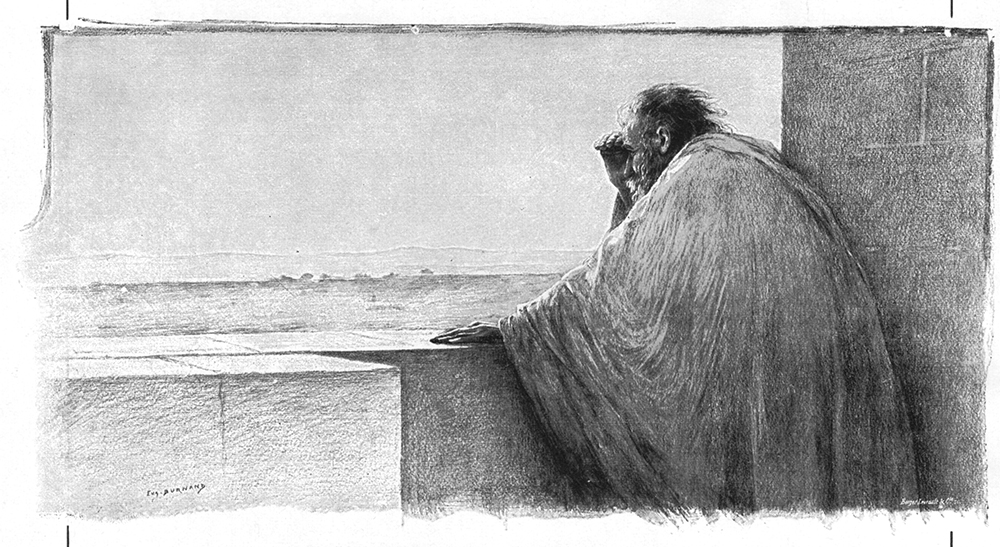
Prodigal Son by Eugene Burnand
To this day, there are people in traditional cultures, like that of Jesus’ day, who find the story at this point quite incredible. Fathers just don’t behave like that; he should (they think) have beaten him, or thrown him out. There is a depth of mystery already built in to the story before the son even leaves home. Again, in modern Western culture children routinely leave homes in the country to pursue their future and their fortune in big cities, or even abroad; but in Jesus’ culture this would likewise be seen as shameful, with the younger son abandoning his obligation to care for his father in his old age. When the son reaches the foreign country, runs through the money, and finds himself in trouble, his degradation reaches a further low point. For a Jew to have anything to do with pigs is bad enough; for him to be feeding them, and hungry enough to share their food, is worse. But of course the most remarkable character in the story is the father himself. One might even call this ‘the parable of the Running Father’: in a culture where senior figures are far too dignified to run anywhere, this man takes to his heels as soon as he sees his young son dragging himself home. His lavish welcome is of course the point of the story: Jesus is explaining why there is a party, why it’s something to celebrate when people turn from going their own way and begin to go God’s way. Because the young man’s degradation is more or less complete, there can be no question of anything in him commending him to his father, or to any other onlookers; but the father’s closing line says it all. ‘This my son was dead and is alive; he was lost and now is found.’
Prodigal Son by Eugene Burnand
How could this not be a cause of celebration? Inside this story there is another dimension which we shouldn’t miss. One of the great stories of Israel’s past was of course the Exodus, when Israel was brought out of Egypt and came home to the promised land. Many years later, after long rebellion, Israel was sent into exile in Babylon ; and, though many of the exiles returned, most of Jesus’ contemporaries reckoned that they were still living in virtual exile, in evil and dark days, with pagans ruling over them. They were still waiting for God to produce a new Exodus, a liberation which would bring them out of their spiritual and social exile and restore their fortunes once and for all. For Jesus to tell a story about a wicked son, lost in a foreign land, who was welcomed back with a lavish party – this was bound to be heard as a reference to the hope of Israel. ‘This my son was dead, and is alive’; ever since Ezekiel 37 the idea of resurrection had been used as picture-language for the true return from exile. Yes, says Jesus, and it’s happening right here. When people repent and turn back to God – which, as we’ve seen, meant for Jesus that they responded positively to his gospel message – then and there the ‘return from exile’ is happening, whether or not it looks like what people expected.

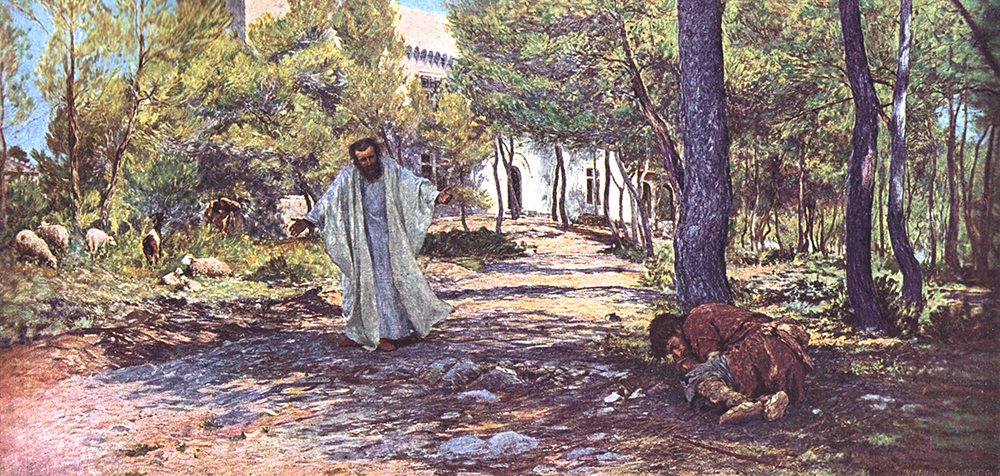
Prodigal Son by Eugene Burnand
His answer to the Pharisees and other critics is simple: if God is fulfilling his promises before your very eyes, you can’t object if I throw a party to celebrate. It’s only right and proper. There is a danger in splitting the story into two, as we’ve done. The second half is vital, and closely interwoven with the first. But in this first section the emphasis is on the father’s costly love. From the moment he generously gives the younger son what he wanted, through to the wonderful homecoming welcome, we have as vivid a picture as anywhere in Jesus’ teaching of what God’s love is like, and of what Jesus himself took as the model for his own ministry of welcome to the outcast and the sinner.
LUKE 15.25– 32 The Parable of the Prodigal: The Father and the Older Son
25‘The older son was out in the fields. When he came home, and got near to the house, he heard music and dancing. 26He called one of the servants and asked what was going on. 27‘“Your brother’s come home!” he said. “And your father has thrown a great party – he’s killed the fattened calf! – because he’s got him back safe and well!” 28‘He flew into a rage, and wouldn’t go in. ‘Then his father came out and pleaded with him. 29“Look here!” he said to his father, “I’ve been slaving for you all these years! I’ve never disobeyed a single commandment of yours. And you never even gave me a young goat so I could have a party with my friends. 30But when this son of yours comes home, once he’s finished gobbling up your livelihood with his whores, you kill the fattened calf for him!” 31‘“My son,” he replied, “you’re always with me. Everything I have belongs to you. 32But we had to celebrate and be happy! This brother of yours was dead and is alive again! He was lost, and now he’s found!”’
A vivid phrase from a schoolboy poem, written by a classmate of mine over thirty years ago, remains with me to this day. He described a park-keeper whose job was to pick up litter on a spiked pole. Surrounded by the glorious beauty of flowers and trees, with the sun sparkling through the leaves, he only had eyes for the garbage he had to collect, and the damage it did. The lines I remember sum up his plight: ‘Destroys the nature in this park, litter,’ he said, without Lifting his head. He could only see the bad, and was blind to the beauty. That sums up the older brother in the story. And it’s the older brother who provides the real punch-line of the parable. This is Jesus ’ response to his critics. They were so focused on the wickedness of the tax-collectors and sinners, and of Jesus himself for daring to eat with them despite claiming to be a prophet of God’s kingdom, that they couldn’t see the sunlight sparkling through the fresh spring leaves of God’s love. Here were all these people being changed, being healed, having their lives transformed physically, emotionally, morally and spiritually; and the grumblers could only see litter, the human garbage that they normally despised and avoided. The portrait of the older brother is brilliantly drawn, with tell-tale little shifts of phrase and meaning. ‘Your brother’, says the servant, ‘has come home’; but he won’t think of him like this. ‘This son of yours,’ he says angrily to his father. ‘This your brother,’ says the father, reminding him gently of the truth of the matter. ‘I’ve been slaving for you,’ he says to his father , whereas in fact they had been working as partners, since the father had already divided his assets between them (verse 12).
Prodigal Son by Eugene Burnand
Everything the father has belongs to him, since the younger brother has spent his share; and that, presumably, is part of the problem, since the older brother sees all too clearly that anything now spent on his brother will be coming out of his own inheritance. The phrase which ties the story to Jesus’ opponents comes out tellingly: ‘I’ve never disobeyed a single command of yours.’ That was the Pharisees’ boast (compare Philippians 3.6); but the moral superiority which it appears to give melts like snow before the sunshine of God’s love. Where resurrection is occurring – where new life is bursting out all around – it is not only appropriate, it is necessary to celebrate (verse 32). Not to do so is to fail to meet generosity with gratitude. It is to pretend that God has not after all been at work. It is to look only at the garbage and to refuse to smell the flowers. In terms of what God was doing in Israel through Jesus, we can see once more that the new kingdom work which was going forward was indeed like a return from exile. Sinners and outcasts were finding themselves welcomed into fellowship with Jesus, and so with God, in a way they would have thought impossible. But whenever a work of God goes powerfully forwards, there is always someone muttering in the background that things aren’t that easy, that God’s got no right to be generous, that people who’ve done nothing wrong are being overlooked. That happened at the time when the exiles returned from Babylon; several people, not least the Samaritans, didn’t want them back. This story reveals above all the sheer self-centredness of the grumbler. The older brother shows, in his bad temper, that he has had no more real respect for his father than his brother had had. He lectures him in front of his guests, and refuses his plea to come in. Once more the father is generous, this time to his self-righteous older son. At this point we sense that Jesus is not content simply to tell the grumblers that they’re out of line; he, too, wants to reason with the Pharisees and the lawyers, to point out that, though God’s generosity is indeed reaching out to people they didn’t expect, this doesn’t mean there isn’t any left for them. If they insist on staying out of the party because it isn’t the sort of thing they like, that’s up to them; but it won’t be because God doesn’t love them as well. This parable, like some of the others, points, for Luke, beyond the immediate situation of Jesus’ ministry and into the early church. There, Gentiles were coming into the church, and Jews and Jewish Christians often found it very difficult to celebrate the fact. Equally, as Paul realized when writing Romans, it was vital that the new communities never gave the impression to their older brother that God had finished with him. Somehow the balance must be kept. The story is, of course, unfinished. We naturally want to know what happened next. How will the younger brother behave from now on? What arrangements will they make? Will the two sons be reconciled? Sometimes when a storyteller leaves us on the edge of our seats like this it’s because we are supposed to think it through, to ask ourselves where we fit within the story, and to learn more about ourselves and our churches as a result. Which role in the story do you and your church find comes most naturally to you? How can we move towards becoming people through whom ‘resurrection’ happens to others? How can we celebrate the party of God’s love in such a way as to welcome not only the younger brothers who have come back from the dead, but also the older brothers who thought there was nothing wrong with them?
Wright, Tom (2001-01-19). Luke for Everyone (New Testament for Everyone) SPCK. Kindle Edition.
Terry Somerville -The New Wineskin Church – YouTube
Victim of Terrorism–Kate Wilson
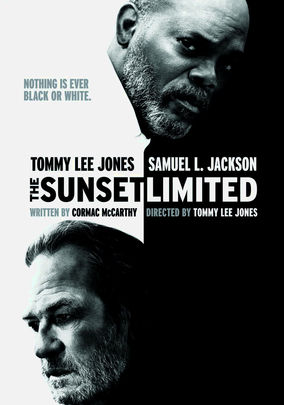
Sunset Limited by Cormac McCarthy with Tommy Lee Jones and Samuel L. Jackson
 by James Ross Kelly
The Sunset Limited (2011), is brought to us by a trinity of American artists. Author, Cormac McCarthy (No Country for Old Men (2007)), Director /Actor, Tommy Lee Jones, and Samuel L. Jackson in perhaps his most powerful role. The HBO Films presentation (now streaming on Amazon Prime and DVD) possibly, eclipses Beckets Waiting for Godot because of this films accessibility, and honest post-modern take on the eternal conundrum. McCarthy’s drama for Television Cinema was originally a play first produced in Chicago and then New York.
Throughout the film, we have ourselves shoe horned into a small ghetto apartment with an academic atheist and a blue collar black believer in Jesus Christ. White, the atheist has attempted suicide by throwing himself in front of a train. Black, the believer, has saved him. The film opens with the two of them across a table from each other. A Bible is in the center of the table. White has a lifelong academic skepticism that has carried him to the point he faces, that begins slowly, but leaps out before the film is over. Black, a former criminal and penitent murder, has a surety from an experiential encounter with his deity. White, while at a distinct disadvantage to the higher ground his adversary has, because he has saved White’s life, begins an interrogation of Black, demanding “jail house stories” from Black. We begin to see a compelling Modernist conceit, which gives way to a dramatic answer that is only despair.
“I yearn for the darkness,” White says. “I pray for death. Real Death. If I thought that in death I would meet the people I’ve known in life I don’t know what I’d do. That would be the ultimate horror.”
Black who was initially in control of the dialogue holds onto what he has learned from the Bible, black preachers, and his sobriety and a changed life. He bows to the mystery while exhorting White and God to consider a change for White. Yet Black acknowledges White his autonomy without ever giving an inch toward the possibility that White might be right. White repeatedly wants to leave and is entreated over and over again by Black to stay knowing he may go again to try the Sunset limited.
Atheists/Agnostics may applaud White’s, determination to remain deterministic and his embrace of despair; but Christians will applaud the 2,000 year old Gospel delivered by Jackson. Superb editing and camera work, gripping dialogue by one of America’s greatest living authors and two of the finest actors in America, transforms a claustrophobic apartment and an age-old philosophical and religious argument into an action film.
Watch “Spontaneous Worship – Jenn Johnson, Bethel Church” on YouTube
Watch “What Your Science Teacher Got Wrong #1 – Chris Galanos/Dr. William Dembski” on YouTube
What Your Science Teacher Got Wrong #1 – Chris Galanos/Dr. William Dembski: http://youtu.be/dX8M7YGM1l8
Risk of Preaching on Genesis–Joel Hunter
Indirect Internal Evidence [that the author of the Gospel of John was the Apostle John]
from Believing in the 21st Century:Chapter Seven
an exhortation..as
a lay Christian examines his faith..
By James Ross Kelly
So again, how does any one judge this veracity? Some say it is truth in that it is mythological truth. I must say adamantly I know I know Him, not the myth of Him. Myth operates as powerful archetype in the human psyche. However the Gospel of John and all the Gospels are presented not as mythos. There is a sense that it could be viewed as a real myth (cf., C.S. Lewis through the Shadowlands, Sibley). Still it comes to us as a story. A story that is told as a true story. It survives as a compelling story from ancient times. Yet again, there seems to be a media friendly secular scholastic conjecture that there was an epistemological cabal involved. One which in a carefully orchestrated fiction was designed to belie and foster a following. Well if so, the purveyors of it all paid with their lives and made no money in doing so, nor any material gain whatsoever. Too many things stack up that surge against this secular conceit.
The reality is that the message spread of the good news that a Savior came to earth and died for all people on the planet throughout the Judeo/Roman/Hellenistic Mediterranean in less than twenty years. All the time the message was accompanied by the same miracles that were evidenced during Christ Jesus’s lifetime— and all done mostly through working class men of the times. The letters of the New Testament were written to various Mediterranean cultures and appeared synchronously through all the trade routes with small congregations of believers in their wake. Matthew was written to the Jewish congregations. Mark mostly likely is an account given from Peter to a disciple named John Mark and was for a population in Rome. Luke was written from a Greek view point by a Physician who traveled with Paul who interviewed the principals involve with the story. Many of these men had seen, walked with, and touched the Christ. All three may have drawn from the extant Gospel of Mark or another now lost early Manuscript referred to by scholars as ‘Q’ (meaning source).3 A manuscript which may have been from Peter’s own hand. John was written later. Do they differ? Yes, slightly. . As evidenced by John’s setting the record straight about who, got to the tomb first. But in context they do not differ in content and purpose. Jesus is the Messiah by all Gospel accounts. Attempts to make it other than that, by some form of “Christological” fabrication on the part of early or later believers comes from a doubting world that has not given the Gospel message its objective due—as simply being exactly what it is purported to be—Good News! It purports to be the Good News of a message from God for the salvation of mankind! All mankind for all time! There is nothing quite like this. A critical examination of the Gospels for what they are as “a story” and a truly objective look at the Archeological record of the manuscripts themselves has an unmistakable presentiment that there has been no other phenomenon like it.
Some have suggested that the disciples, during the years following Jesus death, simply fabricated their accounts of Jesus as the advent of an ecclesiastical cabal. These critics say that the disciples, in an attempt to enhance the authority of Jesus Christ, then published the story that Jesus “claimed to be,” God and was resurrected. Anyone should consider the historical evidence fairly before giving any credence to this conjecture of history. First, the apostles were continually threatened and pressured to deny their Lord Jesus Christ during their ministry. To this end they were constantly under the pressure of torture and martyrdom. However, none of these men who spent time with Jesus chose to save their lives by denying their faith in Him, nor did they deny the fact that He was Who-He-claimed-to-be.
Papyri fragments exist of portions of the New Testament:1. Chester Beatty Biblical Papyri (dated 200-250 A.D.)was made public in 1931 and contains the Gospels, Acts, Paul’s Epistles, and Revelation. 2. Payprus Bodmer Ii (dated 200 A.D.)this discovery announced in 1956 contains fourteen chapters of John, and portions of the last seven chapters.3.John Rylands Mss (dated 130 A.D.). This is oldest fragment of the new Testament books. “Because of its early date and location (Egypt), some distance from the traditional place of composition (Asia Minor), this portion of the Gospel of John tends to confirm the traditional date of the composition of the Gospel.“ General Introduction To The Bible, Geisler & Nix
Recent Biblical scholarship into the “Historical Jesus,” such as the “Jesus Seminar,” and others, claim late dates of the Authorship of the Gospels. Most of these sources deny that the Gospel of John was written by the Apostle John and put a late date (2nd or 3rd Century) on its authorship. There is really little evidence to support these claims. Yet there is much evidence that shows tradition is correct and that the Author of the Gospel that claims Christ’s Deity was the Apostle John, “the disciple whom Jesus loved.” W. Graham Scroggie in his critical work, Guide to the Gospels provides ample objective evidence to refute this Modern, Post-Modern and de-constructionist notion about authorship of the Gospel of John.
Indirect Internal Evidence [that the author of the Gospel of John was the Apostle John]
(a)The Author was a Jew.
He is familiar with Jewish opinions and customs, his composition is impressed with Jewish characteristics, he is penetrated with the spirit of the Jewish dispensation. the vocabulary, the structure of the sentences, the symmetry and arrangement of the thoughts, are essentially Hebrew. The Old Testament is the source of the religious life of the writer. His Jewish opinions and hopes are taken up into and transfigured by his Christian faith, but the Jewish foundation underlies his whole narrative. The Evangelist vindicates the Law as of Divine authority.
(b) The Author was a Jew of Palestine.
This was proved by his local knowledge. He speaks of places with an unaffected precision, as familiar in every case with the scene which he wishes to recall; he moves about in a country which he knows ( “John 1:28; “2:1; “2:11; “3:23; “4:46; “11:18, “11:54; “21:1, “21:2). The writer of the Fourth Gospel is evidently at home in Jerusalem as it was before its fall in AD 70 ( “5:2; “9:7; “18:1; “19:13;* “19:17; “19:20; “19:41). He has an accurate knowledge of the Temple and its ritual (“2:14-16; “2:20; “10:22; especially chapters. “7 , “8). The author’s quotations from the old Testament show that he was not dependent on the Septuagint (LXX), but was acquainted with the original Hebrew.
(c) The Author was an Eye-witness to what he describes.
His narrative is marked by minute details of persons, and time, an number, and place, and manner, which cannot but have come from a direct experience.Persons: “John 6:5, “6:7; “7:21; “14:5; “14:8; “14:22; “13:25; “3:1;”7:50; “19:39; “11:1; “12:1; “12:4; “13:2; “13:26;”18:10; “18:13;;”18:26;
Time: “John 2:13; “2:23; “5:1; “6:4; “7:2; “10:22; also “1:29, “1:35, “1:43; “2:1 ;”12:1; “12:12; “13:1; “19:31; “20:1, “20:26; “4:6 “4:52; “19:14; “13:30 “18:28; “20:1, “21:4;”6:16; “20:19; “3:2Number:”1:35; “2:6; “6:9, “6:19; “19:3; “21:8, “21:11; also, “4:18; “5:5; “7:5; “19:39
Place: “John 1:28; “3:23; “4:46; “5:14; “6:59; “8:20; “10:40; “11:30, “11:54; “11:56; “18:1
Manner: “1:35-51; “8:10-20; “18:1 “5:27; “21:1-14
Other details: “John 6:9; “11:32; “12:3, “12:13; “13:30; “18:3; “19:3; “20:7; “21:17; also, “13:24; “18:6; “19:5; “21:20
(d) The Author was an Apostle
This follows almost necessarily from the character of the scenes, which he describes. He exhibits intimate acquaintances with the feelings of the ‘the disciples.’ He knows their thoughts at critical moments (“John 2:11; “2:17; “2:22; “6:19; “6:60; “12:16; “13:22; “13:28; “21:12). He had an intimate knowledge of Jesus (” 11:33; “13:21; “2:24; “4:1; “5:6; “6:15; “7:1; “16:19; “6:6; “6:61; “6:64; “13:1; “13:3; “13:11; “18:4; “19:28).
(e) The Author was the Apostle John
As the writer is exact in defining the names in his Gospel (“1:42; “11:16; “20:24; “21:2; “6:71; “12:4;”13:2; “13:26;”14:22) it is presumed that the unnamed person of “13:23; “19:26; “20:2; “21:7; “21:20 is himself. If someone else had written this gospel it is unthinkable that he would not have mentioned by name so distinguished an Apostle as John. W. Graham Scroggie. Guide to the Gospels pp.135-139 — summary of an argument from Westcott.
 St. John One: One