Tag / Christianity
Why did the Apostle John refer to himself as, “the disciple whom Jesus loved,”?

William Barclay 1907-1978
From INTRODUCTION TO THE GOSPEL ACCORDING TO SAINT JOHN Vol.I
By William Barclay
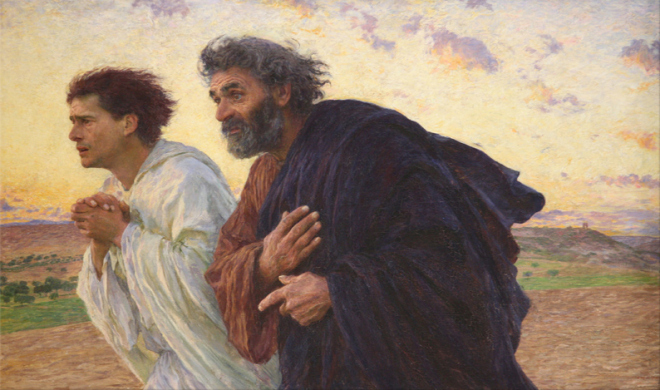
The Beloved Disciple
… All our information about John comes from the first three gospels. It is the astonishing fact that the Fourth Gospel never mentions the apostle John from beginning to end. But it does mention two other people.
First, it speaks of the disciple whom Jesus loved. There are four mentions of him. He was leaning on Jesus’ breast at the Last Supper (John 13:23-25); it is into his care that Jesus committed Mary as he died upon his Cross (John 19:25-27); it was Peter and he whom Mary Magdalene met on her return from the empty tomb on the first Easter morning (John 20:2); he was present at the last resurrection appearance of Jesus by the lake-side (John 21:20).
Second, the Fourth Gospel has a kind of character whom we might call the witness. As the Fourth Gospel tells of the spear thrust into the side of Jesus and the issue of the water and the blood, there comes the comment: “He who saw it has borne witness–his testimony is true, and he knows that he tells the truth–that you also may believe” (John 19:35). At the end of the gospel comes the statement that it was the beloved disciple who testified of these things “and we know that his testimony is true” (John 21:24).
Here we are faced with rather a strange thing. In the Fourth Gospel John is never mentioned, but the beloved disciple is and in addition there is a witness of some kind to the whole story. It has never really been doubted in tradition that the beloved disciple is John. A few have tried to identify him with Lazarus, for Jesus is said to have loved Lazarus (John 11:3-5), or with the Rich Young Ruler, of whom it is said that Jesus, looking on him, loved him (Mark 10:21). But although the gospel never says so in so many words, tradition has always identified the beloved disciple with John, and there is no real need to doubt the identification.
But a very real point arises–suppose John himself actually did the writing of the gospel, would he really be likely to speak of himself as the disciple whom Jesus loved? Would he really be likely to pick himself out like this, and, as it were, to say: “I was his favourite; he loved me best of all”? It is surely very unlikely that John would confer such a title on himself. If it was conferred by others, it is a lovely title; if it was conferred by himself, it comes perilously near to an almost incredible self-conceit.
Is there any way then that the gospel can be John’s own eye-witness story, and yet at the same time have been actually written down by someone else?
The Production of the Church
In our search for the truth we begin by noting one of the outstanding and unique features of the Fourth Gospel. The most remarkable thing about it is the long speeches of Jesus. Often they are whole chapters long, and are entirely unlike the way in which Jesus is portrayed as speaking in the other three gospels. The Fourth Gospel, as we have seen, was written about the year A.D. 100, that is, about seventy years after the crucifixion. Is it possible after these seventy years to look on these speeches as word for word reports of what Jesus said? Or can we explain them in some way that is perhaps even greater than that? We must begin by holding in our minds the fact of the speeches and the question which they inevitably raise.
And we have something to add to that. It so happens that in the writings of the early church we have a whole series of accounts of the way in which the Fourth Gospel came to be written. The earliest is that of Irenaeus who was bishop of Lyons about A.D. 177; and Irenaeus was himself a pupil of Polycarp, who in turn had actually been a pupil of John. There is therefore a direct link between Irenaeus and John. Irenaeus writes:
“John, the disciple of the Lord, who also leant upon his breast,
himself also published the gospel in Ephesus, when he was living
in Asia.”
The suggestive thing there is that Irenaeus does not merely say that John wrote the gospel; he says that John published (exedoke) it in Ephesus. The word that Irenaeus uses makes it sound, not like the private publication of some personal memoir, but like the public issue of some almost official document.
The next account is that of Clement who was head of the great school of Alexandria about A.D. 230. He writes:
“Last of all, John perceiving that the bodily facts had been made
plain in the gospel, being urged by his friends, composed a
spiritual gospel.”
The important thing here is the phrase being urged by his friends. It begins to become clear that the Fourth Gospel is far more than one man’s personal production and that there is a group, a community, a church behind it. On the same lines, a tenth-century manuscript called the Codex Toletanus, which prefaces the New Testament books with short descriptions, prefaces the Fourth Gospel thus:
“The apostle John, whom the Lord Jesus loved most, last of all
wrote this gospel, at the request of the bishops of Asia, against
Cerinthus and other heretics.”
Again we have the idea that behind the Fourth Gospel there is the authority of a group and of a church.
We now turn to a very important document, known as the Muratorian Canon. It is so called after a scholar Muratori who discovered it. It is the first list of New Testament books which the church ever issued and was compiled in Rome about A.D. 170. Not only does it list the New Testament books, it also gives short accounts of the origin and nature and contents of each of them. Its account of the way in which the Fourth Gospel came to be written is extremely important and illuminating.
“At the request of his fellow-disciples and of his bishops, John,
one of the disciples, said: ‘Fast with me for three days from
this time and whatsoever shall be revealed to each of us, whether it be favourable to my writing or not, let us relate it to one another.’ On the same night it was revealed to Andrew that John should relate all things, aided by the revision of all.”
We cannot accept all that statement, because it is not possible that Andrew, the apostle, was in Ephesus in A.D. 100; but the point is that it is stated as clearly as possible that, while the authority and the mind and the memory behind the Fourth Gospel are that of John, it is clearly and definitely the product, not of one man, but of a group and a community.
Now we can see something of what happened. About the year A.D. 100 there was a group of men in Ephesus whose leader was John. They revered him as a saint and they loved him as a father. He must have been almost a hundred years old. Before he died, they thought most wisely that it would be a great thing if the aged apostle set down his memories of the years when he had been with Jesus. But in the end they did far more than that. We can think of them sitting down and reliving the old days. One would say: “Do you remember how Jesus said … ?” And John would say: “Yes, and now we know that he meant…”
In other words this group was not only writing down what Jesus said; that would have been a mere feat of memory. They were writing down what Jesus meant; that was the guidance of the Holy Spirit. John had thought about every word that Jesus had said; and he had thought under the guidance of the Holy Spirit who was so real to him. W. M. Macgregor has a sermon entitled: “What Jesus becomes to a man who has known him long.” That is a perfect description of the Jesus of the Fourth Gospel. A. H. N. Green Armytage puts the thing perfectly in his book John who saw. Mark, he says, suits the missionary with his clear-cut account of the facts of Jesus’ life; Matthew suits the teacher with his systematic account of the teaching of Jesus; Luke suits the parish minister or priest with his wide sympathy and his picture of Jesus as the friend of all; but John is the gospel of the contemplative.
He goes on to speak of the apparent contrast between Mark and John. “The two gospels are in a sense the same gospel. Only, where Mark saw things plainly, bluntly, literally, John saw them subtly, profoundly, spiritually. We might say that John lit Mark’s pages by the lantern of a lifetime’s meditation.” Wordsworth defined poetry as “Emotion recollected in tranquility.” That is a perfect description of the Fourth Gospel. That is why John is unquestionably the greatest of all the gospels. Its aim is, not to give us what Jesus said like a newspaper report, but to give us what Jesus meant. In it the Risen Christ still speaks. John is not so much The Gospel according to St. John; it is rather The Gospel according to the Holy Spirit. It was not John of Ephesus who wrote the Fourth Gospel; it was the Holy Spirit who wrote it through John.
The Penman of the Gospel
We have one question still to ask. We can be quite sure that the mind and the memory behind the Fourth Gospel is that of John the apostle; but we have also seen that behind it is a witness who was the writer, in the sense that he was the actual penman. Can we find out who he was? We know from what the early church writers tell us that there were actually two Johns in Ephesus at the same time. There was John the apostle, but there was another John, who was known as John the elder.
Papias, who loved to collect all that he could find about the history of the New Testament and the story of Jesus, gives us some very interesting information. He was Bishop of Hierapolis, which is quite near Ephesus, and his dates are from about A.D. 70 to about A.D. 145. That is to say, he was actually a contemporary of John. He writes how he tried to find out “what Andrew said or what Peter said, or what was said by Philip, by Thomas, or by James, or by John, or by Matthew, or by any other of the disciples of the Lord; and what things Aristion and the elder John, the disciples of the Lord, say.” In Ephesus there was the apostle John, and the elder John; and the elder John was so well-loved a figure that he was actually known as The Elder. He clearly had a unique place in the church. Both Eusebius and Dionysius the Great tell us that even to their own days in Ephesus there were two famous tombs, the one of John the apostle, and the other of John the elder.
Now let us turn to the two little letters, Second John and Third John. The letters come from the same hand as the gospel, and how do they begin? The second letter begins: “The elder unto the elect lady and her children” (2 John 1:1 ). The third letter begins: “The elder unto the beloved Gaius” (3 John 1:1 ). Here we have our solution. The actual penman of the letters was John the elder; the mind and memory behind them was the aged John the apostle, the master whom John the elder always described as “the disciple whom Jesus loved.”
The Precious Gospel
The more we know about the Fourth Gospel the more precious it becomes. For seventy years John had thought of Jesus. Day by day the Holy Spirit had opened out to him the meaning of what Jesus said. So when John was near the century of life and his days were numbered, he and his friends sat down to remember. John the elder held the pen to write for his master, John the apostle; and the last of the apostles set down, not only what he had heard Jesus say, but also what he now knew Jesus had meant. He remembered how Jesus had said: “I have yet many things to say to you, but you cannot bear them now. When the Spirit of Truth comes, he will guide you into all the truth” (John 16:12-13). There were many things which seventy years ago he had not understood; there were many things which in these seventy years the Spirit of Truth had revealed to him. These things John set down even as the eternal glory was dawning upon him. When we read this gospel let us remember that we are reading the gospel which of all the gospels is most the work of the Holy Spirit, speaking to us of the things which Jesus meant, speaking through the mind and memory of John the apostle and by the pen of John the elder. Behind this gospel is the whole church at Ephesus, the whole company of the saints, the last of the apostles, the Holy Spirit, the Risen Christ himself.
Living Your Truest Identity by Graham Cooke (2). – YouTube
Living Your Truest Identity by Graham Cooke (1). – YouTube
Graham Cooke- NEW NATURE – YouTube

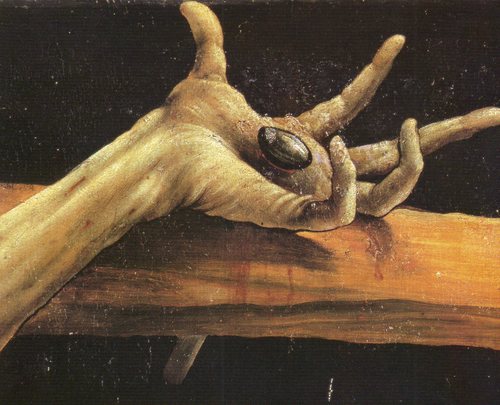
Mathis Gothart Grünewald —Isenheim Altarpiece




Poetry, Symbolism and Typology—Thomas Merton

Cover via Amazon

Now the writers of the Bible were aware that they shared with other religions the cosmic symbols in which God has revealed Himself to all men. But they were also aware that pagan and idolatrous religions had corrupted this symbolism and perverted its original purity [Merton cites Romans 1:18 and 25] The Gentiles had “detained the truth of God in injustice” and “changed the truth of God into a lie.”
Creation had been given to man as a clean window through which the light of God could shine into men’s souls. Sun and moon, night and day, rain, the sea, the crops, the flowering tree, all these things were transparent. They spoke to man not of themselves only but of Him who made them. Nature was symbolic. But the progressive degradation of man after the fall led the Gentiles further and further from this truth. Nature became opaque. The nations were no longer able to penetrate the meaning of the world they lived in. Instead of seeing the sun a witness to the power of God they thought the sun was god. The whole universe became an enclosed system of myths. The meaning and the worth of creatures invested them with an illusory divinity.
Men still sensed that there was something to be venerated in the reality, in the peculiarity of living and growing things, but they no longer knew what that reality was. They became incapable of seeing that the goodness of the creature is only a vestige of God. Darkness settled upon the translucent universe. Men became afraid. Beings had a meaning which men could no longer understand. They became afraid of trees, of the sun, of the sea. These things had to be approached with superstitious rites. It began to seem that the mystery of their meaning, which had become hidden, was now a power that had to be placated and, if possible controlled with magic incantations.
Thus the beautiful living things which were all about us on this earth and which were the windows of heaven to every man, became infected with original sin. The world fell with man, and longs, with man, for regeneration. The symbolic universe, which had now become a labyrinth of myths and magic rites, the dwelling place of a million hostile spirits, ceased altogether to speak to most men of God and told them only of themselves. The symbols which would have raised man above himself to God now became myths, and as such they were simply projections of man’s own biological drives. His deepest appetites, now full of shame, became his darkest fears.
The corruption of cosmic symbolism can be understood by a simple comparison. It was like what happens to a window when a room ceases to receive light from the outside. As long as it is daylight, we see through our windowpane. When night comes, we can still see through it if there is no light inside our room. When our lights go on, then we see only ourselves and our own room reflected in the pane. Adam in Eden could see through creation as through a window. God shone through the windowpane as bright as the light of the sun. Abraham and the patriarchs and David and the holy men of Israel—the chosen race that preserved intact the testimony of God—could still see through the window as one looks out by night from a darkened room and sees the moon and stars. But the Gentiles had begun to forget the sky, and to light lamps of their own, and presently it seemed to them that the reflection of their own room in the window was the “world beyond.” They began to worship what they themselves were doing. And what they were doing was too often an abomination. Nevertheless, something of the original purity of natural revelation remained in the great religions for the East. It is found in the Upanishads in the Baghavad Gita. But the pessimism of Buddha was a reaction against the degeneration of nature by polytheism. Henceforth for the mysticism of the East, nature would no longer be symbol but illusion. Buddha knew too well that the reflections in the window were only projections of our own existence and our own desires, but did not know that this was a window and that there could be sunlight outside the glass.
from “Poetry, Symbolism, and Typology,” The Literary Essays of Thomas Merton, pp 333-335, New Directions 1985. Originally from Merton’s Bread in the Wilderness, a study of the Psalms of the Old Testament as poetry, New Directions, 1953
Thomas Merton— from Theology of Creativity
Excerpted from an essay which first appeared in 1960 in The American Benedictine Review.
The creativity of the Christian person must be seen in relation to the creative vocation of the new Adam, mystical person of the “whole Christ.” The creative will of God has been at work in the cosmos since he said: “Let there be light.” This creative fiat was not uttered merely at the dawn of time. All time and all history are a continued, uninterrupted creative act, a stupendous, ineffable mystery in which God has signified his will to associate man with himself in his work of creation. The will and power of the Almighty Father were not satisfied simply to make the world and turn it over to man to run it as best he could. The creative love of God was met, at first, by the destructive and self-centered recusal of man: an act of such incalculable consequences that it would have amounted to a destruction of God’s plan, if that were possible. But the creative work of God could not be frustrated by man’s sin. On the contrary, sin itself entered into the plan. If man was first called to share in the creative work of his heavenly Father, he now became involved in the “new creation,” the redemption of his own kind and the restoration of the cosmos, purified and transfigured, into the hands of the Father. God himself became man in order that in this way man could be most perfectly associated with him in this great work, the fullest manifestation of his eternal wisdom and mercy.
The Literary Essays of Thomas Merton, New Directions
Cover via Amazon
C. S.Lewis—Heaven

C.S. Lewis
We are very shy nowadays of even mentioning heaven. We are afraid of the jeer about ‘pie in the sky’, and of being told that we are trying to ‘escape’ from the duty of making a happy world here and now into dreams of a happy world elsewhere. But either there is ‘pie in the sky’ or there is not. If there is not, then Christianity is false, for this doctrine is woven into it’s whole fabric. If there is, then this truth, like any other, must be faced, whether it is useful at political meetings or no. Again, we are afraid that heaven is a bribe, and that if we make it our goal we shall no longer be disinterested. It is not so. Heaven offers nothing that a mercenary soul can desire. It is safe to tell the pure in heart that they shall see God, for only the pure in heart want to. There are rewards that do not sully motives. A man’s love for a woman is not mercenary because he wants to marry her, nor his love for poetry mercenary because he wants to read it, nor his love of exercise less disinterested because he wants to run and leap and walk. Love, by definition, seeks to enjoy it’s object. You may think that there is another reason for our silence about heaven—namely, that we do not really desire it. But that may be an illusion. What I am now going to say is merely an opinion of my own without the slightest authority, which I submit to the judgement of better Christians and better scholars than myself. There have been times when I think we do not desire heaven; but more often I find myself wondering whether, in our heart of hearts, we have ever desired anything else. You may have noticed that the books you really love are bound together by a secret thread. You know very well what is the common quality that makes you love them, though you cannot put it into words: but most of your friends do not see it at all, and often wonder why, liking this, you should also like that. Again, you have stood before some landscape, which seems to embody what you have been looking for all your life; and then turned to the friend at your side who appears to be seeing what you saw—but at the first words a gulf yawns between you, and you realise that this landscape means something totally different to him, that he is pursuing an alien vision and cares nothing for the ineffable suggestion by which you are transported. Even in your hobbies, has there not always been some secret attraction which the others are curiously ignorant of—something, not to be identified with, but always on the verge of breaking through, the smell of cut wood in the workshop or the clap-clap of water against the boat’s side?
Are not all lifelong friendships born at the moment when at last you meet another human being who has some inkling (but faint and uncertain even in the best) of that something which you were born desiring, and which, beneath the flux of other desires and in all the momentary silences between the louder passions, night and day, year by year, from childhood to old age, you are looking for, watching for, listening for? You have never had it. All the things that have ever deeply possessed your soul have been but hints of it—tantalising glimpses, promises never quite fulfilled, echoes that died away just as they caught your ear. But if it should really become manifest—if there ever came an echo that did not die away but swelled into the sound it’self—you would know it. Beyond all possibility of doubt you would say ‘Here at last is the thing I was made for.’ We cannot tell each other about it. It is the secret signature of each soul, the incommunicable and unappeasable want, the thing we desired before we met our wives or made our friends or chose our work, and which we shall still desire on our deathbeds, when the mind no longer knows wife or friend or work. While we are, this is. If we lose this, we lose all.
This signature on each soul may be a product of heredity and environment, but that only means that heredity and environment are among the instruments whereby God creates a soul. I am considering not how, but why, He makes each soul unique. If He had no use for all these differences, I do not see why He should have created more souls than one. Be sure that the ins and outs of your individuality are no mystery to Him; and one day they will no longer be a mystery to you. The mould in which a key is made would be a strange thing, if you had never seen a key: and the key it’self a strange thing if you had never seen a lock. Your soul has a curious shape because it is a hollow made to fit a particular swelling in the infinite contours of the Divine substance, or a key to unlock one of the doors in the house with many mansions. For it is not humanity in the abstract that is to be saved, but you—you, the individual reader, John Stubbs or Janet Smith. Blessed and fortunate creature, your eyes shall behold Him and not another’s. All that you are, sins apart, is destined, if you will let God have His good way, to utter satisfaction. The Brocken spectre ‘looked to every man like his first love’, because she was a cheat. But God will look to every soul like it’s first love because He is it’s first love. Your place in heaven will seem to be made for you and you alone, because you were made for it—made for it stitch by stitch as a glove is made for a hand.
Lewis, C. S. (1940). The Problem of Pain (pp. 148-152). Harper Collins, Inc.. Kindle Edition.


