Believing in the 21st Century:Chapter Four


an exhortation..as 
a lay Christian examines his faith..

By James Ross Kelly

Christian orthodoxy has not left this culture, it thrives–in spite of the media’s demeanor of ignorance it thrives in a vibrant way and is in no danger of death as some would assert. This is because this truth is Living Truth. The future may bring a final onslaught, or attack, or pogrom from the current coexistence with the secular portion of our culture. Currently to many there is waning hope that that future is distant. Such violent affronts are presently on-fire in other cultures such as China, Laos, Vietnam, Pakistan and the Sudan where Christianity for one reason or another is viewed as a threat to the ruling order and demands inner allegiance to something other than the Living God of Christianity. Preceded by this has been seven decades of Soviet Russia, and a before that two decades of fascist Europe. Many in the Church believe this will again becoming an end time scenario in our Western world. History of this century has shown that counter doctrine to orthodoxy demands a lock-step subservience to this end—with the true church going underground—nominal Christianity apostatizing to state religion with Christ relegated to academic mythos. The killing fields of Babi Yar, and Cambodia are just two of long list of the results of this 100 year trend.

The God I worship is Father God, Creator of the universe who is outside of space and time as object of our reality. My God exists both in and outside of space and time in fluid conjunctive extra-dimensional spatial reality. My God loves us, my God cares for us, and though He seems dimensionless to our own gaze. He was never invisible in the interior dimension which exists, and is comprehended in one simple way—by His leave and by our own humility through acceptance of His son Christ Jesus, His brief sojourn on the planet earth and the redemptive act done for all time for us all by His death on the cross.

This act is now history, but it is one of an eternal redemptive glorification that was the end and defeat by proxy of all pagan death cults—one which was replaced by the self-sacrifice of the living God who by this loving act through His Holy spirit instituted the Christian Church in an eternal love feast meant for all people of this planet. That the church has fallen short of exemplary stewardship in its temporal charge of eternal matters cannot be argued. However, it can be argued that the Spirit of the Living God was not apart of any of these short comings. And took His leave as we all might at the sight of inquisition and obtuse legalism whether it was in the Protestant, Catholic or Orthodox camp. The history of the church as a human organization has always been far short of the glory of God—yet God’s glory has throughout history shone through his martyrs and the lovers of His truth. St Stephen, St Ignatious, St Polycarp, William Tyndale, Martin Luther King, Joan of Arc and St Francis are but a few examples. The Way of God exemplified by people of God have long out shown the dimness of Church tradition.

Believing in the 21st Century:Chapter Three


an exhortation..as 
a lay Christian examines his faith..

By James Ross Kelly
The assertion of the crucifixion of Jesus of Nazareth as truth is accepted by most all accounts historically, but it is the next Chapter of John’s Gospel that Christ becomes the risen Savior of mankind—and when Christianity is presented to mankind as a Supernatural visitation by the Creator of the Universe. What may go against the humanist grain is that it must be asked given Christianity’s assertion of this truth— it must be seriously asked, ‘What do you say of a group of beings that would torture and kill their own Creator? Who kindly and humbly appeared to them preaching love and forgiveness and supreme fellowship with the whole of Creation of the universe? Given that this is true, if you accept that Jesus of Nazareth was exactly Who he said he was according to scripture previous to Chapter 19 of John’s Gospel—there is now a change that must take place in our essential view of humanity. And it must be said to all, that if Christendom’s message is true as the faithful proclaim it, that this event is the greatest definition of mankind! That humanity killed its Creator and proved itself inhuman for all time—juxtaposed with the Creator offering Himself as a sacrifice that all people might come into a relationship with Him and make themselves, with His divine help, at last truly humane! The greatest anguish turning into greatest joy! This the most important event in all of history—all previous scripture leads toward this event as prophesy and type. All subsequent scripture is then driven by this event, as is all commentary, preaching, doctrines and creeds. The saddest day brings forth the most happy day both then rapt into an inter-dimensional cleft that will guide the coiling of history toward its ultimate destiny. It is the death knell for the god of this world when the sentence, ‘It is finished.’ was uttered. But—it would be most likely not even a foot note in history, lost long ago in human memory if it were not for the following supernatural event that the caused all of paganism to begin a world-wide decent. But then again we must suspend and consider the rest of the story because the former is accepted fact even in an unbelieving world, now again, ‘what if just—as it is written’—this also is true?
John–Chapter 20 (NIV)

1Early on the first day of the week, while it was still dark, Mary Magdalene went to the tomb and saw that the stone had been removed from the entrance.
2So she came running to Simon Peter and the other disciple, the one Jesus loved, and said, “They have taken the Lord out of the tomb, and we don’t know where they have put him!”
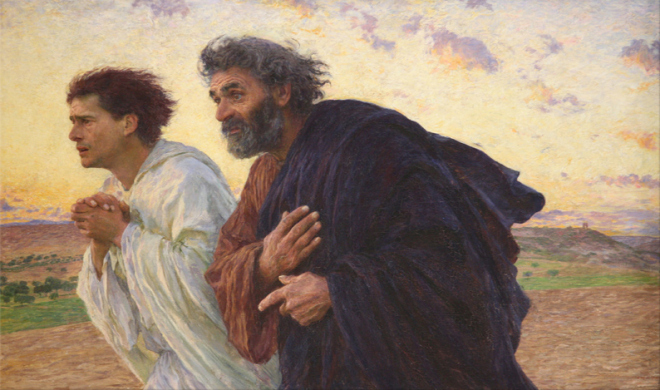
3So Peter and the other disciple started for the tomb.
4Both were running, but the other disciple outran Peter and reached the tomb first.
5He bent over and looked in at the strips of linen lying there but did not go in.
6Then Simon Peter, who was behind him, arrived and went into the tomb. He saw the strips of linen lying there,
7 as well as the burial cloth that had been around Jesus’ head. The cloth was folded up by itself, separate from the linen.
8 Finally the other disciple, who had reached the tomb first, also went inside. He saw and believed.
9(They still did not understand from Scripture that Jesus had to rise from the dead.)
10Then the disciples went back to their homes,
11but Mary stood outside the tomb crying. As she wept, she bent over to look into the tomb
12and saw two angels in white, seated where Jesus’ body had been, one at the head and the other at the foot.
13They asked her, “Woman, why are you crying?” “They have taken my Lord away,” she said, “and I don’t know where they have put him.”
14At this, she turned around and saw Jesus standing there, but she did not realize that it was Jesus.
15″Woman,” he said, “why are you crying? Who is it you are looking for?” Thinking he was the gardener, she said, “Sir, if you have carried him away, tell me where you have put him, and I will get him.”
16Jesus said to her, “Mary.” She turned toward him and cried out in Aramaic, “Rabboni!” (which means Teacher).
17Jesus said, “Do not hold on to me, for I have not yet returned to the Father. Go instead to my brothers and tell them, `I am returning to my Father and your Father, to my God and your God.’”
18Mary Magdalene went to the disciples with the news: “I have seen the Lord!” And she told them that he had said these things to her.
19On the evening of that first day of the week, when the disciples were together, with the doors locked for fear of the Jews, Jesus came and stood among them and said, “Peace be with you!”
20After he said this, he showed them his hands and side. The disciples were overjoyed when they saw the Lord.
21Again Jesus said, “Peace be with you! As the Father has sent me, I am sending you.”
22And with that he breathed on them and said, “Receive the Holy Spirit.
23If you forgive anyone his sins, they are forgiven; if you do not forgive them, they are not forgiven.”
24Now Thomas (called Didymus), one of the Twelve, was not with the disciples when Jesus came.
25So the other disciples told him, “We have seen the Lord!” But he said to them, “Unless I see the nail marks in his hands and put my finger where the nails were, and put my hand into his side, I will not believe it.”
26A week later his disciples were in the house again, and Thomas was with them. Though the doors were locked, Jesus came and stood among them and said, “Peace be with you!”
27Then he said to Thomas, “Put your finger here; see my hands. Reach out your hand and put it into my side. Stop doubting and believe.”
28Thomas said to him, “My Lord and my God!”
29Then Jesus told him, “Because you have seen me, you have believed; blessed are those who have not seen and yet have believed.”
30Jesus did many other miraculous signs in the presence of his disciples, which are not recorded in this book.
31But these are written that you may [1] believe that Jesus is the Christ, the Son of God, and that by believing you may have life in his name.

1.31 Some manuscripts “may continue to”

So the greatest of antinomies is resolved. The entirety of human kind has now been redeemed. And just like anyone unfamiliar or knowledgeable today they did not know they were redeemed. Some did not know they needed to be redeemed then, as they do not know it today. There are those who see who have not seen with the same eyes of Thomas, but with the inner light of truth, as it presents itself simply because it is the Truth and believe in that moment of revelation.

So we who have believed and yet have not seen have inherited this story as the foundation of Western culture—a foundation that may be fast crumbling, and a foundation that is having its ramparts stricken from most every side. Yet it is we who do believe who are left responsible for this message being passed on. The greatest of fallacies is that one has to be part of a graduated class in a seminary to pass this message on. People are often put to death spiritually in Seminaries and others become atheists or pantheists there. Others because of their seminary experience have had to abandon the organized Church rather than look themselves in the mirror because of the hypocrisy of one form or another they found abiding there. And many modern day religionists would charge upon pain of ecclesiastical crucifixion that one is forced to accept this system and live it and put this tradition on over Christ Jesus Himself. And yet it may be that despite all this our Seminaries are a separation process that does produce notable been and women of God.

High Pagan Rome began a precipitous but lengthy fall the day of the crucifixion. From its beginning they wanted no part in it. The religionists of the day wanted it done and done before dark and done their way and would not, could not, take in any form of mercy as an answer—they still can’t—leaving the Messiah on the Cross in the form of condemning legalism rather than loving redemption and the resurrected loving glory of a living God. The Pilate’s of this world are still here in comfortable bureaucracies agreeing to death sentences for some and long terms for others—as portions of Christ are chipped out of our culture on a daily basis in making environmental decisions based upon short term profit, at the expense long term health and human justice. Or, allowing the destiny designed by a loving God to play out in a myriad of aborted lives whose end has come for convenience and pleasures sake at the modern alter of the pagan god that requires human sacrifice for a middle-to-upper-class lifestyle. Just as the ritual and rites of pre-Christian pagan Celtic homes required the ritual sacrifice of the first born on its foundations before a structure was thought to be sound.1 The Pharisees and ruling Sanhedrin-like councils exist as parts of legislatures, courts and political parties and good ol’ boy networks and now it seems good ol’ girl networks.

So? —again, to those that aren’t convinced. Is it true? I believe with every fiber of my being that it-is-true. And not only true but the truth—the ultima veritas. And I believe this after having questioned it thoroughly and found the truth to be vital and living. God the Creator took the form of man and visited earth as humble carpenter. Here he preached the truth of love and redemption to all mankind to the holders of a covenant with Him and was then arrested, tried and killed both by the holders of that covenant and mankind in general in the form of authoritarian civilized Pagan Rome. By this act there is a final redemption for all people in all times and in all walks of life. And through this emerges all other truths and upon which all other truths depend. One adopts the creeds of Christianity not because they are mere words and the party line but because they are in essence the living truth that has been passed on for a length of time in space that surpasses the oldest living things on the planet.

Believing in the 21st Century:Chapter Two


the_creation_michelangeloan exhortation..as 
a lay Christian examines his faith..

By James Ross Kelly

Christian bells toll—despite the shortcomings of Christendom, Evangelic and otherwise. Adherents of a modern material-polytheistic paganism however, should at least seriously consider the real thing which illumes Christ Jesus to a planet full of believers who met Him — personally and individually in a meeting. These days that is the discounted thing. The Gospel is the story of how the living God of the universe, visiting earth in fully human form was met and treated by organized legalist, religionists, and organized, civilized, Pagan law abiding civil servants—and those who sought to proffer their favor.  In a question, before anyone adopts a counter doctrine out of hand, or take present culture oriented stance seriously, or assign Jesus to mythos you must ask. At some point in your life, ‘What if,  just as it is written, what if—this is true?’

John 19:1-42
New King James Version (NKJV) The Holy Bible, New King James Version Copyright © 1982 by Thomas Nelson, Inc.

The Soldiers Mock Jesus

19 So then Pilate took Jesus and scourged Him. And the soldiers twisted a crown of thorns and put it on His head, and they put on Him a purple robe. Then they said,[1] “Hail, King of the Jews!” And they struck Him with their hands.

Pilate then went out again, and said to them, “Behold, I am bringing Him out to you, that you may know that I find no fault in Him.”

Pilate’s Decision

Then Jesus came out, wearing the crown of thorns and the purple robe. And Pilate said to them, “Behold the Man!”

Therefore, when the chief priests and officers saw Him, they cried out, saying, “Crucify Him, crucifyHim!

Pilate said to them, “You take Him and crucify Him, for I find no fault in Him.”

The Jews answered him, “We have a law, and according to our[2] law He ought to die, because He made Himself the Son of God.”

Therefore, when Pilate heard that saying, he was the more afraid, and went again into the Praetorium, and said to Jesus, “Where are You from?” But Jesus gave him no answer.

10 Then Pilate said to Him, “Are You not speaking to me? Do You not know that I have power to crucify You, and power to release You?”

11 Jesus answered, “You could have no power at all against Me unless it had been given you from above. Therefore the one who delivered Me to you has the greater sin.”

12 From then on Pilate sought to release Him, but the Jews cried out, saying, “If you let this Man go, you are not Caesar’s friend. Whoever makes himself a king speaks against Caesar.”

13 When Pilate therefore heard that saying, he brought Jesus out and sat down in the judgment seat in a place that is called The Pavement, but in Hebrew, Gabbatha.* 14 Now it was the Preparation Day of the Passover, and about the sixth hour. And he said to the Jews, “Behold your King!”

15 But they cried out, “Away with Him, away with Him! Crucify Him!”

Pilate said to them, “Shall I crucify your King?”

The chief priests answered, “We have no king but Caesar!”

16 Then he delivered Him to them to be crucified. So they took Jesus and led Him away.[3]

The King on a Cross

17 And He, bearing His cross, went out to a place called the Place of a Skull, which is called in Hebrew, Golgotha, 18 where they crucified Him, and two others with Him, one on either side, and Jesus in the center. 19 Now Pilate wrote a title and put it on the cross. And the writing was:

JESUS OF NAZARETH, THE KING OF THE JEWS.

20 Then many of the Jews read this title, for the place where Jesus was crucified was near the city; and it was written in Hebrew, Greek, and Latin.

21 Therefore the chief priests of the Jews said to Pilate, “Do not write, ‘The King of the Jews,’ but, ‘He said, “I am the King of the Jews.”’”

22 Pilate answered, “What I have written, I have written.”

23 Then the soldiers, when they had crucified Jesus, took His garments and made four parts, to each soldier a part, and also the tunic. Now the tunic was without seam, woven from the top in one piece.24 They said therefore among themselves, “Let us not tear it, but cast lots for it, whose it shall be,” that the Scripture might be fulfilled which says:

“They divided My garments among them,
And for My clothing they cast lots.”[4]

Therefore the soldiers did these things.

Behold Your Mother

25 Now there stood by the cross of Jesus His mother, and His mother’s sister, Mary the wife of Clopas, and Mary Magdalene. 26 When Jesus therefore saw His mother, and the disciple whom He loved standing by, He said to His mother, “Woman, behold your son!” 27 Then He said to the disciple,“Behold your mother!” And from that hour that disciple took her to his own home.

It Is Finished

28 After this, Jesus, knowing[5] that all things were now accomplished, that the Scripture might be fulfilled, said, “I thirst!” 29 Now a vessel full of sour wine was sitting there; and they filled a sponge with sour wine, put it on hyssop, and put it to His mouth. 30 So when Jesus had received the sour wine, He said, “It is finished!” And bowing His head, He gave up His spirit.

Jesus’ Side Is Pierced

31 Therefore, because it was the Preparation Day, that the bodies should not remain on the cross on the Sabbath (for that Sabbath was a high day), the Jews asked Pilate that their legs might be broken, and that they might be taken away. 32 Then the soldiers came and broke the legs of the first and of the other who was crucified with Him. 33 But when they came to Jesus and saw that He was already dead, they did not break His legs. 34 But one of the soldiers pierced His side with a spear, and immediately blood and water came out. 35 And he who has seen has testified, and his testimony is true; and he knows that he is telling the truth, so that you may believe. 36 For these things were done that the Scripture should be fulfilled, “Not one of His bones shall be broken.”[6] 37 And again another Scripture says, “They shall look on Him whom they pierced.”[7]

Jesus Buried in  Joseph’s Tomb

38 After this, Joseph of Arimathea, being a disciple of Jesus, but secretly, for fear of the Jews, asked Pilate that he might take away the body of Jesus; and Pilate gave him permission. So he came and took the body of Jesus. 39 And Nicodemus, who at first came to Jesus by night, also came, bringing a mixture of myrrh and aloes, about a hundred pounds. 40 Then they took the body of Jesus, and bound it in strips of linen with the spices, as the custom of the Jews is to bury. 41 Now in the place where He was crucified there was a garden, and in the garden a new tomb in which no one had yet been laid.42 So there they laid Jesus, because of the Jews’ Preparation Day, for the tomb was nearby.

Footnotes:

  1. John 19:3 NU-Text reads And they came up to Him and said.
  2. John 19:7 NU-Text reads the law.
  3. John 19:16 NU-Text omits and led Him away.
  4. John 19:24 Psalm 22:18
  5. John 19:28 M-Text reads seeing.
  6. John 19:36 Exodus 12:46Numbers 9:12Psalm 34:20
  7. John 19:37 Zechariah 12:10

* There had never been any historical record of the court where Jesus Christ was tried by Pilate – called the “Gabbatha” or pavement in John 19:13. William F. Albright, in The Archeology of Palestine, shows that this court was the court of the Tower of Antonia, which was the Roman military headquarters of Rome in Jerusalem. The court was destroyed between 66 A.D. – 70 A.D. during the siege of Jerusalem. It was left buried when the city was rebuilt in the time of Hadrian, and not discovered until recently.

Why did the Apostle John refer to himself as, “the disciple whom Jesus loved,”?


William Barclay 1907-1978

William Barclay 1907-1978

From INTRODUCTION TO THE GOSPEL ACCORDING TO SAINT JOHN Vol.I
By William Barclay

The Beloved Disciple

… All our information about John comes from the first three gospels. It is the astonishing fact that the Fourth Gospel never mentions the apostle John from beginning to end. But it does mention two other people.

First, it speaks of the disciple whom Jesus loved. There are four mentions of him. He was leaning on Jesus’ breast at the Last Supper (John 13:23-25); it is into his care that Jesus committed Mary as he died upon his Cross (John 19:25-27); it was Peter and he whom Mary Magdalene met on her return from the empty tomb on the first Easter morning (John 20:2); he was present at the last resurrection appearance of Jesus by the lake-side (John 21:20).

Second, the Fourth Gospel has a kind of character whom we might call the witness. As the Fourth Gospel tells of the spear thrust into the side of Jesus and the issue of the water and the blood, there comes the comment: “He who saw it has borne witness–his testimony is true, and he knows that he tells the truth–that you also may believe” (John 19:35). At the end of the gospel comes the statement that it was the beloved disciple who testified of these things “and we know that his testimony is true” (John 21:24).

Here we are faced with rather a strange thing. In the Fourth Gospel John is never mentioned, but the beloved disciple is and in addition there is a witness of some kind to the whole story. It has never really been doubted in tradition that the beloved disciple is John. A few have tried to identify him with Lazarus, for Jesus is said to have loved Lazarus (John 11:3-5), or with the Rich Young Ruler, of whom it is said that Jesus, looking on him, loved him (Mark 10:21). But although the gospel never says so in so many words, tradition has always identified the beloved disciple with John, and there is no real need to doubt the identification.

But a very real point arises–suppose John himself actually did the writing of the gospel, would he really be likely to speak of himself as the disciple whom Jesus loved? Would he really be likely to pick himself out like this, and, as it were, to say: “I was his favourite; he loved me best of all”? It is surely very unlikely that John would confer such a title on himself. If it was conferred by others, it is a lovely title; if it was conferred by himself, it comes perilously near to an almost incredible self-conceit.

Is there any way then that the gospel can be John’s own eye-witness story, and yet at the same time have been actually written down by someone else?

The Production of the Church

In our search for the truth we begin by noting one of the outstanding and unique features of the Fourth Gospel. The most remarkable thing about it is the long speeches of Jesus. Often they are whole chapters long, and are entirely unlike the way in which Jesus is portrayed as speaking in the other three gospels. The Fourth Gospel, as we have seen, was written about the year A.D. 100, that is, about seventy years after the crucifixion. Is it possible after these seventy years to look on these speeches as word for word reports of what Jesus said? Or can we explain them in some way that is perhaps even greater than that? We must begin by holding in our minds the fact of the speeches and the question which they inevitably raise.

And we have something to add to that. It so happens that in the writings of the early church we have a whole series of accounts of the way in which the Fourth Gospel came to be written. The earliest is that of Irenaeus who was bishop of Lyons about A.D. 177; and Irenaeus was himself a pupil of Polycarp, who in turn had actually been a pupil of John. There is therefore a direct link between Irenaeus and John. Irenaeus writes:

“John, the disciple of the Lord, who also leant upon his breast,
himself also published the gospel in Ephesus, when he was living
in Asia.”

The suggestive thing there is that Irenaeus does not merely say that John wrote the gospel; he says that John published (exedoke) it in Ephesus. The word that Irenaeus uses makes it sound, not like the private publication of some personal memoir, but like the public issue of some almost official document.

The next account is that of Clement who was head of the great school of Alexandria about A.D. 230. He writes:

“Last of all, John perceiving that the bodily facts had been made
plain in the gospel, being urged by his friends, composed a
spiritual gospel.”

The important thing here is the phrase being urged by his friends. It begins to become clear that the Fourth Gospel is far more than one man’s personal production and that there is a group, a community, a church behind it. On the same lines, a tenth-century manuscript called the Codex Toletanus, which prefaces the New Testament books with short descriptions, prefaces the Fourth Gospel thus:

“The apostle John, whom the Lord Jesus loved most, last of all
wrote this gospel, at the request of the bishops of Asia, against
Cerinthus and other heretics.”

Again we have the idea that behind the Fourth Gospel there is the authority of a group and of a church.

We now turn to a very important document, known as the Muratorian Canon. It is so called after a scholar Muratori who discovered it. It is the first list of New Testament books which the church ever issued and was compiled in Rome about A.D. 170. Not only does it list the New Testament books, it also gives short accounts of the origin and nature and contents of each of them. Its account of the way in which the Fourth Gospel came to be written is extremely important and illuminating.

“At the request of his fellow-disciples and of his bishops, John,
one of the disciples, said: ‘Fast with me for three days from
this time and whatsoever shall be revealed to each of us, whether it be favourable to my writing or not, let us relate it to one another.’ On the same night it was revealed to Andrew that John should relate all things, aided by the revision of all.”

We cannot accept all that statement, because it is not possible that Andrew, the apostle, was in Ephesus in A.D. 100; but the point is that it is stated as clearly as possible that, while the authority and the mind and the memory behind the Fourth Gospel are that of John, it is clearly and definitely the product, not of one man, but of a group and a community.

Now we can see something of what happened. About the year A.D. 100 there was a group of men in Ephesus whose leader was John. They revered him as a saint and they loved him as a father. He must have been almost a hundred years old. Before he died, they thought most wisely that it would be a great thing if the aged apostle set down his memories of the years when he had been with Jesus. But in the end they did far more than that. We can think of them sitting down and reliving the old days. One would say: “Do you remember how Jesus said … ?” And John would say: “Yes, and now we know that he meant…”

In other words this group was not only writing down what Jesus said; that would have been a mere feat of memory. They were writing down what Jesus meant; that was the guidance of the Holy Spirit. John had thought about every word that Jesus had said; and he had thought under the guidance of the Holy Spirit who was so real to him. W. M. Macgregor has a sermon entitled: “What Jesus becomes to a man who has known him long.” That is a perfect description of the Jesus of the Fourth Gospel. A. H. N. Green Armytage puts the thing perfectly in his book John who saw. Mark, he says, suits the missionary with his clear-cut account of the facts of Jesus’ life; Matthew suits the teacher with his systematic account of the teaching of Jesus; Luke suits the parish minister or priest with his wide sympathy and his picture of Jesus as the friend of all; but John is the gospel of the contemplative.

He goes on to speak of the apparent contrast between Mark and John. “The two gospels are in a sense the same gospel. Only, where Mark saw things plainly, bluntly, literally, John saw them subtly, profoundly, spiritually. We might say that John lit Mark’s pages by the lantern of a lifetime’s meditation.” Wordsworth defined poetry as “Emotion recollected in tranquility.” That is a perfect description of the Fourth Gospel. That is why John is unquestionably the greatest of all the gospels. Its aim is, not to give us what Jesus said like a newspaper report, but to give us what Jesus meant. In it the Risen Christ still speaks. John is not so much The Gospel according to St. John; it is rather The Gospel according to the Holy Spirit. It was not John of Ephesus who wrote the Fourth Gospel; it was the Holy Spirit who wrote it through John.

The Penman of the Gospel

We have one question still to ask. We can be quite sure that the mind and the memory behind the Fourth Gospel is that of John the apostle; but we have also seen that behind it is a witness who was the writer, in the sense that he was the actual penman. Can we find out who he was? We know from what the early church writers tell us that there were actually two Johns in Ephesus at the same time. There was John the apostle, but there was another John, who was known as John the elder.

Papias, who loved to collect all that he could find about the history of the New Testament and the story of Jesus, gives us some very interesting information. He was Bishop of Hierapolis, which is quite near Ephesus, and his dates are from about A.D. 70 to about A.D. 145. That is to say, he was actually a contemporary of John. He writes how he tried to find out “what Andrew said or what Peter said, or what was said by Philip, by Thomas, or by James, or by John, or by Matthew, or by any other of the disciples of the Lord; and what things Aristion and the elder John, the disciples of the Lord, say.” In Ephesus there was the apostle John, and the elder John; and the elder John was so well-loved a figure that he was actually known as The Elder. He clearly had a unique place in the church. Both Eusebius and Dionysius the Great tell us that even to their own days in Ephesus there were two famous tombs, the one of John the apostle, and the other of John the elder.

Now let us turn to the two little letters, Second John and Third John. The letters come from the same hand as the gospel, and how do they begin? The second letter begins: “The elder unto the elect lady and her children” (2 John 1:1 ). The third letter begins: “The elder unto the beloved Gaius” (3 John 1:1 ). Here we have our solution. The actual penman of the letters was John the elder; the mind and memory behind them was the aged John the apostle, the master whom John the elder always described as “the disciple whom Jesus loved.”

The Precious Gospel

The more we know about the Fourth Gospel the more precious it becomes. For seventy years John had thought of Jesus. Day by day the Holy Spirit had opened out to him the meaning of what Jesus said. So when John was near the century of life and his days were numbered, he and his friends sat down to remember. John the elder held the pen to write for his master, John the apostle; and the last of the apostles set down, not only what he had heard Jesus say, but also what he now knew Jesus had meant. He remembered how Jesus had said: “I have yet many things to say to you, but you cannot bear them now. When the Spirit of Truth comes, he will guide you into all the truth” (John 16:12-13). There were many things which seventy years ago he had not understood; there were many things which in these seventy years the Spirit of Truth had revealed to him. These things John set down even as the eternal glory was dawning upon him. When we read this gospel let us remember that we are reading the gospel which of all the gospels is most the work of the Holy Spirit, speaking to us of the things which Jesus meant, speaking through the mind and memory of John the apostle and by the pen of John the elder. Behind this gospel is the whole church at Ephesus, the whole company of the saints, the last of the apostles, the Holy Spirit, the Risen Christ himself.


nb [Indirect Evidence]
The light would scatter and travel in all directions through the darkness–Thomas Merton


JCFRMSHIn the cool darkness of the spring night the priest and his ministers gather outside the door of the empty Church. The “new fire,” struck from flint, is enkindled and blessed. From this new fire the Paschal Candle will be lit. The marvelous Exsultet will then be sung, proclaiming the full meaning of the Easter mystery. Flame will be taken from the great candle, and multiplied throughout the building in all the different hanging lamps, and on the altar candles. As Mass is being prepared, “prophecies” will be chanted from various books of the Old Testament, showing how the types and figures hidden in the obscurity of the Old Law, have been brought to light in the glory of the resurrection. Each prophecy kindles a mystical light in the listening Church. This is a feast of light, a feast of life, celebrating not merely a past event but the present existential reality of the redemptive fact by which Christ communicates His life to us and unites us to Himself in one spirit.

Animate and inanimate creation join with the Church in her feast. Not only men are present to solemnize the mystery, but angelic spirits join with them in the liturgical celebration. The texts that are chanted, the prayers and blessings, are the richest in the liturgical year. They are a compendium of theology—theology not merely studied, not merely meditated, but lived. Through the medium of the liturgy, the Word Himself, uncreated Truth, enters into our spirits and becomes our theology. The first voice that speaks in the silent night is the cold flint. Out of the flint springs fire. The fire, making no sound, is the most eloquent preacher on this night that calls for no other sermon than liturgical action and mystery. That spark should spring from cold rock, reminds us that the strength, the life of God, is always deeply buried in the substance

The light that leaps out of darkness, the fire that comes from stone, symbolizes Christ’s conquest of death. He, Who is the source of all life, could never remain in death, could not see corruption. Death is not a reality, but the absence of a reality. And in Him there is nothing unreal. The fire that springs from the stone speaks, then, of His reality springing from the alienated coldness of our dead hearts, of our souls that have forgotten themselves, that have been exiled from themselves and from their God—and have lost their way in death. But there is nothing lost that God cannot find again. Nothing dead that cannot live again in the presence of His Spirit. No heart so dark, so hopeless, that it cannot be enlightened and brought back to itself, warmed back to the life of charity.  

In the old days, on Easter night, the Russian peasants used to carry the blest fire home from Church. The light would scatter and travel in all directions through the darkness, and the desolation of the night would be pierced and dispelled as lamps came on in the windows of the farmhouses one by one. Even so the glory of God sleeps everywhere, ready to blaze out unexpectedly in created things. Even so His peace and His order lie hidden in the world, even the world of today, ready to reestablish themselves in His way, in His own good time: but never without the instrumentality of free options made by free men.

Merton, Thomas (1999-11-29). The New Man (Kindle Locations 2190-2215). Macmillan. Kindle Edition.

Thomas Merton— from Theology of Creativity


thomas merton

Excerpted from an essay which first  appeared in 1960 in  The American Benedictine Review. 

The creativity of the Christian person must be seen in relation to the creative vocation of the new Adam, mystical person of the “whole Christ.” The creative will of God has been at work in the cosmos since he said: “Let there be light.”  This creative fiat was not uttered merely at the dawn of time. All time and all history are a continued, uninterrupted creative act, a stupendous, ineffable mystery in which God has signified his will to associate man with himself in his work of creation. The will and power of the Almighty Father were not satisfied simply to make the world and turn it over to man to run it as best he could. The creative love of God was met, at first, by the destructive and self-centered recusal of man: an act of such incalculable consequences that it would have amounted to a destruction of God’s plan, if that were possible. But the creative work of God could not be frustrated by man’s sin. On the contrary, sin itself entered into the plan. If man was first called to share in the creative work of his heavenly Father, he now became involved in the “new creation,” the redemption of his own kind and the restoration of the cosmos, purified and transfigured, into the hands of the Father. God himself became man in order that in this way man could be most perfectly associated with him in this great work, the fullest manifestation of his eternal wisdom and mercy.

The Literary Essays of Thomas Merton,  New Directions

Cover of "The Literary Essays of Thomas M...

Cover via Amazon

Two Eleven Year Old Girls Raped And Strangled


Papers have headlined
& the airwaves reported
events of last week..

Lord, this time
like many others You seem conspicuous
by your seeming absence

or is it always that
we are absent from
ourselves in such
vast numbers
you cannot make it
to all the sheep
before nightfall?
or, did you know
the events before hand
in the vast immediacy
of this universe
of yours as it travels
the speed of light
experiencing no time,
leaving that & sorrow
to our own devices,
allowing dark evils
their own course?

I don’t believe this is true..

were their Guardian Angels
napping? or taking
time out for a celestial dram?
or were they waylaid
by some other faraway pity?

or the next County?
do Angels make mistakes? & if not
how could they have watched? or,
very pointedly, who held them back?

I do not accept
an abstract drivel
about the all and everything,
in the natural course of events,
this instance being related
to cause and effect and destiny
or a hippies notion of Karma

so, this is laid at Your feet
for an answer
& as these words are written
they do seem to wheel and come back,
& bite me & maybe
an answer

in the flippant
careless thoughts and words
absently  let out
in an inattentive air
leaving gaps
in our guard
& good sense–allowing
evil its course, daily
or  something on the other side to push it on us
because every day, we forget to love..

every day…

Our Father + Spontaneous Worship – Bethel Church feat.Amy Renée Jeremy Riddle – January 20, 2013 – YouTube


Our Father + Spontaneous Worship – Bethel Church feat.Amy Renée Jeremy Riddle – January 20, 2013 – YouTube.