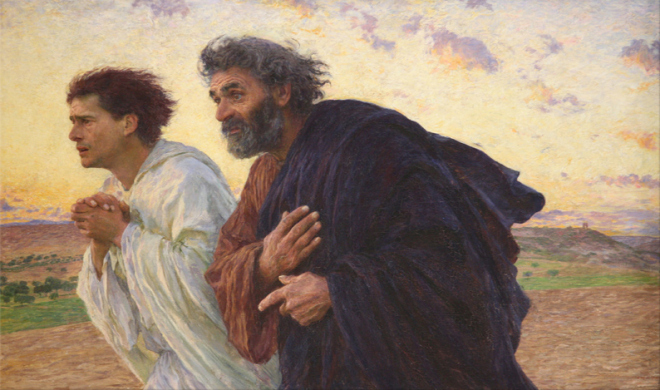
Palm Sunday Church Bombings in Egypt Kill 43, Wound Dozens
Sounding the alarm – WORLD
Many transgender persons regret what they did to their bodies and souls, and some are pleading that others not repeat their mistake
Source: Sounding the alarm – WORLD
I AM A CONVINCED UNIVERSALIST — by William Barclay

 William Barclay 1907-1978
I am a convinced universalist. I believe that in the end all men will be gathered into the love of God. In the early days Origen was the great name connected with universalism. I would believe with Origen that universalism is no easy thing. Origen believed that after death there were many who would need prolonged instruction, the sternest discipline, even the severest punishment before they were fit for the presence of God. Origen did not eliminate hell; he believed that some people would have to go to heaven via hell. He believed that even at the end of the day there would be some on whom the scars remained. He did not believe in eternal punishment, but he did see the possibility of eternal penalty. And so the choice is whether we accept God’s offer and invitation willingly, or take the long and terrible way round…
View original post 869 more words
Apprehending God–A.W. Tozer
from The Pursuit of God by A.W. Tozer
Chapter 4 : Apprehending God.
O taste and see.
Ps. 34:8
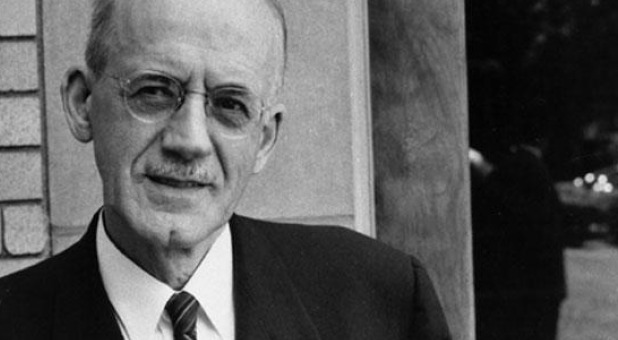
A.W. Tozer
It was Canon Holmes, of India, who more than twenty-five years ago called attention to the inferential character of the average man’s faith in God. To most people God is an inference, not a reality. He is a deduction from evidence which they consider adequate; but He remains personally unknown to the individual. `He must be,’ they say, `therefore we believe He is.’ Others do not go even so far as this; they know of Him only by hearsay. They have never bothered to think the matter out for themselves, but have heard about Him from others, and have put belief in Him into the back of their minds along with the various odds and ends that make up their total creed. To many others God is but an ideal, another name for goodness, or beauty, or truth; or He is law, or life, or the creative impulse back of the phenomena of existence. These notions about God are many and varied, but they who hold them have one thing in common: they do not know God in personal experience. The possibility of intimate acquaintance with Him has not entered their minds. While admitting His existence they do not think of Him as knowable in the sense that we know things or people.
Christians, to be sure, go further than this, at least in theory. Their creed requires them to believe in the personality of God, and they have been taught to pray, `Our Father, which art in heaven.‘ Now personality and fatherhood carry with them the idea of the possibility of personal acquaintance. This is admitted, I say, in theory, but for millions of Christians, nevertheless, God is no more real than He is to the non-Christian. They go through life trying to love an ideal and be loyal to a mere principle.
Over against all this cloudy vagueness stands the clear scriptural doctrine that God can be known in personal experience. A loving Personality dominates the Bible, walking among the trees of the garden and breathing fragrance over every scene. Always a living Person is present, speaking, pleading, loving, working, and manifesting Himself whenever and wherever His people have the receptivity necessary to receive the manifestation.
The Bible assumes as a self-evident fact that men can know God with at least the same degree of immediacy as they know any other person or thing that comes within the field of their experience. The same terms are used to express the knowledge of God as are used to express knowledge of physical things. `O taste and see that the Lord is good.‘ (Ps 34:8) `All thy garments smell of myrrh, and aloes, and cassia, out of the ivory palaces.‘ (Ps 45:8) `My sheep hear my voice.‘ (Jn 10:27) `Blessed are the pure in heart, for they shall see God.‘ (Mt 5:8) These are but four of countless such passages from the Word of God. And more important than any proof text is the fact that the whole import of the Scripture is toward this belief.
What can all this mean except that we have in our hearts organs by means of which we can know God as certainly as we know material things through our familiar five senses? We apprehend the physical world by exercising the faculties given us for the purpose, and we possess spiritual faculties by means of which we can know God and the spiritual world if we will obey the Spirit’s urge and begin to use them. That a saving work must first be done in the heart is taken for granted here. The spiritual faculties of the unregenerate man lie asleep in his nature, unused and for every purpose dead; that is the stroke which has fallen upon us by sin. They may be quickened to active life again by the operation of the Holy Spirit in regeneration; that is one of the immeasurable benefits which come to us through Christ’s atoning work on the cross.
But the very ransomed children of God themselves: why do they know so little of that habitual conscious communion with God which the Scriptures seem to offer? The answer is our chronic unbelief. Faith enables our spiritual sense to function. Where faith is defective the result will be inward insensibility and numbness toward spiritual things. This is the condition of vast numbers of Christians today. No proof is necessary to support that statement. We have but to converse with the first Christian we meet or enter the first church we find open to acquire all the proof we need.
A spiritual kingdom lies all about us, enclosing us, embracing us, altogether within reach of our inner selves, waiting for us to recognize it. God Himself is here waiting our response to His Presence. This eternal world will come alive to us the moment we begin to reckon upon its reality.
I have just now used two words which demand definition; or if definition is impossible, I must at least make clear what I mean when I use them. They are `reckon’ and `reality.’ What do I mean by reality? I mean that which has existence apart from any idea any mind may have of it, and which would exist if there were no mind anywhere to entertain a thought of it. That which is real has being in itself. It does not depend upon the observer for its validity.
I am aware that there are those who love to poke fun at the plain man’s idea of reality. They are the idealists who spin endless proofs that nothing is real outside of the mind. They are the relativists who like to show that there are no fixed points in the universe from which we can measure anything. They smile down upon us from their lofty intellectual peaks and settle us to their own satisfaction by fastening upon us the reproachful term `absolutist.’ The Christian is not put out of countenance by this show of contempt. He can smile right back at them, for he knows that there is only One who is Absolute, that is God. But he knows also that the Absolute One has made this world for man’s uses, and, while there is nothing fixed or real in the last meaning of the words (the meaning as applied to God) for every purpose of human life we are permitted to act as if there were. And every man does act thus except the mentally sick. These unfortunates also have trouble with reality, but they are consistent; they insist upon living in accordance with their ideas of things. They are honest, and it is their very honesty that constitutes them a social problem.
The idealists and relativists are not mentally sick. They prove their soundness by living their lives according to the very notions of reality which they in theory repudiate and by counting upon the very fixed points which they prove are not there. They could earn a lot more respect for their notions if they were willing to live by them; but this they are careful not to do. Their ideas are brain-deep, not life- deep. Wherever life touches them they repudiate their theories and live like other men.
The Christian is too sincere to play with ideas for their own sake. He takes no pleasure in the mere spinning of gossamer webs for display. All his beliefs are practical. They are geared into his life. By them he lives or dies, stands or falls for this world and for all time to come. From the insincere man he turns away.
The sincere plain man knows that the world is real. He finds it here when he wakes to consciousness, and he knows that he did not think it into being. It was here waiting for him when he came, and he knows that when he prepares to leave this earthly scene it will be here still to bid him good-bye as he departs. By the deep wisdom of life he is wiser than a thousand men who doubt. He stands upon the earth and feels the wind and rain in his face and he knows that they are real. He sees the sun by day and the stars by night.
He sees the hot lightning play out of the dark thundercloud. He hears the sounds of nature and the cries of human joy and pain. These he knows are real. He lies down on the cool earth at night and has no fear that it will prove illusory or fail him while he sleeps. In the morning the firm ground will be under him, the blue sky above him and the rocks and trees around him as when he closed his eyes the night before. So he lives and rejoices in a world of reality. With his five senses he engages this real world. All things necessary to his physical existence he apprehends by the faculties with which he has been equipped by the God who created him and placed him in such a world as this.
Now by our definition also God is real. He is real in the absolute and final sense that nothing else is. All other reality is contingent upon His. The great Reality is God who is the Author of that lower and dependent reality which makes up the sum of created things, including ourselves. God has objective existence independent of and apart from any notions which we may have concerning Him.The worshipping heart does not create its Object. It finds Him here when it wakes from its moral slumber in the morning of its regeneration.
Another word that must be cleared up is the word reckon. This does not mean to visualize or imagine. Imagination is not faith. The two are not only different from, but stand in sharp opposition to, each other. Imagination projects unreal images out of the mind and seeks to attach reality to them. Faith creates nothing; it simply reckons upon that which is already there. God and the spiritual world are real. We can reckon upon them with as much assurance as we reckon upon the familiar world around us. Spiritual things are there (or rather we should say here) inviting our attention and challenging our trust.
Our trouble is that we have established bad thought habits. We habitually think of the visible world as real and doubt the reality of any other. We do not deny the existence of the spiritual world but we doubt that it is real in the accepted meaning of the word. The world of sense intrudes upon our attention day and night for the whole of our lifetime. It is clamorous, insistent and self- demonstrating. It does not appeal to our faith; it is here, assaulting our five senses, demanding to be accepted as real and final. But sin has so clouded the lenses of our hearts that we cannot see that other reality, the City of God, shining around us. The world of sense triumphs. The visible becomes the enemy of the invisible; the temporal, of the eternal. That is the curse inherited by every member of Adam’s tragic race.
At the root of the Christian life lies belief in the invisible. The object of the Christian’s faith is unseen reality. Our uncorrected thinking, influenced by the blindness of our natural hearts and the intrusive ubiquity of visible things, tends to draw a contrast between the spiritual and the real; but actually no such contrast exists. The antithesis lies elsewhere: between the real and the imaginary, between the spiritual and the material, between the temporal and the eternal; but between the spiritual and the real.
The spiritual is real. If we would rise into that region of light and power plainly beckoning us through the Scriptures of truth we must break the evil habit of ignoring the spiritual. We must shift our interest from the seen to the unseen. For the great unseen Reality is God. `He that cometh to God must believe that he is, and that he is a rewarder of them that diligently seek him.‘ (Hebr 11:6) This is basic in the life of faith. From there we can rise to unlimited heights. `Ye believe in God,‘ said our Lord Jesus Christ, `believe also in me.‘ (John 14:1) Without the first there can be no second.
If we truly want to follow God we must seek to be other-worldly. This I say knowing well that that word has been used with scorn by the sons of this world and applied to the Christian as a badge of reproach. So be it. Everyman must choose his world. If we who follow Christ, with all the facts before us and knowing what we are about, deliberately choose the Kingdom of God as our sphere of interest I see no reason why anyone should object. If we lose by it, the loss is our own; if we gain we rob no one by so doing.
The `other world,’ which is the object of this world’s disdain and the subject of the drunkard’s mocking song, is our carefully chosen goal and the object of our holiest longing. But we must avoid the common fault of pushing the `other world’ into the future. It is not future, but present. It parallels our familiar physical world, and the doors between the two worlds are open. `Ye are come,‘ says the writer to the Hebrews (and the tense is plainly present), `unto Mount Zion, and unto the city of the living God, the heavenly Jerusalem, and to an innumerable company of angels, to the general assembly and church of the firstborn, which are written in heaven, and to God the Judge of all, and to the spirits of just men made perfect, and to Jesus the mediator of the new covenant, and to the blood of sprinkling, that speaketh better things than that of Abel‘ (Hebrews 12:22-24) All these things are contrasted with `the mount that might be touched’ and `the sound of a trumpet and the voice of words’ that might be heard. May we not safely conclude that, as the realities of Mount Sinai were apprehended by the senses, so the realities of Mount Zion are to be grasped by the soul? And this not by any trick of the imagination, but in downright actuality. The soul has eyes with which to see and ears with which to hear. Feeble they may be from long disuse, but by the life-giving touch of Christ alive now and capable of sharpest sight and most sensitive hearing.
As we begin to focus upon God the things of the spirit will take shape before our inner eyes. Obedience to the word of Christ will bring an inward revelation of the Godhead (John 14:21-23). It will give acute perception enabling us to see God even as is promised to the pure in heart. A new God-consciousness will seize upon us and we shall begin to taste and hear and inwardly feel the God who is our life and our all. There will be seen the constant shining of the light that lighteth every man that cometh into the world. (John 1:9) More and more, as our faculties grow sharper and more sure, God will become to us the great All, and His Presence the glory and wonder of our lives. O God, quicken to life every power within me, that I may lay hold on eternal things. Open my eyes that I may see; give me acute spiritual perception; enable me to taste Thee and know that Thou art good. Make heaven more real to me than any earthly thing has ever been. Amen
from The Pursuit of God by A.W. Tozer Chapter 4: Apprehending God
12 Evidences for the Resurrection of Jesus, Part 1 – Reflections

Jesus’s resurrection is at the very heart of historic Christianity. In fact, the bodily resurrection of Jesus Christ is both a central doctrinal belief of the faith and the primary evidence f…
Source: 12 Evidences for the Resurrection of Jesus, Part 1 – Reflections
Watch “Radical Permission 2: The Roots Of Passion with Graham Cooke” on YouTube
9 archaeology finds that confirm the New Testament
 Hundreds of archaeological findings are confirming the biblical record. Peter S Williams looks at some of the most interesting discoveries
Why did the Apostle John refer to himself as, “the disciple whom Jesus loved,”?
From INTRODUCTION TO THE GOSPEL ACCORDING TO SAINT JOHN Vol. I By William Barclay –The Beloved Disciple …
All our information about John comes from the first three gospels. It is the astonishing fact…
Source: Why did the Apostle John refer to himself as, “the disciple whom Jesus loved,”?
Shared from WordPress
Alister McGrath: “Richard Dawkins vs. C.S. Lewis on the Meaning of Life” – http://wp.me/pZtoa-SE

