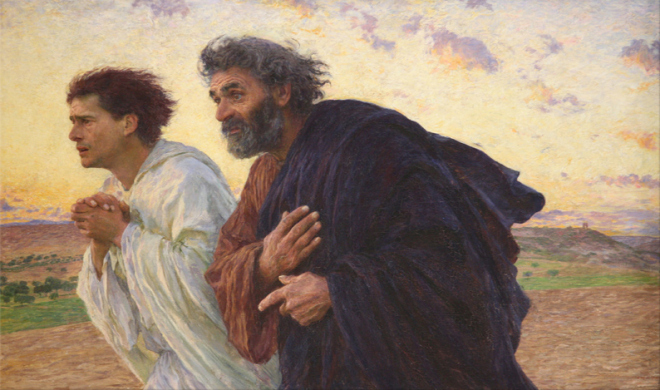
 N. T. Wright recently spoke at the Heriot-Watt University Chaplaincy Annual Public Lecture. Listen to his talk, “Speaking of God in a Confused World”
Category / God
Watch “About Global Legacy 2014” on YouTube
Through the house the child would shout ‘Abba!’—William Barclay

William Barclay 1907-1978
Like most people brought up in an evangelical home I did not at first know that there was any other way of thinking of the Atonement except in terms of God laying on Jesus the punishment that should have been laid on me… It seemed to me that the whole conception starts from the wrath of God, while the New Testament starts from the love of God. It was because he so loved the world that God sent his Son into the world (John 3:16). It was his love that God showed to us in the death of Christ for us while we were still sinners (Romans 5:8). Never in the New Testament, never once, is God said to be reconciled to man; it is always man who is reconciled to God. We plead with you, says Paul, on behalf of Christ, be reconciled to God (2 Corinthians 5:20).
Slowly it began to dawn on me that apart from the love of God there would have been no Atonement at all. And then I began to see this tremendous thing, the fact that Jesus came, not to change God’s attitude to men, but to demonstrate God’s attitude to men, to show men at the cost of the Cross what God is like. And then still later when I had to study the New Testament, I came to see that this is precisely what John is saying [John 1:14] — and what a difference! The God of terror became the God of love. It became the most natural thing in the world to seek the presence of God instead of running away from God.
Let us see this difference in operation. I have written of this again and again because I do not think that it can be stated too often. First of all, let us see the thing in Judaism. The angel of the Lord came to Manoah and his wife to tell them that their son Samson was to be born, and when Manoah realized who their heavenly visitor had been he said in terror: ‘We shall surely die, for we have seen God’ (Judg. 13:22). In Judaism to see God was, so they believed, [would be] to die. Now let us turn to the New Testament. No one has seen God; it is the only Son who has revealed Him (John 1:18). And revealed him as what? ‘He who has seen me has seen the Father’ (John 14:9). And in what sense? Jesus called God Abba (Mark 14:36). It is but that name that we too may call God, that we are invited to call him, says Paul (Rom.8:15; Gal. 4:6). And what does this word Abba mean? Abba is the word—to this day—by which a little Jewish boy or girl addresses his father in the home circle, in the family. Through the house the child would shout ‘Abba!’—Daddy.
Second, let us take the early Greek conception of God. In the old Greek mythology Prometheus was the supreme benefactor of man; he instructed man in architecture, astronomy, mathematics, writing, rearing cattle, navigation, medicine, the art of prophecy, working in metal and in every other art. The myth said that Prometheus had made man of clay, and, to give his clay life, [Prometheus] stole fire from heaven to put into it. The result was that Zeus chained him to a rock in the middle of the ocean and prepared a vulture to tear out his liver, which grew again each night to be torn out again each day. The gods grudged man everything, and any god who became a benefactor of men incurred the divine wrath in its most savage manifestation. What a difference between that and the God and Father of our Lord Jesus Christ!
Third, let us take the conception of the God of Greek philosophy with the New Testament. Both the great school of philosophy, the Stoics and the Epicureans, held that the supreme good in life is ataraxia, which means serenity. If that is true for man, how much more must it be true of God? In order to provide God with this ataraxia, the held that God must have apatheia. Apatheia is not apathy in the sense of indifference; it is the complete inability to feel anything at all. The being who has apatheia cannot know love or hate, but remains forever completely insulated against all feeling. If anyone can cause us sorrow or joy, it means that for that moment that person is greater than we are, because that person can have some influence over us. So the way to complete serenity is insulation against all feeling. When the countess of Lyttelton’s husband died, J. M. Barrie wrote to her: ‘If you had cared for him less, if he had been less worth caring for, the road would be less heavy-going. Joy has to be paid for.’ Sorrow is the price of love. If we never allowed ourselves to care for any one then there would be no such thing as sorrow. So the Greeks conceived of a God who essentially was unable to care. What a difference from the God who so loved the world, from the Jesus who could be moved with compassion, who wept! The difference between the apathetic Greek God and the Christian God of love is as wide as infinity.
I believe in Jesus, because it is only through Jesus that I know God as the Friend and Father, in whose presence I can be at home without fear, as a child with his father.
[from William Barclay: A Spiritual Autobiography, pg 51-54, William B Eerdmans Publishing Company, Grand Rapids, 1975.]
Professor of Divinity and Biblical Criticism at Glasgow University and the author of many Biblical commentaries and books, including a translation of the New Testament, Barclay New Testament, and The Daily Study Bible Series.
Chris Quilala – Spontaneous – YouTube
Which archaeologists have the oldest camels?


Logos — The Eternal Word—William Barclay
From The Daily Bible Study Series
by William Barclay
(John 1:1-2)
1:1-2 When the world had its beginning, the word was already there; and the word was with God; and the word was God. This word was in the beginning with God.
William Barclay 1907-1978
The beginning of John’s gospel is of such importance and of such depth of meaning that we must study it almost verse by verse.* It is John’s great thought that Jesus is none other than God’s creative and life-giving and light-giving word, that Jesus is the power of God which created the world and the reason of God which sustains the world come to earth in human and bodily form.
Here at the beginning John says three things about the Word; which is to say that he says three things about Jesus.
(i) The Word was already there at the very beginning things. John’s thought is going back to the first verse of the Bible. “In the beginning God created the heavens and the earth” (Gen 1:1). What John is saying is this—the Word is not one of the created things; the Word was there before creation.The Word is not part of the world which came into being in time; the Word is part of eternity and was there with God before time and the world began. John was thinking of what is known as the preexistence of Christ.
In many ways this idea of preexistence is very difficult, if not altogether impossible, to grasp. But it does mean one very simple, very practical, and very tremendous thing. If the Word was with God before time began, if God’s Word is part of the eternal scheme of things, it means that God was always like Jesus. Sometimes we tend to think of God as stern and avenging; and we tend to think that something Jesus did changed God’s anger into love and altered his attitude to men. The New Testament knows nothing of that idea. The whole New Testament tells us, this passage of John especially, that God has always been like Jesus. What Jesus did was to open a window in time that we might see the eternal and unchanging love of God.
We may well ask, “What then about some of the things that we read in the Old Testament? What about the passages which speak about commandments of God to wipe out whole cities and to destroy men, women and children? What of the anger and the destructiveness and the jealousy of God that we sometimes read of in the older parts of Scripture?” The answer is this—it is not God who has changed; it is men’s knowledge of him that has changed. Men wrote these things because they did not know any better; that was the stage which their knowledge of God had reached.
When a child is learning any subject, he has to learn it stage by stage. He does not begin with full knowledge; he begins with what he can grasp and goes on to more and more. When he begins music appreciation, he does not start with a Bach Prelude and Fugue; he starts with something much more simple; and goes through stage after stage until his knowledge grows. It was that way with men and God. They could only grasp and understand God’s nature and his ways in part. It was only when Jesus came that they saw fully and completely what God has always been like.
It is told that a little girl was once confronted with some of the more bloodthirsty and savage parts of the Old Testament. Her comment was: “But that happened before God became a Christian!” If we may so put it with all reverence, when John says that the Word was always there, he is saying that God was always a Christian. He is telling us that God was and is and ever shall be like Jesus; but men could never know and realize that until Jesus came.
(ii) John goes on to say that the Word was with God. What does he mean by that? He means that always there has been the closest connection between the Word and God. Let us put that in another and a simpler way—there has always been the most intimate connection between Jesus and God. That means no one can tell us what God is like, what God’s will is for us, what God’s love and heart and mind are like, as Jesus can.
Let us take a simple human analogy. If we want to know what someone really thinks and feels about something, and if we are unable to approach the person ourselves, we do not go to someone who is merely an acquaintance of that person, to someone who has known him only a short time; we go to someone whom we know to be an intimate friend of many years’ standing. We know that he will really be able to interpret the mind and the heart of the other person to us.
It is something like that that John is saying about Jesus. He is saying that Jesus has always been with God. Let us use very human language because it is the only language we can use. John is saying that Jesus is so intimate with God that God has no secrets from him; and that, therefore, Jesus is the one person in all the universe who can reveal to us what God is like and how God feels towards us.
(iii) Finally John says that the Word was God. This is a difficult saying for us to understand, and it is difficult because Greek, in which John wrote, had a different way of saying things from the way in which English speaks. When Greek uses a noun it almost always uses the definite article with it. The Greek for God is theos and the definite article is ho. When Greek speaks about God it does not simply say theos; it says ho theos. Now when Greek does not use the definite article with a noun that noun becomes much more like an adjective. John did not say that the Word was ho theos ; that would have been to say that the Word was identical with God. He said that the Word was theos—without the definite article—which means that the Word was, we might say, of the very same character and quality and essence and being as God. When John said the Word was God he was not saying that Jesus was identical with God; he was saying that Jesus was so perfectly the same as God in mind, in heart, in being that in him we perfectly see what God is like.
So right at the beginning of his Gospel John lays it down that in Jesus, and in him alone, there is perfectly revealed to men all that God always was and always will be, and all that he feels towards and desires for men.
[*italics of the 1955 edition restored but not text, which differs slightly]
The Outpouring of the Holy Ghost at Azusa Street Mission
William Joseph Seymour
(May 2, 1870 – September 28, 1922)
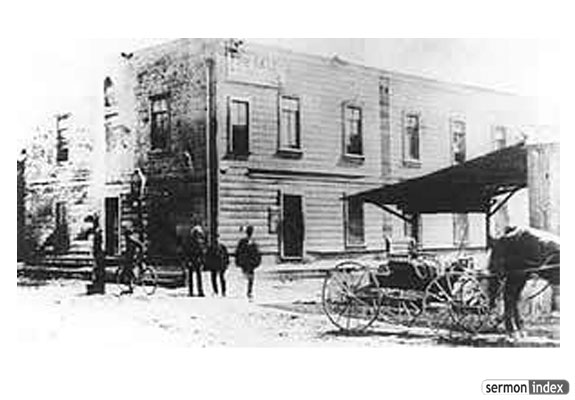
Azusa Street Mission–312 Azusa Street circa 1906
Koinonia – The Great Commission, Part 9 by Rick Joyner | MorningStar Word for the Week 2014
“Men have forgotten God”—Aleksandr Solzhenitsyn
Over a half century ago, while I was still a child, I recall hearing a number of old people offer the following explanation for the great disasters that had befallen Russia: “Men have forgotten God; that’s why all this has happened.” Since then I have spent well-nigh 50 years working on the history of our revolution; in the process I have read hundreds of books, collected hundreds of personal testimonies, and have already contributed eight volumes of my own toward the effort of clearing away the rubble left by that upheaval. But if I were asked today to formulate as concisely as possible the main cause of the ruinous revolution that swallowed up some 60 million of our people, I could not put it more accurately than to repeat: “Men have forgotten God; that’s why all this has happened.”

Ericson, Edward E. Jr. (October 1985) “Solzhenitsyn – Voice from the Gulag,” Eternity, pp. 23–4
Nihilism and the End of Law — Phillip E. Johnson
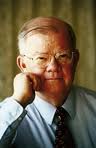
Nihilism and the End of the Law by Phillip E. Johnson
“Secularized intellectuals have long been complacent in their apostasy because they were sure they weren’t missing anything important in consigning God to the ashcan of history. They were happy to replace the Creator with a mindless evolutionary process that left humans free and responsible only to themselves. They complacently assumed that when their own reasoning power was removed from its grounding in the only ultimate reality, it could float, unsupported, on nothing at all. As modernist rationalism gives way in universities to its own natural child-postmodernist nihilism-modernists are learning very slowly what a bargain they have made. It isn’t a bargain a society can live with indefinitely.”
 St. John One: One