Review of Defining Inerrancy


Daniel B. Wallace's avatarDaniel B. Wallace

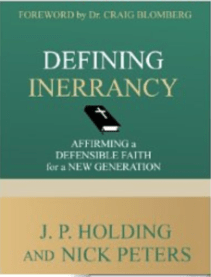
Defining Inerrancy: Affirming a Defensible Faith for a New Generation, by J. P. Holding and Nick Peters, published by Tekton E-Bricks on 22 May 2014, is intended to be a response to Norm Geisler and Bill Roach’s Defending Inerrancy—and so much more. Both have a similar cover and similar title. Defining Inerrancy, however, is a gloves-off defense and affirmation of a version of inerrancy that many are not acquainted with. That is, many except those who are Old and New Testament scholars.

Defining inerrancyDefending Inerrancy

Defining Inerrancy also interacts heavily with Norm Geisler and David Farnell’s The Jesus Quest, a book published just last March. The info on Amazon says that the eBook is the equivalent of 98 pages long, based on the number of “page turns” on a Kindle. A preliminary Word draft of Defining Inerrancy, sent to me by the authors, weighs in at just 74…

View original post 1,522 more words

Overflowing love of God–N.T. Wright


NTJesus’ valuation of each human being is based not on
abstract egalitarian ideals, but on the overflowing love of
God, which, like a great river breaking its banks into a
parched countryside, irrigates those parts of human society
which until now had remained barren and unfruitful.

Wright, Tom (2001-01-19). Luke for Everyone (New Testament
for Everyone) (p. 131). SPCK. Kindle Edition.

Parable of the Wedding Feast–William Barclay


Joy and Judgment (Matthew 22:1-10)

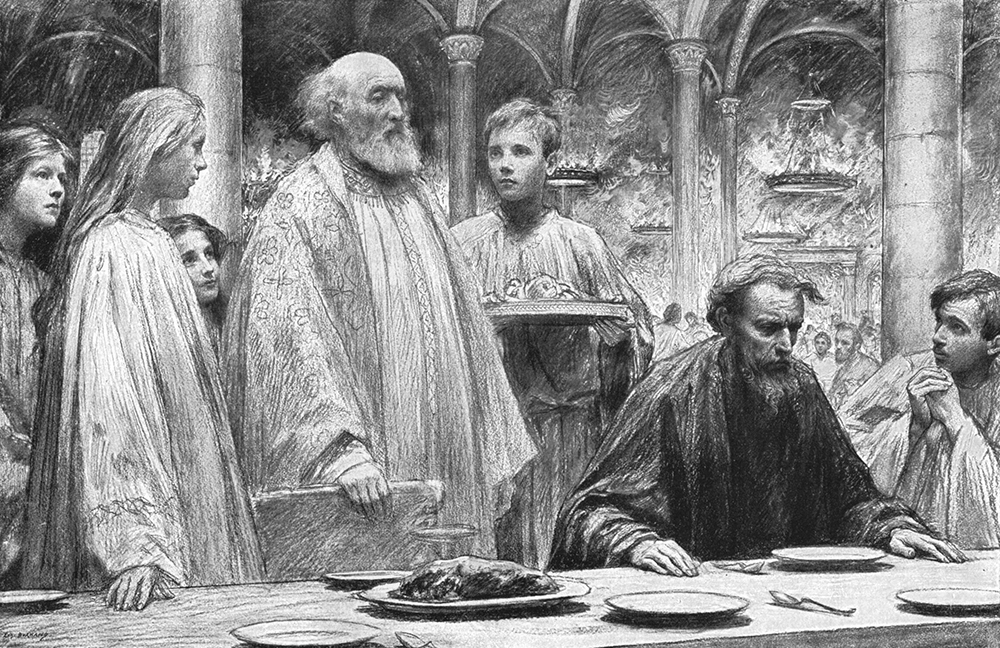
Jesus again answered them in parables: “The Kingdom of Heaven is like the situation which arose when a man who was a king arranged a wedding for his son. He sent his servants to summon those who had been invited to the wedding, and they refused to come. He again sent other servants. ‘Tell those who have been invited,’ he said, ‘look you, I have my meal all prepared; my oxen and my specially fattened animals have been killed; and everything is ready. Come to the wedding.’ But they disregarded the invitation and went away, one to his estate, and another to his business. The rest seized the servants and treated them shamefully and killed them. The king was angry, and sent his armies, and destroyed those murderers, and set fire to their city. Then he said to his servants, ‘The wedding is ready. Those who have been invited did not deserve to come. Go, then, to the highways and invite to the wedding all you may find.’ So the servants went out to the roads, and collected all whom they found, both bad and good; and the wedding was supplied with guests.”

Parable of the Wedding Feast by Eugene Burnand

Parable of the Wedding Feast by Eugene Burnand

Matt 22:1-14 form not one parable, but two; and we will grasp their meaning far more easily and far more fully if we take them separately.

The events of the first of the two were completely in accordance with normal Jewish customs. When the invitations to a great feast, like a wedding feast, were sent out, the time was not stated; and when everything was ready the servants were sent out with a final summons to tell the guests to come. So, then, the king in this parable had long ago sent out his invitations; but it was not till everything was prepared that the final summons was issued—and insultingly refused. This parable has two meanings.

(i) It has a purely local meaning. Its local meaning was a driving home of what had already been, said in the Parable of the Wicked Husbandmen; once again it was an accusation of the Jews. The invited guests who when the time came refused to come, stand for the Jews. Ages ago they had been invited by God to be his chosen people; yet when God’s son came into the world, and they were invited to follow him they contemptuously refused. The result was that the invitation of God went out direct to the highways and the byways; and the people in the highways and the byways stand for the sinners and the Gentiles, who never expected an invitation into the Kingdom.

As the writer of the gospel saw it, the consequences of the refusal were terrible. There is one verse of the parable which is strangely out of place; and that because it is not part of the original parable as Jesus told it, but an interpretation by the writer of the gospel. That is Matt 22:7, which tells how the king sent his armies against those who refused the invitation, and burned their city.
Parable of the Wedding Feast by Eugene Burnand

Parable of the Wedding Feast by Eugene Burnand

This introduction of armies and the burning of the city seems at first sight completely out of place taken in connexion with invitations to a wedding feast. But Matthew was composing his gospel some time between A.D. 80 and 90. What had happened during the period between the actual life of Jesus and now? The answer is—the destruction of Jerusalem by the armies of Rome in A.D. 70. The Temple was sacked and burned and the city destroyed stone from stone, so that a plough was drawn across it. Complete disaster had come to those who refused to recognize the Son of God when he came.***

The Parable of the Wedding Feast by Eugene Burnand

The Parable of the Wedding Feast by Eugene Burnand

The writer of the gospel adds as his comment the terrible things which did in fact happen to the nation which would not take the way of Christ. And it is indeed the simple historical fact that if the Jews had accepted the way of Christ, and had walked in love, in humility and in sacrifice they would never have been the rebellious, warring people who finally provoked the avenging wrath of Rome, when Rome could stand their political machinations no longer.

(ii) Equally this parable has much to say on a much wider scale.

(a) It reminds us that the invitation of God is to a feast as joyous as a wedding feast. His invitation is to joy. To think of Christianity as a gloomy giving up of everything which brings laughter and sunshine and happy fellowship is to mistake its whole nature. It is to joy that the Christian is invited; and it is joy he misses, if he refuses the invitation.

(b) It reminds us that the things which make men deaf to the invitation of Christ are not necessarily bad in themselves. One man went to his estate; the other to his business. They did not go off on a wild carousal or an immoral adventure. They went off on the [ task], in itself, excellent task of efficiently administering their business life. It is very easy for a man to be so busy with the things of time that he forgets the things of eternity, to be so preoccupied with the things which are seen that he forgets the things which are unseen, to hear so insistently the claims of the world that he cannot hear the soft invitation of the voice of Christ. The tragedy of life is that it is so often the second bests which shut out the bests, that it is things which are good in themselves which shut out the things that are supreme. A man can be so busy making a living that he fails to make a life; he can be so busy with the administration and the organization of life that he forgets life itself.

(c) It reminds us that the appeal of Christ is not so much to consider how we will be punished as it is to see what we will miss, if we do not take his way of things. Those who would not come were punished, but their real tragedy was that they lost the joy of the wedding feast. If we refuse the invitation of Christ, some day our greatest pain will lie, not in the things we suffer, but in the realization of the precious things we have missed.

(d) It reminds us that in the last analysis God’s invitation is the invitation of grace. Those who were gathered in from the highways and the byways had no claim on the king and they could never by any stretch of imagination have expected an invitation to the wedding feast, still less could they ever have deserved it. It came to them from nothing other than the wide-armed, open-hearted, generous hospitality of the king. It was grace which offered the invitation and grace which gathered men in.

The Scrutiny of the King (Matthew 22:11-14)

The king came in to see those who were sitting at table, and he saw there a man who was not wearing a wedding garment. “Friend,” he said to him, “how did you come here with no wedding garment?” The man was struck silent. Then the king said to the attendants, “Bind him hands and feet, and throw him out into the outer darkness. There shall be weeping and gnashing of teeth there. For many are called, but few are chosen.”

This is a second parable, but it is also a very close continuation and amplification of the previous one. It is the story of a guest who appeared at a royal wedding feast without a wedding garment.

wedding feast7One of the great interests of this parable is that in it we see Jesus taking a story which was already familiar to his hearers and using it in his own way. The Rabbis had two stories which involved kings and garments. The first told of a king who invited his guests to a feast, without telling them the exact date and time; but he did tell them that they must wash, and anoint, and clothe themselves that they might be ready when the summons came. The wise prepared themselves at once, and took their places waiting at the palace door, for they believed that in a palace a feast could be prepared so quickly that there would be no long warning. The foolish believed that it would take a long time to make the necessary preparations and that they would have plenty of time. So they went, the mason to his lime, the potter to his clay, the smith to his furnace, the fuller to his bleaching-ground, and went on with their work. Then, suddenly, the summons to the feast came without any warning. The wise were ready to sit down, and the king rejoiced over them, and they ate and drank. But those who had not arrayed themselves in their wedding garments had to stand outside, sad and hungry, and look on at the joy that they had lost. That rabbinic parable tells of the duty of preparedness for the summons of God, and the garments stand for the preparation that must be made.

The second rabbinic parable told how a king entrusted to his servants royal robes. Those who were wise took the robes, and carefully stored them away, and kept them in all their pristine loveliness. Those who were foolish wore the robes to their work, and soiled and stained them. The day came when the king demanded the robes back. The wise handed them back fresh and clean; so the king laid up the robes in his treasury and bade them go in peace. The foolish handed them back stained and soiled. The king commanded that the robes should be given to the fuller to cleanse, and that the foolish servants should be cast into prison. This parable teaches that a man must hand back his soul to God in all its original purity; but that the man who has nothing but a stained soul to render back stands condemned.

No doubt Jesus had these two parables in mind when he told his own story. What, then, was he seeking to teach? This parable also contains both a local and a universal lesson.
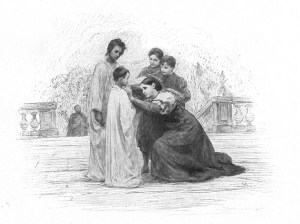
Parable of the Wedding Feast by Eugene Burnand

Parable of the Wedding Feast by Eugene Burnand

(i) The local lesson is this. Jesus has just said that the king, to supply his feast with guests, sent his messengers out into the highways and byways to gather all men in. That was the parable of the open door. It told how the Gentiles and the sinners would be gathered in. This parable strikes the necessary balance. It is true that the door is open to all men, but when they come they must bring a life which seeks to fit the love which has been given to them. Grace is not only a gift; it is a grave responsibility. A man cannot go on living the life he lived before he met Jesus Christ. He must be clothed in a new purity and a new holiness and a new goodness. The door is open, but the door is not open for the sinner to come and remain a sinner, but for the sinner to come and become a saint.

(ii) This is the permanent lesson. The way in which a man comes to anything demonstrates the spirit in which he comes. If we go to visit in a friend’s house, we do not go in the clothes we wear in the shipyard or the garden. We know very well that it is not the clothes which matter to the friend. It is not that we want to put on a show. It is simply a matter of respect that we should present ourselves in our friend’s house as neatly as we can. The fact that we prepare ourselves to go there is the way in which we outwardly show our affection and our esteem for our friend. So it is with God’s house. This parable has nothing to do with the clothes in which we go to church; it has everything to do with the spirit in which we go to God’s house. It is profoundly true that church-going must never be a fashion parade. But there are garments of the mind and of the heart and of the soul—the garment of expectation, the garment of humble penitence, the garment of faith, the garment of reverence—and these are the garments without which we ought not to approach God. Too often we go to God’s house with no preparation at all; if every man and woman in our congregations came to church prepared to worship, after a little prayer, a little thought, and a little self-examination, then worship would be worship indeed—the worship in which and through which things happen in men’s souls and in the life of the Church and in the affairs of the world.

Parable of the Wedding Feast by Eugene Burnand

Parable of the Wedding Feast by Eugene Burnand

***[There is a good argument for an earlier composition of Matthew than Barclay’s 80-90 AD, which makes Jesus prophetic in this parable as Matthew 24 would be as well if this Gospel was penned prior to AD 70 cf., R.C. Sproul, The Last Days of Jesus  according to Jesus]

Gospel of Matthew Vol II;  by William Barclay; Barclay’s Daily Study Bible (NT).
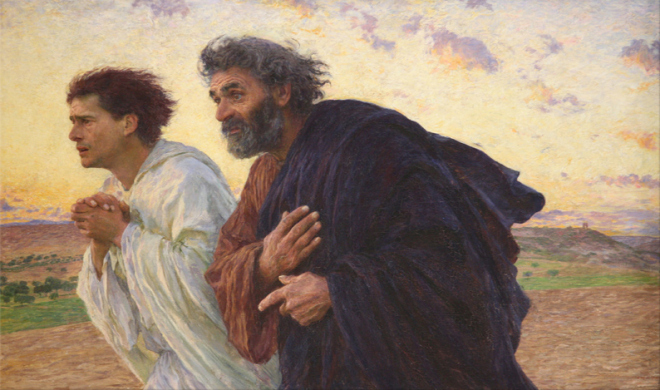
Parable of the Unjust Steward—William Barclay


A Bad Man’s Good Example (Luke 16:1-13)

Parable of the Dishonest Steward—Eugene Burnand

Parable of the Dishonest Steward—Eugene Burnand

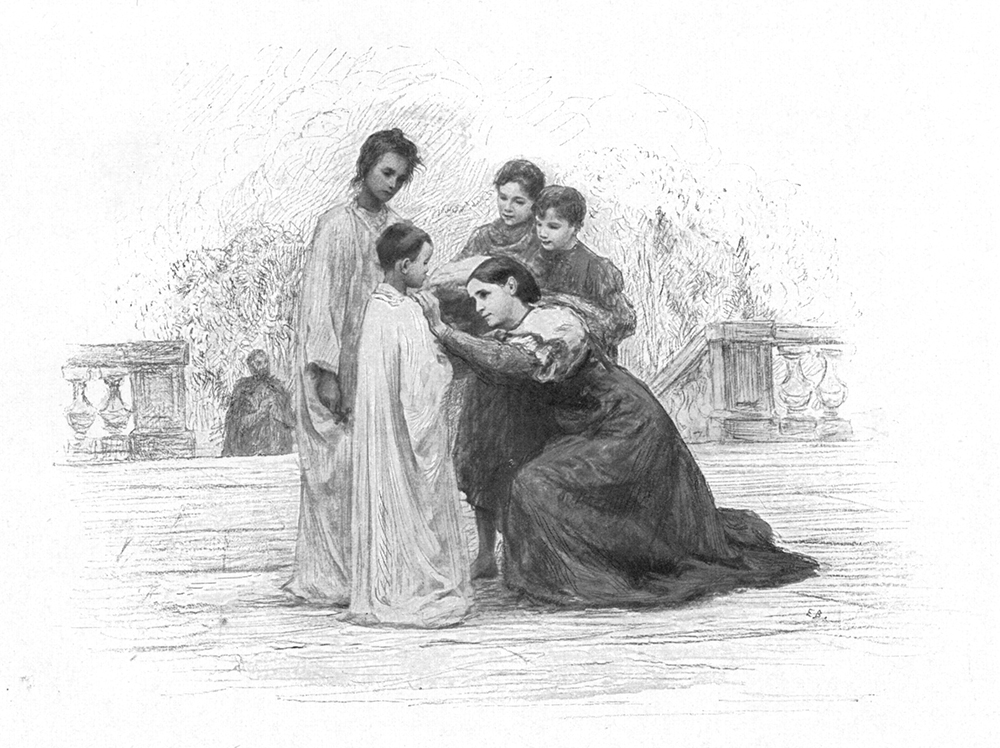
Jesus said to his disciples, “There was a rich man who had a steward. He received information against the steward which alleged that he was dissipating his goods. He called him, and said to him, ‘What is this that I hear about you? Give an account of your stewardship, for you can no longer be steward.’ The steward said to himself, ‘What am I to do? I have not the strength to dig, and I am ashamed to beg. I know what I will do, so that, when I am removed from my stewardship, they will receive me into their houses.’ So he summoned each of the people who owed debts to his master. To the first he said, ‘How much do you owe my master?’ He said, ‘Nine hundred gallons of oil.’ He said to him, ‘Take your account and sit down and write quickly, four hundred and fifty.’ Then he said to another ‘And you—how much do you owe?’ He said, ‘A thousand bushels of corn.’ He said to him, ‘Take your accounts and write eight hundred.’ And the master praised the wicked steward because he acted shrewdly; for the sons of this world are shrewder in their own generation than the sons of light. And, I tell you, make for yourselves friends by means of your material possessions, even if they have been unjustly acquired, so that when your money has gone they will receive you into a dwelling which lasts forever. He who is trustworthy in a very little is also trustworthy in much; and he who is dishonest in a very little is also dishonest in much. If you have not shown yourself trustworthy in your ordinary business dealings about material things, who will trust you with the genuine wealth? If you have not shown yourselves trustworthy in what belongs to someone else, who will give you what is your own? No household slave can serve two masters, for either he will hate the one and love the other, or he will hold to the one and despise the other. You cannot be the slave of God and of material things.”

Parable of the Dishonest Steward—Eugene Burnand

Parable of the Dishonest Steward—Eugene Burnand

This is a difficult parable to interpret. It is a story about as choice a set of rascals as one could meet anywhere.

The steward was a rascal. He was a slave, but he was nonetheless in charge of the running of his master’s estate. In Palestine there were many absentee landlords. The master may well have been one of these, and his business may well have been entrusted to his steward’s hands. The steward had followed a career of embezzlement.

The debtors were also rascals. No doubt what they owed was rent. Rent was often paid to a landlord, not in money, but in kind. It was often an agreed proportion of the produce of the part of the estate which had been rented. The steward knew that he had lost his job. He, therefore, had a brilliant idea. He falsified the entries in the books so that the debtors were debited with far less than they owed. This would have two effects. First, the debtors would be grateful to him; and second, and much more effective, he had involved the debtors in his own misdemeanours, and, if the worst came to the worst, he was now in a strong position to exercise a little judicious blackmail!

The master himself was something of a rascal, for, instead of being shocked at the whole proceeding, he appreciated the shrewd brain behind it and actually praised the steward for what he had done.

The difficulty of the parable is clearly seen from the fact that Luke attaches no fewer than four different lessons to it.

(i) In Lk 16:8 the lesson is that the sons of this world are wiser in their generation than the sons of light. That means that, if only the Christian was as eager and ingenious in his attempt to attain goodness as the man of the world is in his attempt to attain money and comfort, he would be a much better man. If only men would give as much attention to the things which concern their souls as they do to the things which concern their business, they would be much better men. Over and over again a man will expend twenty times the amount of time and money and effort on his pleasure, his hobby, his garden, his sport as he does on his church. Our Christianity will begin to be real and effective only when we spend as much time and effort on it as we do on our worldly activities.

(ii) In Lk 16:9 the lesson is that material possessions should be used to cement the friendships wherein the real and permanent value of life lies. That could be done in two ways.

(a) It could be done as it affects eternity. The Rabbis had a saying, “The rich help the poor in this world, but the poor help the rich in the world to come.” Ambrose, commenting on the rich fool who built bigger barns to store his goods, said, “The bosoms of the poor, the houses of widows, the mouths of children are the barns which last forever.” It was a Jewish belief that charity given to poor people would stand to a man’s credit in the world to come. A man’s true wealth would consist not in what he kept, but in what he gave away.

(b) It could be done as it affects this world. A man can use his wealth selfishly or he can use it to make life easier, not only for himself, but for his friends and his fellow-men. How many a scholar is forever grateful to a rich man who gave or left money to found bursaries and scholarships which made a university career possible! How many a man is grateful to a better-off friend who saw him through some time of need in the most practical way! Possessions are not in themselves a sin, but they are a great responsibility, and the man who uses them to help his friends has gone far to discharge that responsibility.

(iii) In Lk 16:10-11 the lesson is that a man’s way of fulfilling a small task is the best proof of his fitness or unfitness to be entrusted with a bigger task. That is clearly true of earthly things. No man will be advanced to higher office until he has given proof of his honesty and ability in a smaller position. But Jesus extends the principle to eternity. He says, “Upon earth you are in charge of things which are not really yours. You cannot take them with you when you die. They are only lent to you. You are only a steward over them. They cannot, in the nature of things, be permanently yours. On the other hand, in heaven you will get what is really and eternally yours. And what you get in heaven depends on how you use the things of earth. What you will be given as your very own will depend on how you use the things of which you are only steward.”

(iv) Lk 16:13 lays down the rule that no slave can serve two masters. The master possessed the slave, and possessed him exclusively. Nowadays, a servant or a workman can quite easily do two jobs and work for two people. He can do one job in his working time and another in his spare time. He can, for instance, be a clerk by day and a musician by night. Many a man augments his income or finds his real interest in a spare-time occupation. But a slave had no spare time; every moment of his day, and every ounce of his energy, belonged to his master. He had no time which was his own. So, serving God can never be a part-time or a spare-time job. Once a man chooses to serve God every moment of his time and every atom of his energy belongs to God. God is the most exclusive of masters. We either belong to him totally or not at all.

Gospel of Luke, Barclay’s Daily Study Bible (NT).

** William Barclay’s translation.

Parable of the Good Samaritan—William Barclay


good samaritan2

The Parable of the Good Samaritan by Eugene Burnand

Who Is My Neighbour? (Luke 10:25-37)
10:25-37 Look you—an expert in the law stood up and asked Jesus a test question. “Teacher,” he said, “What is it I am to do to become the possessor of eternal life?” He said to him, “What stands written in the law? How do you read?” He answered, “You must love the Lord your God with your whole heart, and with your whole mind, and your neighbour as yourself.” “Your answer is correct,” said Jesus. But he, wishing to put himself in the right, said to Jesus, “And who is my neighbour?” Jesus answered, “There was a man who went down from Jerusalem to Jericho. He fell amongst brigands who stripped him and laid blows upon him, and went away and left him half-dead. Now, by chance, a priest came down by that road. He looked at him and passed by on the other side. In the same way when a Levite came to the place he looked at him and passed by on the other side. A Samaritan who was on the road came to where he was. He looked at him and was moved to the depths of his being with pity. So he came up to him and bound up his wounds, pouring in wine and oil; and he put him on his own beast and brought him to an inn and cared for him. On the next day he put down 10p and gave it to the innkeeper. ‘Look after him,’ he said, ‘and whatever more you are out of pocket, when I come back this way, I’ll square up with you in full.’ Which of these three, do you think, was neighbour to the man who fell into the hands of brigands?” He said, “He who showed mercy on him.” “Go,” said Jesus to him, “and do likewise.”**


good samaritan1

The Parable of the Good Samaritan by Eugene Burnand

First, let us look at the scene of this story. The road from Jerusalem to Jericho was a notoriously dangerous road. Jerusalem is 2,300 feet above sea-level; the Dead Sea, near which Jericho stood, is 1,300 feet below sea-level. So then, in somewhat less than 20 miles, this road dropped 3,600 feet. It was a road of narrow, rocky deifies, and of sudden turnings which made it the happy hunting-ground of brigands. In the fifth century Jerome tells us that it was still called “The Red, or Bloody Way.” In the 19th century it was still necessary to pay safety money to the local Sheiks before one could travel on it. As late as the early 1930’s, H. V. Morton tells us that he was warned to get home before dark, if he intended to use the road, because a certain Abu Jildah was an adept at holding up cars and robbing travellers and tourists, and escaping to the hills before the police could arrive. When Jesus told this story, he was telling about the kind of thing that was constantly happening on the Jerusalem to Jericho road.
Second, let us look at the characters.
(a) There was the traveler. He was obviously a reckless and foolhardy character. People seldom attempted the Jerusalem to Jericho road alone if they were carrying goods or valuables. Seeking safety in numbers, they traveled in convoys or caravans. This man had no one but himself to blame for the plight in which he found himself.
(b) There was the priest. He hastened past. No doubt he was remembering that he who touched a dead man was unclean for seven days (Numbers 19:11). He could not be sure but he feared that the man was dead; to touch him would mean losing his turn of duty in the Temple; and he refused to risk that. He set the claims of ceremonial above those of charity. The Temple and its liturgy meant more to him than the pain of man.
(c) There was the Levite. He seems to have gone nearer to the man before he passed on. The bandits were in the habit of using decoys. One of their number would act the part of a wounded man; and when some unsuspecting traveller stopped over him, the others would rush upon him and overpower him. The Levite was a man whose motto was, “Safety first.” He would take no risks to help anyone else.
(d) There was the Samaritan. The listeners would obviously expect that with his arrival the villain had arrived. He may not have been racially a Samaritan at all. The Jews had no dealings with the Samaritans and yet this man seems to have been a kind of commercial traveler who was a regular visitor to the inn. In John 8:48 the Jews call Jesus a Samaritan. The name was sometimes used to describe a man who was a heretic and a breaker of the ceremonial law. Perhaps this man was a Samaritan in the sense of being one whom all orthodox good people despised.
We note two things about him.
(i) His credit was good! Clearly the innkeeper was prepared to trust him. He may have been theologically unsound, but he was an honest man.
(ii) He alone was prepared to help. A heretic he may have been, but the love of God was in his heart. It is no new experience to find the orthodox more interested in dogmas than in help and to find the man the orthodox despise to be the one who loves his fellow-men. In the end we will be judged not by the creed we hold but by the life we live.
Third, let us look at the teaching of the parable. The scribe who asked this question was in earnest. Jesus asked him what was written in the law, and then said, “How do you read?” Strict orthodox Jews wore round their wrists little leather boxes called phylacteries, which contained certain passages of scripture—Ex 13:1-10; Exo 13:11-16; Deut 6:4-9; Deut 11:13-20. “You will love the Lord your God” is from Deut 6:4 and Deut 11:13. So Jesus said to the scribe, “Look at the phylactery on your own wrist and it will answer your question.” To that the scribes added Lev 19:18, which bids a man love his neighbour as himself; but with their passion for definition the Rabbis sought to define who a man’s neighbour was; and at their worst and their narrowest they confined the word neighbour to their fellow Jews. For instance, some of them said that it was illegal to help a gentile woman in her sorest time, the time of childbirth, for that would only have been to bring another gentile into the world. So then the scribe’s question, “Who is my neighbour?” was genuine.
Jesus’ answer involves three things.good samaritan3
(i) We must help a man even when he has brought his trouble on himself, as the traveller had done.
(ii) Any man of any nation who is in need is our neighbour. Our help must be as wide as the love of God.
(iii) The help must be practical and not consist merely in feeling sorry. No doubt the priest and the Levite felt a pang of pity for the wounded man, but they did nothing. Compassion, to be real, must issue in deeds.
What Jesus said to the scribe, he says to us—”Go you and do the same.”

Gospel of Luke, Barclay’s Daily Study Bible (NT).
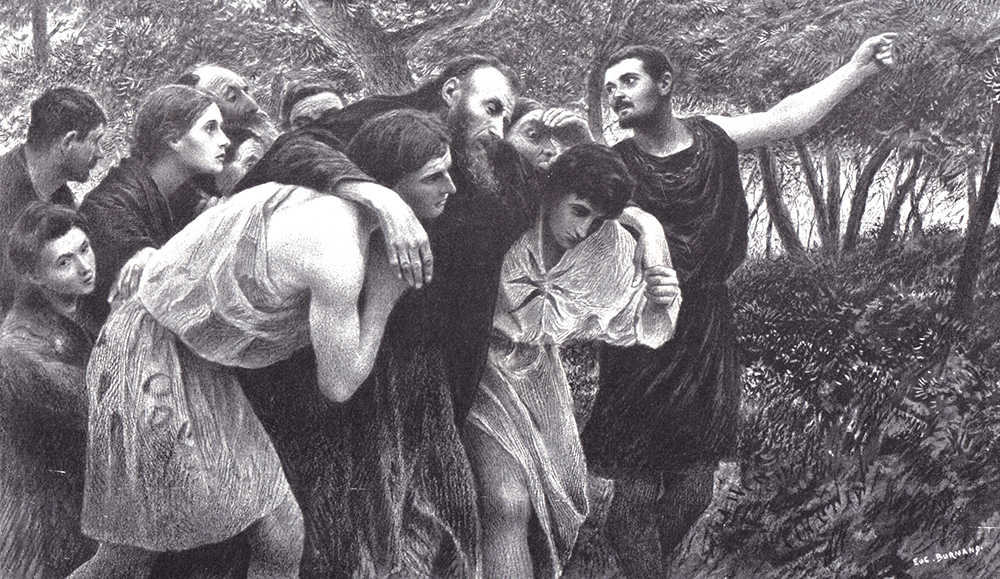
** William Barclay’s translation.

Parable of the Barren Fig Tree—William Barclay


Barren fig tree

The Barren Fig Tree—Eugene Burnand

Gospel of the Other Chance and Threat of the Last Chance (Luke 13:6-9)
Jesus spoke this parable, “A man had a fig-tree planted in his vineyard. He came looking for fruit on it and did not find it. He said to the keeper of the vineyard, ‘Look you—for the last three years I have been coming and looking for fruit on this fig-tree, and I still am not finding any. Cut it down! Why should it use up the ground’ ‘Lord,’ he answered him, ‘let it be this year too, until I dig round about it and manure it, and if it bears fruit in the coming year, well and good; but if not, you will cut it down.'”**
Here is a parable at one and the same time lit by grace and close packed with warnings.
(i) The fig-tree occupied a specially favoured position. It was not unusual to see fig-trees, thorn-trees and apple-trees in vineyards. The soil was so shallow and poor that trees were grown wherever there was soil to grow them; but the fig-tree had a more than average chance; and it had not proved worthy of it. Repeatedly, directly and by implication, Jesus reminded men that they would be judged according to the opportunities they had. C. E. M. Joad once said, “We have the powers of gods and we use them like irresponsible schoolboys.” Never was a generation entrusted with so much as ours and, therefore, never was a generation so answerable to God.
(ii) The parable teaches that uselessness invites disaster. It has been claimed that the whole process of evolution in this world is to produce useful things, and that what is useful will go on from strength to strength, while what is useless will be eliminated. The most searching question we can be asked is, “Of what use were you in this world?”
(iii) Further, the parable teaches that nothing which only takes out can survive. The fig-tree was drawing strength and sustenance from the soil; and in return was producing nothing. That was precisely its sin. In the last analysis, there are two kinds of people in this world—those who take out more than they put in, and those who put in more than they take out.
In one sense we are all in debt to life. We came into it at the peril of someone else’s life; and we would never have survived without the care of those who loved us. We have inherited a Christian civilization and a freedom which we did not create. There is laid on us the duty of handing things on better than we found them.
“Die when I may,” said Abraham Lincoln, “I want it said of me that I plucked a weed and planted a flower wherever I thought a flower would grow.” Once a student was being shown bacteria under the microscope. He could actually see one generation of these microscopic living things being born and dying and another being born to take its place. He saw, as he had never seen before, how one generation succeeds another. “After what I have seen,” he said, “I pledge myself never to be a weak link.”
If we take that pledge we will fulfil the obligation of putting into life at least as much as we take out.
(iv) The parable tells us of the gospel of the second chance. A fig-tree normally takes three years to reach maturity. If it is not fruiting by that time it is not likely to fruit at all. But this fig-tree was given another chance.
It is always Jesus’ way to give a man chance after chance. Peter and Mark and Paul would all gladly have witnessed to that. God is infinitely kind to the man who falls and rises again.
(v) But the parable also makes it quite clear that there is a final chance. If we refuse chance after chance, if God’s appeal and challenge come again and again in vain, the day finally comes, not when God has shut us out, but when we by deliberate choice have shut ourselves out. God save us from that!
Gospel of Luke, Barclay’s Daily Study Bible (NT).

** William Barclay’s own translation.

Green Scholars Initiative – greenscholarsinitiative.org


New Testament Manuscript collection:


Green Scholars Initiative – greenscholarsinitiative.org.

Remarriage and Divorce: Seven Minute Seminary-by Craig Keener – YouTube


Remarriage and Divorce: Seven Minute Seminary – YouTube.

Craig S. Keener

Craig Keener

Craig Keener

The Resurrection Argument That Changed a Generation of Scholars – Gary Habermas at UCSB – YouTube


Inerrancy to be a Christian? –Daniel Wallace via Lee Strobel


Lee Strobel

Lee Strobel

Scholar Daniel Wallace is interviewed by Lee Strobel for  The Case for the Real Jesus—Student Edition: A Journalist Investigates Current Challenges to ChristianityStrobel begins:

Daniel B. Wallace

Daniel B. Wallace


THE PROTECTIVE SHELL

I’ve heard people say, “Find me one error, and I’ll throw out the whole Bible.” I wondered what Wallace thought about that. “What if you found an incontrovertible error in the Bible?” I asked. “How would you react?” He thought for a moment, then replied. “It wouldn’t affect my foundational view of Christ. I don’t start by saying, ‘If the Bible has a few mistakes, then I have to throw it all out.’ That’s not a logical position. We don’t take that attitude toward any other ancient historical writings. For instance, did the first-century Jewish historian Josephus need to be inerrant before we could affirm that he got anything right?

“If we do that to the Bible, then we’re putting it on a pedestal and just inviting people to try to knock it off. We’ve basically turned the Bible into the fourth person of the Trinity, as if it should be worshiped. What we need to do with Scripture instead is say that it’s a great witness to the person of Jesus Christ and the acts of God in history. Now, is it more than that? Yes, I believe so. But whether it is or not, my salvation is still secure in Christ.”

“So it’s not necessary for a person to believe in inerrancy to be a Christian?” I asked.

“Personally, I believe in inerrancy,” he began. “However, I wouldn’t consider inerrancy to be a primary or essential doctrine for saving faith. It’s what I call a ‘protective shell’ doctrine. Picture concentric circles with the essential doctrines of Christ and salvation at the core. A little bit further out are some other doctrines until, finally, outside of everything is inerrancy. Inerrancy is intended to protect these inner doctrines. But if inerrancy isn’t true, does that mean that infallibility isn’t true? No. It’s a non sequitur to say I can’t trust the Bible in the minutiae of history, so therefore I can’t trust it in matters of faith and practice.”

I nodded as he talked to indicate I was following his line of thinking. “With that concentric-circle approach, then, a supposed error in the New Testament shouldn’t be fatal to a person’s faith,” I said.
“Absolutely,” he replied without hesitation. “It might affect inerrancy, which is an outer-shell doctrine. But dismantling that wouldn’t affect Christ, who’s a core doctrine.”
THE CORE OF THE GOSPELS
Wallace paused. “May I tell you a story about this?” he asked.
“Please,” I said.
“Some years ago I met a Muslim girl who was interested in Christianity,” he said. “She came to me with six handwritten, single-spaced pages of supposed discrepancies in the Gospels. She’d been taught by Muslims that if you can find one error in the Gospels, then you can’t believe anything they say. She said to me, ‘You’re going to have to answer every single one of these before I can believe anything about Christianity.’ “
My response was, ‘Don’t you think this list proves that the writers didn’t conspire and collude when they wrote their Gospels?’
“She said, ‘I’ve never thought of it that way.’
“I said, ‘What you need to do is look at the places where the Gospels don’t disagree at all. And what do you find? You find a core message that is revolutionary: Jesus was confessed as the Messiah by his disciples, he performed miracles and healed people, he forgave sins, he prophesied his own death and resurrection, he died on a Roman cross, and he was raised bodily from the dead.
“‘So now, what are you going to do with Jesus? Even if the Gospel writers have differences in their accounts—whether we should really call them “discrepancies” is a topic for later—then this only adds to their credibility by showing they weren’t huddled together in a corner cooking all of this up. Doesn’t their agreement on an absolute core of central beliefs suggest that they got the basics right, precisely because they were reporting on the same events?’”
“What happened to her?” I asked.
“Two weeks later she became a Christian, and now she’s a student at Dallas Seminary. My point is this: Inerrancy is important, but the gospel is bigger than inerrancy.
“As one British scholar said, ‘We should treat the Bible like any other book in order to show it’s not like any other book.’ That’s better than the opposite position that has become an evangelical mantra: ‘Hands off the Bible—we don’t want people to find any mistakes in it because we hold to inerrancy.’
“I’m not saying doctrines like inerrancy and infallibility aren’t important,” he went on. “I’m just saying they’re not necessary for salvation. However, they are important for spiritual health and growth.”
“How so?”
“If you doubt whether the Bible is an authoritative guide for faith and practice, it will inevitably affect your spiritual journey. You might begin questioning passages that are clear in their meaning, but they’re too convicting for you, so you reject them. You begin to pick and choose out of the Bible what you want to believe and obey.” Wallace summed up his perspective. “Whatever you do with this,” he urged, “don’t throw out Christ if you’re going to question inerrancy. Personally, I believe in inerrancy, but I’m not going to die for inerrancy. I will die for Christ. That’s where my heart is because that’s where salvation is,” he said with conviction.
“The Bible wasn’t hanged on the cross; Jesus was.”

Strobel, Lee (2009-07-14). The Case for the Real Jesus—Student Edition: A Journalist Investigates Current Challenges to Christianity (Kindle Locations 700-748). Zondervan/Youth Specialties. Kindle Edition.