Unknown's avatar

Posts by James Ross Kelly

James Ross Kelly lives in Northern California next to the Sacramento River. Mr. Kelly was a long-time resident of Southern Oregon where he grew up. And the Fires We Talked About published by Uncollected Press in 2020 is Mr. Kelly’s first book of fiction. In 2024 Mr. Kelly published his third book, "Above Neil Rock," a memoir.

Believing in the 21st Century:Chapter Two


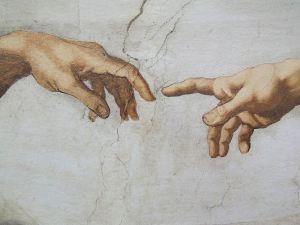
the_creation_michelangeloan exhortation..as 
a lay Christian examines his faith..

By James Ross Kelly

Christian bells toll—despite the shortcomings of Christendom, Evangelic and otherwise. Adherents of a modern material-polytheistic paganism however, should at least seriously consider the real thing which illumes Christ Jesus to a planet full of believers who met Him — personally and individually in a meeting. These days that is the discounted thing. The Gospel is the story of how the living God of the universe, visiting earth in fully human form was met and treated by organized legalist, religionists, and organized, civilized, Pagan law abiding civil servants—and those who sought to proffer their favor.  In a question, before anyone adopts a counter doctrine out of hand, or take present culture oriented stance seriously, or assign Jesus to mythos you must ask. At some point in your life, ‘What if,  just as it is written, what if—this is true?’

John 19:1-42
New King James Version (NKJV) The Holy Bible, New King James Version Copyright © 1982 by Thomas Nelson, Inc.

The Soldiers Mock Jesus

19 So then Pilate took Jesus and scourged Him. And the soldiers twisted a crown of thorns and put it on His head, and they put on Him a purple robe. Then they said,[1] “Hail, King of the Jews!” And they struck Him with their hands.

Pilate then went out again, and said to them, “Behold, I am bringing Him out to you, that you may know that I find no fault in Him.”

Pilate’s Decision

Then Jesus came out, wearing the crown of thorns and the purple robe. And Pilate said to them, “Behold the Man!”

Therefore, when the chief priests and officers saw Him, they cried out, saying, “Crucify Him, crucifyHim!

Pilate said to them, “You take Him and crucify Him, for I find no fault in Him.”

The Jews answered him, “We have a law, and according to our[2] law He ought to die, because He made Himself the Son of God.”

Therefore, when Pilate heard that saying, he was the more afraid, and went again into the Praetorium, and said to Jesus, “Where are You from?” But Jesus gave him no answer.

10 Then Pilate said to Him, “Are You not speaking to me? Do You not know that I have power to crucify You, and power to release You?”

11 Jesus answered, “You could have no power at all against Me unless it had been given you from above. Therefore the one who delivered Me to you has the greater sin.”

12 From then on Pilate sought to release Him, but the Jews cried out, saying, “If you let this Man go, you are not Caesar’s friend. Whoever makes himself a king speaks against Caesar.”

13 When Pilate therefore heard that saying, he brought Jesus out and sat down in the judgment seat in a place that is called The Pavement, but in Hebrew, Gabbatha.* 14 Now it was the Preparation Day of the Passover, and about the sixth hour. And he said to the Jews, “Behold your King!”

15 But they cried out, “Away with Him, away with Him! Crucify Him!”

Pilate said to them, “Shall I crucify your King?”

The chief priests answered, “We have no king but Caesar!”

16 Then he delivered Him to them to be crucified. So they took Jesus and led Him away.[3]

The King on a Cross

17 And He, bearing His cross, went out to a place called the Place of a Skull, which is called in Hebrew, Golgotha, 18 where they crucified Him, and two others with Him, one on either side, and Jesus in the center. 19 Now Pilate wrote a title and put it on the cross. And the writing was:

JESUS OF NAZARETH, THE KING OF THE JEWS.

20 Then many of the Jews read this title, for the place where Jesus was crucified was near the city; and it was written in Hebrew, Greek, and Latin.

21 Therefore the chief priests of the Jews said to Pilate, “Do not write, ‘The King of the Jews,’ but, ‘He said, “I am the King of the Jews.”’”

22 Pilate answered, “What I have written, I have written.”

23 Then the soldiers, when they had crucified Jesus, took His garments and made four parts, to each soldier a part, and also the tunic. Now the tunic was without seam, woven from the top in one piece.24 They said therefore among themselves, “Let us not tear it, but cast lots for it, whose it shall be,” that the Scripture might be fulfilled which says:

“They divided My garments among them,
And for My clothing they cast lots.”[4]

Therefore the soldiers did these things.

Behold Your Mother

25 Now there stood by the cross of Jesus His mother, and His mother’s sister, Mary the wife of Clopas, and Mary Magdalene. 26 When Jesus therefore saw His mother, and the disciple whom He loved standing by, He said to His mother, “Woman, behold your son!” 27 Then He said to the disciple,“Behold your mother!” And from that hour that disciple took her to his own home.

It Is Finished

28 After this, Jesus, knowing[5] that all things were now accomplished, that the Scripture might be fulfilled, said, “I thirst!” 29 Now a vessel full of sour wine was sitting there; and they filled a sponge with sour wine, put it on hyssop, and put it to His mouth. 30 So when Jesus had received the sour wine, He said, “It is finished!” And bowing His head, He gave up His spirit.

Jesus’ Side Is Pierced

31 Therefore, because it was the Preparation Day, that the bodies should not remain on the cross on the Sabbath (for that Sabbath was a high day), the Jews asked Pilate that their legs might be broken, and that they might be taken away. 32 Then the soldiers came and broke the legs of the first and of the other who was crucified with Him. 33 But when they came to Jesus and saw that He was already dead, they did not break His legs. 34 But one of the soldiers pierced His side with a spear, and immediately blood and water came out. 35 And he who has seen has testified, and his testimony is true; and he knows that he is telling the truth, so that you may believe. 36 For these things were done that the Scripture should be fulfilled, “Not one of His bones shall be broken.”[6] 37 And again another Scripture says, “They shall look on Him whom they pierced.”[7]

Jesus Buried in  Joseph’s Tomb

38 After this, Joseph of Arimathea, being a disciple of Jesus, but secretly, for fear of the Jews, asked Pilate that he might take away the body of Jesus; and Pilate gave him permission. So he came and took the body of Jesus. 39 And Nicodemus, who at first came to Jesus by night, also came, bringing a mixture of myrrh and aloes, about a hundred pounds. 40 Then they took the body of Jesus, and bound it in strips of linen with the spices, as the custom of the Jews is to bury. 41 Now in the place where He was crucified there was a garden, and in the garden a new tomb in which no one had yet been laid.42 So there they laid Jesus, because of the Jews’ Preparation Day, for the tomb was nearby.

Footnotes:

  1. John 19:3 NU-Text reads And they came up to Him and said.
  2. John 19:7 NU-Text reads the law.
  3. John 19:16 NU-Text omits and led Him away.
  4. John 19:24 Psalm 22:18
  5. John 19:28 M-Text reads seeing.
  6. John 19:36 Exodus 12:46Numbers 9:12Psalm 34:20
  7. John 19:37 Zechariah 12:10

* There had never been any historical record of the court where Jesus Christ was tried by Pilate – called the “Gabbatha” or pavement in John 19:13. William F. Albright, in The Archeology of Palestine, shows that this court was the court of the Tower of Antonia, which was the Roman military headquarters of Rome in Jerusalem. The court was destroyed between 66 A.D. – 70 A.D. during the siege of Jerusalem. It was left buried when the city was rebuilt in the time of Hadrian, and not discovered until recently.

Believing in the 21st Century:Chapter One


Harrowingan exhortation..as
a lay Christian examines his faith..

By James Ross Kelly

For post modern westerners among a diversity of worldviews,  there is only one moral discourse that remains resolute through time—this is the Christian worldview in its orthodox sense. You may disagree with this statement and this worldview as you perceive it, but you may not adopt another that has held sway for as long without leaping out of your own culture and shakily into another.

There is however a nominal view of Christianity that academically operates outside this orthodoxy and considers itself scholastic, vital—and at the same time considers itself valid in its own formality. It must be said that now, this scholastic endeavor and its formality has little, or no basis of really calling itself Christianity—for it has little or nothing to do with Christ Jesus. Where once the university system held the Christian paradigm sacrosanct it is now relegated to only part of comparative religion.

In what has been termed the “Post-Modern era,” a number of scholars such as those involved with the “Jesus Seminar,” have published a number of titles whose popularity has made books sell briskly in the secular press. However, today, even the term “orthodoxy,” rolls off the tongue with a slight to fervent distaste by the media and manufacturers of our popular culture. What pundits in orthodoxy’s stead, have embraced—is a counter-doctrine: that Jesus of Nazareth the founder of Christianity, while still a premier moral and ethical fulcrum philosophically, in Western thought—was not divine—but an historical person who has developed mythical proportions due to the exaggeration of scripture. This dogmatic counter-doctrine juxtaposed against two thousand years of orthodox thought and teaching is one that is fervently embraced by most elements of secular academic paradigms and the secular academic culture. Can Christianity share a canopy with this thinking—and remain vital?

Relationship to God and to one another Chuck Smith, Jr


t_chuckjr

The world s not going to be changed by Christians who merely go to church. the nature of the church in post-modernity has to be that of a spiritual community that strives to go beyond the modern concern for correct doctrine and institutionalism  A spiritual community is not based on dogma but on relationship to God and to one another.

Chuck Smith, Jr.,  The End of the World…as We Know It

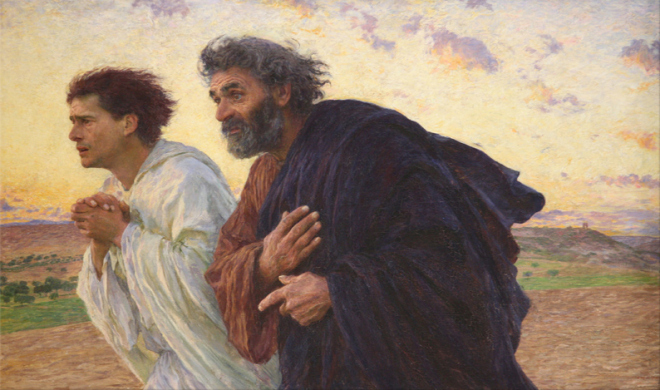
Why did the Apostle John refer to himself as, “the disciple whom Jesus loved,”?


William Barclay 1907-1978

William Barclay 1907-1978

From INTRODUCTION TO THE GOSPEL ACCORDING TO SAINT JOHN Vol.I
By William Barclay

The Beloved Disciple

… All our information about John comes from the first three gospels. It is the astonishing fact that the Fourth Gospel never mentions the apostle John from beginning to end. But it does mention two other people.

First, it speaks of the disciple whom Jesus loved. There are four mentions of him. He was leaning on Jesus’ breast at the Last Supper (John 13:23-25); it is into his care that Jesus committed Mary as he died upon his Cross (John 19:25-27); it was Peter and he whom Mary Magdalene met on her return from the empty tomb on the first Easter morning (John 20:2); he was present at the last resurrection appearance of Jesus by the lake-side (John 21:20).

Second, the Fourth Gospel has a kind of character whom we might call the witness. As the Fourth Gospel tells of the spear thrust into the side of Jesus and the issue of the water and the blood, there comes the comment: “He who saw it has borne witness–his testimony is true, and he knows that he tells the truth–that you also may believe” (John 19:35). At the end of the gospel comes the statement that it was the beloved disciple who testified of these things “and we know that his testimony is true” (John 21:24).

Here we are faced with rather a strange thing. In the Fourth Gospel John is never mentioned, but the beloved disciple is and in addition there is a witness of some kind to the whole story. It has never really been doubted in tradition that the beloved disciple is John. A few have tried to identify him with Lazarus, for Jesus is said to have loved Lazarus (John 11:3-5), or with the Rich Young Ruler, of whom it is said that Jesus, looking on him, loved him (Mark 10:21). But although the gospel never says so in so many words, tradition has always identified the beloved disciple with John, and there is no real need to doubt the identification.

But a very real point arises–suppose John himself actually did the writing of the gospel, would he really be likely to speak of himself as the disciple whom Jesus loved? Would he really be likely to pick himself out like this, and, as it were, to say: “I was his favourite; he loved me best of all”? It is surely very unlikely that John would confer such a title on himself. If it was conferred by others, it is a lovely title; if it was conferred by himself, it comes perilously near to an almost incredible self-conceit.

Is there any way then that the gospel can be John’s own eye-witness story, and yet at the same time have been actually written down by someone else?

The Production of the Church

In our search for the truth we begin by noting one of the outstanding and unique features of the Fourth Gospel. The most remarkable thing about it is the long speeches of Jesus. Often they are whole chapters long, and are entirely unlike the way in which Jesus is portrayed as speaking in the other three gospels. The Fourth Gospel, as we have seen, was written about the year A.D. 100, that is, about seventy years after the crucifixion. Is it possible after these seventy years to look on these speeches as word for word reports of what Jesus said? Or can we explain them in some way that is perhaps even greater than that? We must begin by holding in our minds the fact of the speeches and the question which they inevitably raise.

And we have something to add to that. It so happens that in the writings of the early church we have a whole series of accounts of the way in which the Fourth Gospel came to be written. The earliest is that of Irenaeus who was bishop of Lyons about A.D. 177; and Irenaeus was himself a pupil of Polycarp, who in turn had actually been a pupil of John. There is therefore a direct link between Irenaeus and John. Irenaeus writes:

“John, the disciple of the Lord, who also leant upon his breast,
himself also published the gospel in Ephesus, when he was living
in Asia.”

The suggestive thing there is that Irenaeus does not merely say that John wrote the gospel; he says that John published (exedoke) it in Ephesus. The word that Irenaeus uses makes it sound, not like the private publication of some personal memoir, but like the public issue of some almost official document.

The next account is that of Clement who was head of the great school of Alexandria about A.D. 230. He writes:

“Last of all, John perceiving that the bodily facts had been made
plain in the gospel, being urged by his friends, composed a
spiritual gospel.”

The important thing here is the phrase being urged by his friends. It begins to become clear that the Fourth Gospel is far more than one man’s personal production and that there is a group, a community, a church behind it. On the same lines, a tenth-century manuscript called the Codex Toletanus, which prefaces the New Testament books with short descriptions, prefaces the Fourth Gospel thus:

“The apostle John, whom the Lord Jesus loved most, last of all
wrote this gospel, at the request of the bishops of Asia, against
Cerinthus and other heretics.”

Again we have the idea that behind the Fourth Gospel there is the authority of a group and of a church.

We now turn to a very important document, known as the Muratorian Canon. It is so called after a scholar Muratori who discovered it. It is the first list of New Testament books which the church ever issued and was compiled in Rome about A.D. 170. Not only does it list the New Testament books, it also gives short accounts of the origin and nature and contents of each of them. Its account of the way in which the Fourth Gospel came to be written is extremely important and illuminating.

“At the request of his fellow-disciples and of his bishops, John,
one of the disciples, said: ‘Fast with me for three days from
this time and whatsoever shall be revealed to each of us, whether it be favourable to my writing or not, let us relate it to one another.’ On the same night it was revealed to Andrew that John should relate all things, aided by the revision of all.”

We cannot accept all that statement, because it is not possible that Andrew, the apostle, was in Ephesus in A.D. 100; but the point is that it is stated as clearly as possible that, while the authority and the mind and the memory behind the Fourth Gospel are that of John, it is clearly and definitely the product, not of one man, but of a group and a community.

Now we can see something of what happened. About the year A.D. 100 there was a group of men in Ephesus whose leader was John. They revered him as a saint and they loved him as a father. He must have been almost a hundred years old. Before he died, they thought most wisely that it would be a great thing if the aged apostle set down his memories of the years when he had been with Jesus. But in the end they did far more than that. We can think of them sitting down and reliving the old days. One would say: “Do you remember how Jesus said … ?” And John would say: “Yes, and now we know that he meant…”

In other words this group was not only writing down what Jesus said; that would have been a mere feat of memory. They were writing down what Jesus meant; that was the guidance of the Holy Spirit. John had thought about every word that Jesus had said; and he had thought under the guidance of the Holy Spirit who was so real to him. W. M. Macgregor has a sermon entitled: “What Jesus becomes to a man who has known him long.” That is a perfect description of the Jesus of the Fourth Gospel. A. H. N. Green Armytage puts the thing perfectly in his book John who saw. Mark, he says, suits the missionary with his clear-cut account of the facts of Jesus’ life; Matthew suits the teacher with his systematic account of the teaching of Jesus; Luke suits the parish minister or priest with his wide sympathy and his picture of Jesus as the friend of all; but John is the gospel of the contemplative.

He goes on to speak of the apparent contrast between Mark and John. “The two gospels are in a sense the same gospel. Only, where Mark saw things plainly, bluntly, literally, John saw them subtly, profoundly, spiritually. We might say that John lit Mark’s pages by the lantern of a lifetime’s meditation.” Wordsworth defined poetry as “Emotion recollected in tranquility.” That is a perfect description of the Fourth Gospel. That is why John is unquestionably the greatest of all the gospels. Its aim is, not to give us what Jesus said like a newspaper report, but to give us what Jesus meant. In it the Risen Christ still speaks. John is not so much The Gospel according to St. John; it is rather The Gospel according to the Holy Spirit. It was not John of Ephesus who wrote the Fourth Gospel; it was the Holy Spirit who wrote it through John.

The Penman of the Gospel

We have one question still to ask. We can be quite sure that the mind and the memory behind the Fourth Gospel is that of John the apostle; but we have also seen that behind it is a witness who was the writer, in the sense that he was the actual penman. Can we find out who he was? We know from what the early church writers tell us that there were actually two Johns in Ephesus at the same time. There was John the apostle, but there was another John, who was known as John the elder.

Papias, who loved to collect all that he could find about the history of the New Testament and the story of Jesus, gives us some very interesting information. He was Bishop of Hierapolis, which is quite near Ephesus, and his dates are from about A.D. 70 to about A.D. 145. That is to say, he was actually a contemporary of John. He writes how he tried to find out “what Andrew said or what Peter said, or what was said by Philip, by Thomas, or by James, or by John, or by Matthew, or by any other of the disciples of the Lord; and what things Aristion and the elder John, the disciples of the Lord, say.” In Ephesus there was the apostle John, and the elder John; and the elder John was so well-loved a figure that he was actually known as The Elder. He clearly had a unique place in the church. Both Eusebius and Dionysius the Great tell us that even to their own days in Ephesus there were two famous tombs, the one of John the apostle, and the other of John the elder.

Now let us turn to the two little letters, Second John and Third John. The letters come from the same hand as the gospel, and how do they begin? The second letter begins: “The elder unto the elect lady and her children” (2 John 1:1 ). The third letter begins: “The elder unto the beloved Gaius” (3 John 1:1 ). Here we have our solution. The actual penman of the letters was John the elder; the mind and memory behind them was the aged John the apostle, the master whom John the elder always described as “the disciple whom Jesus loved.”

The Precious Gospel

The more we know about the Fourth Gospel the more precious it becomes. For seventy years John had thought of Jesus. Day by day the Holy Spirit had opened out to him the meaning of what Jesus said. So when John was near the century of life and his days were numbered, he and his friends sat down to remember. John the elder held the pen to write for his master, John the apostle; and the last of the apostles set down, not only what he had heard Jesus say, but also what he now knew Jesus had meant. He remembered how Jesus had said: “I have yet many things to say to you, but you cannot bear them now. When the Spirit of Truth comes, he will guide you into all the truth” (John 16:12-13). There were many things which seventy years ago he had not understood; there were many things which in these seventy years the Spirit of Truth had revealed to him. These things John set down even as the eternal glory was dawning upon him. When we read this gospel let us remember that we are reading the gospel which of all the gospels is most the work of the Holy Spirit, speaking to us of the things which Jesus meant, speaking through the mind and memory of John the apostle and by the pen of John the elder. Behind this gospel is the whole church at Ephesus, the whole company of the saints, the last of the apostles, the Holy Spirit, the Risen Christ himself.


nb [Indirect Evidence]

A powerful “well done” that affirms our dignity — Chuck Smith, Jr.


t_chuckjrBecause fundamentalist guilt and Roman Catholic guilt are so pervasive in our society, we have to distinguish between the way God speaks to us and the way we tend to condemn ourselves. God disciplines us in love (Hebrews 12: 5-11), and He affirms us even as He corrects us. God’s Word may take us out of the old self, but He also brings us into the new self “created to be like God in true righteousness and holiness” (Ephesians 4:24). If Scripture convicts us, it also contains a powerful “well done” that affirms our dignity and worth in the sight of God.

Chuck Smith, Jr.,  The End of the World…as We Know It