Parable of the Good Samaritan—William Barclay


good samaritan2

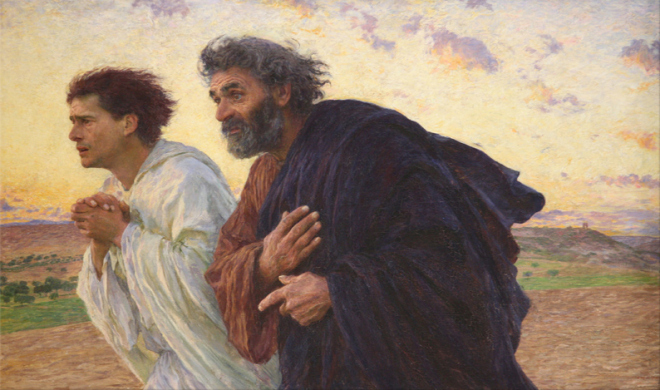
The Parable of the Good Samaritan by Eugene Burnand

Who Is My Neighbour? (Luke 10:25-37)
10:25-37 Look you—an expert in the law stood up and asked Jesus a test question. “Teacher,” he said, “What is it I am to do to become the possessor of eternal life?” He said to him, “What stands written in the law? How do you read?” He answered, “You must love the Lord your God with your whole heart, and with your whole mind, and your neighbour as yourself.” “Your answer is correct,” said Jesus. But he, wishing to put himself in the right, said to Jesus, “And who is my neighbour?” Jesus answered, “There was a man who went down from Jerusalem to Jericho. He fell amongst brigands who stripped him and laid blows upon him, and went away and left him half-dead. Now, by chance, a priest came down by that road. He looked at him and passed by on the other side. In the same way when a Levite came to the place he looked at him and passed by on the other side. A Samaritan who was on the road came to where he was. He looked at him and was moved to the depths of his being with pity. So he came up to him and bound up his wounds, pouring in wine and oil; and he put him on his own beast and brought him to an inn and cared for him. On the next day he put down 10p and gave it to the innkeeper. ‘Look after him,’ he said, ‘and whatever more you are out of pocket, when I come back this way, I’ll square up with you in full.’ Which of these three, do you think, was neighbour to the man who fell into the hands of brigands?” He said, “He who showed mercy on him.” “Go,” said Jesus to him, “and do likewise.”**


good samaritan1

The Parable of the Good Samaritan by Eugene Burnand

First, let us look at the scene of this story. The road from Jerusalem to Jericho was a notoriously dangerous road. Jerusalem is 2,300 feet above sea-level; the Dead Sea, near which Jericho stood, is 1,300 feet below sea-level. So then, in somewhat less than 20 miles, this road dropped 3,600 feet. It was a road of narrow, rocky deifies, and of sudden turnings which made it the happy hunting-ground of brigands. In the fifth century Jerome tells us that it was still called “The Red, or Bloody Way.” In the 19th century it was still necessary to pay safety money to the local Sheiks before one could travel on it. As late as the early 1930’s, H. V. Morton tells us that he was warned to get home before dark, if he intended to use the road, because a certain Abu Jildah was an adept at holding up cars and robbing travellers and tourists, and escaping to the hills before the police could arrive. When Jesus told this story, he was telling about the kind of thing that was constantly happening on the Jerusalem to Jericho road.
Second, let us look at the characters.
(a) There was the traveler. He was obviously a reckless and foolhardy character. People seldom attempted the Jerusalem to Jericho road alone if they were carrying goods or valuables. Seeking safety in numbers, they traveled in convoys or caravans. This man had no one but himself to blame for the plight in which he found himself.
(b) There was the priest. He hastened past. No doubt he was remembering that he who touched a dead man was unclean for seven days (Numbers 19:11). He could not be sure but he feared that the man was dead; to touch him would mean losing his turn of duty in the Temple; and he refused to risk that. He set the claims of ceremonial above those of charity. The Temple and its liturgy meant more to him than the pain of man.
(c) There was the Levite. He seems to have gone nearer to the man before he passed on. The bandits were in the habit of using decoys. One of their number would act the part of a wounded man; and when some unsuspecting traveller stopped over him, the others would rush upon him and overpower him. The Levite was a man whose motto was, “Safety first.” He would take no risks to help anyone else.
(d) There was the Samaritan. The listeners would obviously expect that with his arrival the villain had arrived. He may not have been racially a Samaritan at all. The Jews had no dealings with the Samaritans and yet this man seems to have been a kind of commercial traveler who was a regular visitor to the inn. In John 8:48 the Jews call Jesus a Samaritan. The name was sometimes used to describe a man who was a heretic and a breaker of the ceremonial law. Perhaps this man was a Samaritan in the sense of being one whom all orthodox good people despised.
We note two things about him.
(i) His credit was good! Clearly the innkeeper was prepared to trust him. He may have been theologically unsound, but he was an honest man.
(ii) He alone was prepared to help. A heretic he may have been, but the love of God was in his heart. It is no new experience to find the orthodox more interested in dogmas than in help and to find the man the orthodox despise to be the one who loves his fellow-men. In the end we will be judged not by the creed we hold but by the life we live.
Third, let us look at the teaching of the parable. The scribe who asked this question was in earnest. Jesus asked him what was written in the law, and then said, “How do you read?” Strict orthodox Jews wore round their wrists little leather boxes called phylacteries, which contained certain passages of scripture—Ex 13:1-10; Exo 13:11-16; Deut 6:4-9; Deut 11:13-20. “You will love the Lord your God” is from Deut 6:4 and Deut 11:13. So Jesus said to the scribe, “Look at the phylactery on your own wrist and it will answer your question.” To that the scribes added Lev 19:18, which bids a man love his neighbour as himself; but with their passion for definition the Rabbis sought to define who a man’s neighbour was; and at their worst and their narrowest they confined the word neighbour to their fellow Jews. For instance, some of them said that it was illegal to help a gentile woman in her sorest time, the time of childbirth, for that would only have been to bring another gentile into the world. So then the scribe’s question, “Who is my neighbour?” was genuine.
Jesus’ answer involves three things.good samaritan3
(i) We must help a man even when he has brought his trouble on himself, as the traveller had done.
(ii) Any man of any nation who is in need is our neighbour. Our help must be as wide as the love of God.
(iii) The help must be practical and not consist merely in feeling sorry. No doubt the priest and the Levite felt a pang of pity for the wounded man, but they did nothing. Compassion, to be real, must issue in deeds.
What Jesus said to the scribe, he says to us—”Go you and do the same.”

Gospel of Luke, Barclay’s Daily Study Bible (NT).

** William Barclay’s translation.

Parable of the Barren Fig Tree—William Barclay


Barren fig tree

The Barren Fig Tree—Eugene Burnand

Gospel of the Other Chance and Threat of the Last Chance (Luke 13:6-9)
Jesus spoke this parable, “A man had a fig-tree planted in his vineyard. He came looking for fruit on it and did not find it. He said to the keeper of the vineyard, ‘Look you—for the last three years I have been coming and looking for fruit on this fig-tree, and I still am not finding any. Cut it down! Why should it use up the ground’ ‘Lord,’ he answered him, ‘let it be this year too, until I dig round about it and manure it, and if it bears fruit in the coming year, well and good; but if not, you will cut it down.'”**
Here is a parable at one and the same time lit by grace and close packed with warnings.
(i) The fig-tree occupied a specially favoured position. It was not unusual to see fig-trees, thorn-trees and apple-trees in vineyards. The soil was so shallow and poor that trees were grown wherever there was soil to grow them; but the fig-tree had a more than average chance; and it had not proved worthy of it. Repeatedly, directly and by implication, Jesus reminded men that they would be judged according to the opportunities they had. C. E. M. Joad once said, “We have the powers of gods and we use them like irresponsible schoolboys.” Never was a generation entrusted with so much as ours and, therefore, never was a generation so answerable to God.
(ii) The parable teaches that uselessness invites disaster. It has been claimed that the whole process of evolution in this world is to produce useful things, and that what is useful will go on from strength to strength, while what is useless will be eliminated. The most searching question we can be asked is, “Of what use were you in this world?”
(iii) Further, the parable teaches that nothing which only takes out can survive. The fig-tree was drawing strength and sustenance from the soil; and in return was producing nothing. That was precisely its sin. In the last analysis, there are two kinds of people in this world—those who take out more than they put in, and those who put in more than they take out.
In one sense we are all in debt to life. We came into it at the peril of someone else’s life; and we would never have survived without the care of those who loved us. We have inherited a Christian civilization and a freedom which we did not create. There is laid on us the duty of handing things on better than we found them.
“Die when I may,” said Abraham Lincoln, “I want it said of me that I plucked a weed and planted a flower wherever I thought a flower would grow.” Once a student was being shown bacteria under the microscope. He could actually see one generation of these microscopic living things being born and dying and another being born to take its place. He saw, as he had never seen before, how one generation succeeds another. “After what I have seen,” he said, “I pledge myself never to be a weak link.”
If we take that pledge we will fulfil the obligation of putting into life at least as much as we take out.
(iv) The parable tells us of the gospel of the second chance. A fig-tree normally takes three years to reach maturity. If it is not fruiting by that time it is not likely to fruit at all. But this fig-tree was given another chance.
It is always Jesus’ way to give a man chance after chance. Peter and Mark and Paul would all gladly have witnessed to that. God is infinitely kind to the man who falls and rises again.
(v) But the parable also makes it quite clear that there is a final chance. If we refuse chance after chance, if God’s appeal and challenge come again and again in vain, the day finally comes, not when God has shut us out, but when we by deliberate choice have shut ourselves out. God save us from that!
Gospel of Luke, Barclay’s Daily Study Bible (NT).

** William Barclay’s own translation.

Through the house the child would shout ‘Abba!’—William Barclay


James Ross Kelly's avatarSt. John One: One

William Barclay 1907-1978 William Barclay 1907-1978

Like most people brought up in an evangelical home I did not at first know that there was any other way of thinking of the Atonement except in terms of God laying on Jesus the punishment that should have been laid on me… It seemed to me that the whole conception starts from the wrath of God, while the New Testament starts from the love of God. It was because he so loved the world that God sent his Son into the world (John 3:16). It was his love that God showed to us in the death of Christ for us while we were still sinners (Romans 5:8). Never in the New Testament, never once, is God said to be reconciled to man; it is always man who is reconciled to God. We plead with you, says Paul, on behalf of Christ, be…

View original post 852 more words

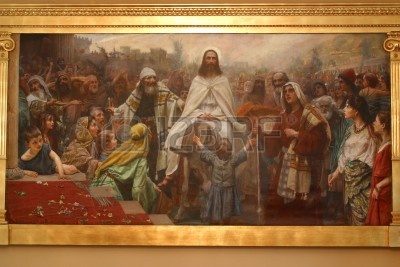
Palm Sunday–Triumphal Entry! by William Barclay


6580492-jesus-on-palm-sundayThe Beginning of the Last Act (Matt 21:1-11)
21:1-11 When they had come near to Jerusalem, and when they had come to Bethphage, to the Mount of Olives, then Jesus sent on two disciples ahead. “Go into the village which is facing you,” he said, “and immediately you will find an ass tethered, and a colt with her. Loose them, and bring them to me. And, if anyone says anything to you, say, ‘The Master needs them.’ Immediately he will send them on.” This was done that there might be fulfilled that which was spoken through the prophet, when he said, “Say to the daughter of Sion, Look you, your king comes to you, gentle, and riding upon an ass, and a colt, the foal of a beast who bears the yoke.” So the disciples went, and they carried out Jesus’ orders, and they brought the ass and the colt, and put their cloaks upon them; and he took his seat on them. The very large crowd spread their cloaks on the road. Others cut down branches from the trees and strewed them on the road; and the crowds who went in front and followed behind kept shouting, “Hosanna to the Son of David! Blessed in the name of the Lord is he who comes. Hosanna in the highest!” As he entered Jerusalem, the whole city was shaken. “Who is this?” they asked; and the crowds said, “This is the prophet, Jesus, who comes from Nazareth in Galilee.”

William Barclay 1907-1978

William Barclay 1907-1978

With this passage we embark on the last act in the drama of the life of Jesus; and here indeed is a dramatic moment.
It was the Passover time, and Jerusalem and the whole surrounding neighbourhood was crowded with pilgrims. Thirty years later a Roman governor was to take a census of the lambs slain in Jerusalem for the Passover and find that the number was not far off a quarter of a million. It was the Passover regulation that there must be a party of a minimum of ten for each lamb which means that at that Passover time more than two and a half million people had crowded their way into Jerusalem. The law was that every adult male Jew who lived within twenty miles of Jerusalem must come to the Passover; but not only the Jews of Palestine, Jews from every corner of the world made their way to the greatest of their national festivals. Jesus could not have chosen a more dramatic moment; it was into a city surging with people keyed up with religious expectations that he came.
Nor was this a sudden decision of Jesus, taken on the moment. It was something which he had prepared in advance. The whole tone of the story shows that he was carrying out plans which he had made ahead. He sent his disciples into “the village” to collect the ass and her foal. Matthew mentions Bethphage only (the pronunciation is not Bethphage with the age as in the English word page; the “e” at the end is pronounced as “ae”; the word is Bethphagae). But Mark also mentions Bethany (Mk 11:1). No doubt the village was Bethany. Jesus had already arranged that the ass and her foal should be waiting for him, for he must have had many friends in Bethany; and the phrase, “The Master needs them,” was a password by which their owner would know that the hour which Jesus had arranged had come.
So Jesus rode into Jerusalem. The fact that the ass had never been ridden before made it specially suitable for sacred purposes. The red heifer which was used in the ceremonies of cleansing must be a beast “upon which a yoke has never come” (Num 19:2; Deut 21:3); the cart on which the ark of the Lord was carried had to be a vehicle which had never been used for any other purpose (1 Sam 6:7). The special sacredness of the occasion was underlined by the fact that the ass had never been ridden by any man before.
The crowd received Jesus like a king. They spread their cloaks in front of him. That is what his friends had done when Jehu was proclaimed king (2 Ki 9:13). They cut down and waved the palm branches. That is what they did when Simon Maccabaeus entered Jerusalem after one of his most notable victories (1 Macc 13:51).
They greeted him as they would greet a pilgrim, for the greeting: “Blessed be he who enters in the name of the Lord” (Ps 118:26) was the greeting which was addressed to pilgrims as they came to the Feast.
They shouted “Hosanna!” We must be careful to see what this word means. Hosanna means Save now! and it was the cry for help which a people in distress addressed to their king or their god. It is really a kind of quotation from Ps 118:25: “Save us, we beseech Thee, O Lord.” The phrase, “Hosanna in the highest!” must mean, “Let even the angels in the highest heights of heaven cry unto God, Save now!”
It may be that the word hosanna had lost some of its original meaning; and that it had become to some extent only a cry of welcome and of acclamation, like “Hail!”; but essentially it is a people’s cry for deliverance and for help in the day of their trouble; it is an oppressed people’s cry to their saviour and their king.
Barclay’s Daily Study Bible (NT).

Who Is My Neighbour? (Luke 10:25-37)—William Barclay


Who Is My Neighbour? (Luke 10:25-37)

10:25-37 —an expert in the law stood up and asked Jesus a test question. “Teacher,” he said, “What is it I am to do to become the possessor of eternal life?” He said to him, “What stands written in the law? How do you read?” He answered, “You must love the Lord your God with your whole heart, and with your whole mind, and your neighbour as yourself.” “Your answer is correct,” said Jesus. But he, wishing to put himself in the right, said to Jesus, “And who is my neighbour?” Jesus answered, “There was a man who went down from Jerusalem to Jericho. He fell amongst brigands who stripped him and laid blows upon him, and went away and left him half-dead. Now, by chance, a priest came down by that road. He looked at him and passed by on the other side. In the same way when a Levite came to the place he looked at him and passed by on the other side. A Samaritan who was on the road came to where he was. He looked at him and was moved to the depths of his being with pity. So he came up to him and bound up his wounds, pouring in wine and oil; and he put him on his own beast and brought him to an inn and cared for him. On the next day he put down 10p and gave it to the innkeeper. ‘Look after him,’ he said, ‘and whatever more you are out of pocket, when I come back this way, I’ll square up with you in full.’ Which of these three, do you think, was neighbour to the man who fell into the hands of brigands?” He said, “He who showed mercy on him.” “Go,” said Jesus to him, “and do likewise.”

William Barclay 1907-1978

William Barclay 1907-1978

First, let us look at the scene of this story. The road from Jerusalem to Jericho was a notoriously dangerous road. Jerusalem is 2,300 feet above sea-level; the Dead Sea, near which Jericho stood, is 1,300 feet below sea-level. So then, in somewhat less than 20 miles, this road dropped 3,600 feet. It was a road of narrow, rocky deifies, and of sudden turnings which made it the happy hunting-ground of brigands. In the fifth century Jerome tells us that it was still called “The Red, or Bloody Way.” In the 19th century it was still necessary to pay safety money to the local Sheiks before one could travel on it. As late as the early 1930’s, H. V. Morton tells us that he was warned to get home before dark, if he intended to use the road, because a certain Abu Jildah was an adept at holding up cars and robbing travellers and tourists, and escaping to the hills before the police could arrive. When Jesus told this story, he was telling about the kind of thing that was constantly happening on the Jerusalem to Jericho road.

Second, let us look at the characters.

(a) There was the traveller. He was obviously a reckless and foolhardy character. People seldom attempted the Jerusalem to Jericho road alone if they were carrying goods or valuables. Seeking safety in numbers, they travelled in convoys or caravans. This man had no one but himself to blame for the plight in which he found himself.

(b) There was the priest. He hastened past. No doubt he was remembering that he who touched a dead man was unclean for seven days (Num 19:11). He could not be sure but he feared that the man was dead; to touch him would mean losing his turn of duty in the Temple; and he refused to risk that. He set the claims of ceremonial above those of charity. The Temple and its liturgy meant more to him than the pain of man.

(c) There was the Levite. He seems to have gone nearer to the man before he passed on. The bandits were in the habit of using decoys. One of their number would act the part of a wounded man; and when some unsuspecting traveller stopped over him, the others would rush upon him and overpower him. The Levite was a man whose motto was, “Safety first.” He would take no risks to help anyone else.

(d) There was the Samaritan. The listeners would obviously expect that with his arrival the villain had arrived. He may not have been racially a Samaritan at all. The Jews had no dealings with the Samaritans and yet this man seems to have been a kind of commercial traveller who was a regular visitor to the inn. In Jn 8:48 the Jews call Jesus a Samaritan. The name was sometimes used to describe a man who was a heretic and a breaker of the ceremonial law. Perhaps this man was a Samaritan in the sense of being one whom all orthodox good people despised.

We note two things about him.

(i) His credit was good! Clearly the innkeeper was prepared to trust him. He may have been theologically unsound, but he was an honest man.

(ii) He alone was prepared to help. A heretic he may have been, but the love of God was in his heart. It is no new experience to find the orthodox more interested in dogmas than in help and to find the man the orthodox despise to be the one who loves his fellow-men. In the end we will be judged not by the creed we hold but by the life we live.

Third, let us look at the teaching of the parable. The scribe who asked this question was in earnest. Jesus asked him what was written in the law, and then said, “How do you read?” Strict orthodox Jews wore round their wrists little leather boxes called phylacteries, which contained certain passages of scripture—Ex 13:1-10; Exo 13:11-16; Deut 6:4-9; Deut 11:13-20. “You will love the Lord your God” is from Deut 6:4 and Deut 11:13. So Jesus said to the scribe, “Look at the phylactery on your own wrist and it will answer your question.” To that the scribes added Lev 19:18, which bids a man love his neighbour as himself; but with their passion for definition the Rabbis sought to define who a man’s neighbour was; and at their worst and their narrowest they confined the word neighbour to their fellow Jews. For instance, some of them said that it was illegal to help a gentile woman in her sorest time, the time of childbirth, for that would only have been to bring another gentile into the world. So then the scribe’s question, “Who is my neighbour?” was genuine.

Jesus’ answer involves three things.

(i) We must help a man even when he has brought his trouble on himself, as the traveller had done.

(ii) Any man of any nation who is in need is our neighbour. Our help must be as wide as the love of God.

(iii) The help must be practical and not consist merely in feeling sorry. No doubt the priest and the Levite felt a pang of pity for the wounded man, but they did nothing. Compassion, to be real, must issue in deeds.

What Jesus said to the scribe, he says to us—”Go you and do the same.”

Barclay’s Daily Study Bible (NT).

Through the house the child would shout ‘Abba!’—William Barclay


William Barclay 1907-1978

William Barclay 1907-1978

Like most people brought up in an evangelical home I did not at first know that there was any other way of thinking of the Atonement except in terms of God laying on Jesus the punishment that should have been laid on me… It seemed to me that the whole conception starts from the wrath of God, while the New Testament starts from the love of God. It was because he so loved the world that God sent his Son into the world (John 3:16). It was his love that God showed to us in the death of Christ for us while we were still sinners (Romans 5:8). Never in the New Testament, never once, is God said to be reconciled to man; it is always man who is reconciled to God. We plead with you, says Paul, on behalf of Christ, be reconciled to God (2 Corinthians 5:20).

Slowly it began to dawn on me that apart from the love of God there would have been no Atonement at all. And then I began to see this tremendous thing, the fact that Jesus came, not to change God’s attitude to men, but to demonstrate God’s attitude to men, to show men at the cost of the Cross what God is like. And then still later when I had to study the New Testament, I came to see that this is precisely what John is saying [John 1:14] — and what a difference! The God of terror became the God of love. It became the most natural thing in the world to seek the presence of God instead of running away from God.

Let us see this difference in operation. I have written of this again and again because I do not think that it can be stated too often. First of all, let us see the thing in Judaism. The angel of the Lord came to Manoah and his wife to tell them that their son Samson was to be born, and when Manoah realized who their heavenly visitor had been he said in terror: ‘We shall surely die, for we have seen God’ (Judg. 13:22). In Judaism to see God was, so they believed, [would be] to die. Now let us turn to the New Testament. No one has seen God; it is the only Son who has revealed Him (John 1:18). And revealed him as what? ‘He who has seen me has seen the Father’ (John 14:9). And in what sense? Jesus called God Abba  (Mark 14:36). It is but that name that we too may call God, that we are invited to call him, says Paul (Rom.8:15; Gal. 4:6). And what does this word Abba mean? Abba is the word—to this day—by which a little Jewish boy or girl addresses his father in the home circle, in the family. Through the house the child would shout ‘Abba!’—Daddy.

Second, let us take the early Greek conception of God. In the old Greek mythology Prometheus was the supreme benefactor of man; he instructed man in architecture, astronomy, mathematics, writing, rearing cattle, navigation, medicine, the art of prophecy, working in metal and in every other art. The myth said that Prometheus had made man of clay, and, to give his clay life, [Prometheus] stole fire from heaven to put into it. The result was that Zeus chained him to a rock in the middle of the ocean and prepared a vulture to tear out his liver, which grew again each night to be torn out again each day. The gods grudged man everything, and any god who became a benefactor of men incurred the divine wrath in its most savage manifestation. What a difference between that and the God and Father of our Lord Jesus Christ!

Third, let us take the conception of the God of Greek philosophy with the New Testament. Both the great school of philosophy, the Stoics and the Epicureans, held that the supreme good in life is ataraxia, which means serenity. If that is true for man, how much more must it be true of God? In order to provide God with this ataraxia, the held that God must have apatheia. Apatheia is not apathy in the sense of indifference; it is the complete inability to feel anything at all. The being who has apatheia cannot know love or hate, but remains forever completely insulated against all feeling. If anyone can cause us sorrow or joy, it means that for that moment that person is greater than we are, because that person can have some influence over us. So the way to complete serenity is insulation against all feeling. When the countess of Lyttelton’s husband died, J. M. Barrie wrote to her: ‘If you had cared for him less, if he had been less worth caring for, the road would be less heavy-going. Joy has to be paid for.’ Sorrow is the price of love. If we never allowed ourselves to care for any one then there would be no such thing as sorrow. So the Greeks conceived of a God who essentially was unable to care. What a difference from the God who so loved the world,  from the Jesus who could be moved with compassion, who wept! The difference between the apathetic Greek God and the Christian God of love is as wide as infinity.

I believe in Jesus, because it is only through Jesus that I know God as the Friend and Father, in whose presence I can be at home without fear, as a child with his father.

[from William Barclay: A Spiritual Autobiography, pg 51-54, William B Eerdmans Publishing Company, Grand Rapids, 1975.]

Professor of Divinity and Biblical Criticism at Glasgow University and the author of many Biblical commentaries and books, including a translation of the New Testament, Barclay New Testament, and The Daily Study Bible Series.

Logos — The Eternal Word—William Barclay


From  The Daily Bible Study Series

The Gospel of John Volume 1

by William Barclay

(John 1:1-2)
1:1-2 When the world had its beginning, the word was already there; and the word was with God; and the word was God. This word was in the beginning with God.

William Barclay 1907-1978

William Barclay 1907-1978

The beginning of John’s gospel is of such importance and of such depth of meaning that we must study it almost verse by verse.* It is John’s great thought that Jesus is none other than God’s creative and life-giving and light-giving word, that Jesus is the power of God which created the world and the reason of God which sustains the world come to earth in human and bodily form.
Here at the beginning John says three things about the Word; which is to say that he says three things about Jesus.
(i) The Word was already there at the very beginning things. John’s thought is going back to the first verse of the Bible. “In the beginning God created the heavens and the earth” (Gen 1:1). What John is saying is this—the Word is not one of the created things; the Word was there before creation.The Word is not part of the world which came into being in time; the Word is part of eternity and was there with God before time and the world began. John was thinking of what is known as the preexistence of Christ.
In many ways this idea of preexistence is very difficult, if not altogether impossible, to grasp. But it does mean one very simple, very practical, and very tremendous thing. If the Word was with God before time began, if God’s Word is part of the eternal scheme of things, it means that God was always like Jesus. Sometimes we tend to think of God as stern and avenging; and we tend to think that something Jesus did changed God’s anger into love and altered his attitude to men. The New Testament knows nothing of that idea. The whole New Testament tells us, this passage of John especially, that God has always been like Jesus. What Jesus did was to open a window in time that we might see the eternal and unchanging love of God.
We may well ask, “What then about some of the things that we read in the Old Testament? What about the passages which speak about commandments of God to wipe out whole cities and to destroy men, women and children? What of the anger and the destructiveness and the jealousy of God that we sometimes read of in the older parts of Scripture?” The answer is this—it is not God who has changed; it is men’s knowledge of him that has changed. Men wrote these things because they did not know any better; that was the stage which their knowledge of God had reached.
When a child is learning any subject, he has to learn it stage by stage. He does not begin with full knowledge; he begins with what he can grasp and goes on to more and more. When he begins music appreciation, he does not start with a Bach Prelude and Fugue; he starts with something much more simple; and goes through stage after stage until his knowledge grows. It was that way with men and God. They could only grasp and understand God’s nature and his ways in part. It was only when Jesus came that they saw fully and completely what God has always been like.
It is told that a little girl was once confronted with some of the more bloodthirsty and savage parts of the Old Testament. Her comment was: “But that happened before God became a Christian!” If we may so put it with all reverence, when John says that the Word was always there, he is saying that God was always a Christian. He is telling us that God was and is and ever shall be like Jesus; but men could never know and realize that until Jesus came.
(ii) John goes on to say that the Word was with God. What does he mean by that? He means that always there has been the closest connection between the Word and God. Let us put that in another and a simpler way—there has always been the most intimate connection between Jesus and God. That means no one can tell us what God is like, what God’s will is for us, what God’s love and heart and mind are like, as Jesus can.
Let us take a simple human analogy. If we want to know what someone really thinks and feels about something, and if we are unable to approach the person ourselves, we do not go to someone who is merely an acquaintance of that person, to someone who has known him only a short time; we go to someone whom we know to be an intimate friend of many years’ standing. We know that he will really be able to interpret the mind and the heart of the other person to us.
It is something like that that John is saying about Jesus. He is saying that Jesus has always been with God. Let us use very human language because it is the only language we can use. John is saying that Jesus is so intimate with God that God has no secrets from him; and that, therefore, Jesus is the one person in all the universe who can reveal to us what God is like and how God feels towards us.
(iii) Finally John says that the Word was God. This is a difficult saying for us to understand, and it is difficult because Greek, in which John wrote, had a different way of saying things from the way in which English speaks. When Greek uses a noun it almost always uses the definite article with it. The Greek for God is theos  and the definite article is  ho. When Greek speaks about God it does not simply say theos; it says ho theos. Now when Greek does not use the definite article with a noun that noun becomes much more like an adjective. John did not say that the Word was ho  theos ; that would have been to say that the Word was identical with God. He said that the Word was theos—without the definite article—which means that the Word was, we might say, of the very same character and quality and essence and being as God. When John said the Word was God he was not saying that Jesus was identical with God; he was saying that Jesus was so perfectly the same as God in mind, in heart, in being that in him we perfectly see what God is like.
So right at the beginning of his Gospel John lays it down that in Jesus, and in him alone, there is perfectly revealed to men all that God always was and always will be, and all that he feels towards and desires for men.

[*italics of the 1955 edition restored but not text, which differs slightly]

“..whatever the world is like, God has not abandoned it.” William Barclay on Matthew 24


The Day Of The Lord (Matt 24:6-8,29-31)

24:6-8,29-31 “You will hear of wars and reports of wars. See that you are not disturbed; for these things must happen; for the end is not yet. For nation shall rise against nation, and kingdom against kingdom, and there will be famines and earthquakes in various places.

“Immediately after the affliction of these days the sun will be darkened, and the moon will not give her light, and the stars will fall from heaven, and the powers of heaven will be shaken. Then there will appear the sign of the Son of Man in heaven. And then all the tribes of the earth will lament, and they will see the Son of Man coming in the clouds of heaven with power and much glory. And he will send his angels with a great trumpet call, and they will gather the elect from the four winds, from one boundary of heaven to the other.” [RSV]

William Barclay 1907-1978

William Barclay 1907-1978

“… an essential part of the Jewish thought of the future was the Day of the Lord that day when God was going to intervene directly in history, and when the present age, with all its incurable evil, would begin to be transformed into the age to come.

Very naturally the New Testament writers to a very great extent identified the Second Coming of Jesus and the Day of the Lord; and they took over all the imagery which had to do with the Day of the Lord and applied them to the Second Coming. None of these pictures is to be taken literally; they are pictures, and they are visions; they are attempts to put the indescribable into human words and to find some kind of picture for happenings for which human language has no picture.

But from all these pictures there emerge certain great truths.

(i) They tell us that God has not abandoned the world; for all its wickedness, the world is still the scene in which God’s purpose is being worked out. It is not abandonment that God contemplates; it is intervention.

(ii) They tell us that even a very crescendo of evil must not discourage us. An essential part of the Jewish picture of the Day of the Lord is that a complete breakdown of all moral standards and an apparent complete disintegration of the world must precede it. But, for all that, this is not the prelude to destruction; it is the prelude to recreation.

(iii) They tell us that both judgment and a new creation are certain. They tell us that God contemplates the world both in justice and in mercy; and that God’s plan is not the obliteration of the world, but the creation of a world which is nearer to his heart’s desire.

The value of these pictures is not in their details, which at best are only symbolic and which use the only pictures which the minds of men could conceive, but in the eternal truth which they conserve; and the basic truth in them is that, whatever the world is like, God has not abandoned it.”

William Barclay, Gospel of Matthew Vol. 2 p. 308-309