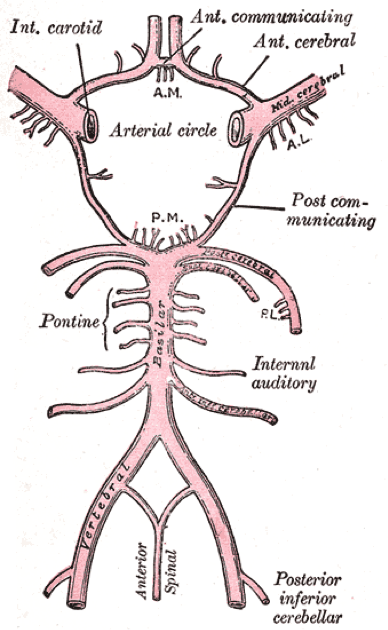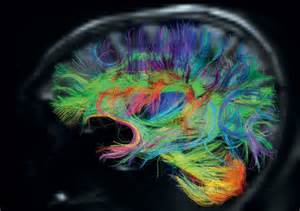
..the human brain (the most ‘centro-complex’ organism yet achieved to our knowledge in the universe)..
from an Essay, “Turmoil or Genesis?” by
Pierre Teilhard de Chardin, in The Future of Man. 1969 Harper Torchbook, pp 228-228
..the human brain (the most ‘centro-complex’ organism yet achieved to our knowledge in the universe)..
from an Essay, “Turmoil or Genesis?” by
Pierre Teilhard de Chardin, in The Future of Man. 1969 Harper Torchbook, pp 228-228
 This sketch of the human story began in a cave; the cave which popular science associates with the cave-man and in which practical discovery has really found archaic drawings of animals. The second half of human history, which was like a new creation of the world, also begins in a cave. There is even a shadow of such a fancy in the fact that animals were again present; for it was a cave used as a stable by the mountaineers of the uplands about Bethlehem; who still drive their cattle into such holes and caverns at night. It was here that a homeless couple had crept underground with the cattle when the doors of the crowded caravanserai had been shut in their faces; and it was here beneath the very feet of the passers-by, in a cellar under the very floor of the world, that Jesus Christ was born. But in that second creation there was indeed something symbolical in the roots of the primeval rock or the horns of the prehistoric herd. God also was a Cave-Man, and had also traced strange shapes of creatures, curiously coloured, upon the wall of the world; but the pictures that he made had come to life.
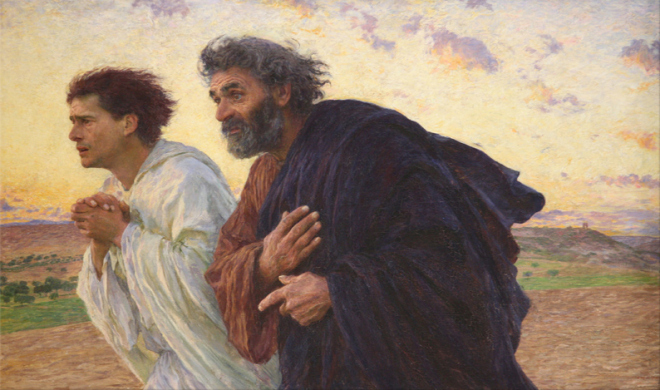
A mass of legend and literature, which increases and will never end, has repeated and rung the changes on that single paradox; that the hands that had made the sun and stars were too small to reach the huge heads of the cattle. Upon this paradox, we might almost say upon this jest, all the literature of our faith is founded. It is at least like a jest in this, that it is something which the scientific critic cannot see. He laboriously explains the difficulty which we have always defiantly and almost derisively exaggerated; and mildly condemns as improbable something that we have almost madly exalted as incredible; as something that would be much too good to be true, except that it is true. When that contrast between the cosmic creation and the little local infancy has been repeated, reiterated, underlined, emphasised, exulted in, sung, shouted, roared, not to say howled, in a hundred thousand hymns, carols, rhymes, rituals, pictures, poems, and popular sermons, it may be suggested that we hardly need a higher critic to draw our attention to something a little odd about it; especially one of the sort that seems to take a long time to see a joke, even his own joke. But about this contrast and combination of ideas one thing may be said here, because it is relevant to the whole thesis of this book. The sort of modern critic of whom I speak is generally much impressed with the importance of education in life and the importance of psychology in education. That sort of man is never tired of telling us that first impressions fix character by the law of causation; and he will become quite nervous if a child’s visual sense is poisoned by the wrong colours on a golliwog or his nervous system prematurely shaken by a cacophonous rattle. Yet he will think us very narrow-minded, if we say that this is exactly why there really is a difference between being brought up as a Christian and being brought up as a Jew or a Moslem or an atheist. The difference is that every Catholic child has learned from pictures, and even every Protestant child from stories, this incredible combination of contrasted ideas as one of the very first impressions on his mind. It is not merely a theological difference. It is a psychological difference which can outlast any theologies. It really is, as that sort of scientist loves to say about anything, incurable. Any agnostic or atheist whose childhood has known a real Christmas has ever afterwards, whether he likes it or not, an association in his mind between two ideas that most of mankind must regard as remote from each other; the idea of a baby and the idea of unknown strength that sustains the stars. His instincts and imagination can still connect them, when his reason can no longer see the need of the connection ; for him there will always be some savour of religion about the mere picture of a mother and a baby; some hint of mercy and softening about the mere mention of the dreadful name of God. But the two ideas are not naturally or necessarily combined. They would not be necessarily combined for an ancient Greek or a Chinaman, even for Aristotle or Confucius. It is no more inevitable to connect God with an infant than to connect gravitation with a kitten. It has been created in our minds by Christmas because we are Christians, because we are psychological Christians even when we are not theological ones. In other words, this combination of ideas has emphatically, in the much disputed phrase, altered human nature. There is really a difference between the man who knows it and the man who does not. It may not be a difference of moral worth, for the Moslem or the Jew might be worthier according to his lights; but it is a plain fact about the crossing of two particular lights, the conjunction of two stars in our particular horoscope. Omnipotence and impotence, or divinity and infancy, do definitely make a sort of epigram which a million repetitions cannot turn into a platitude. It is not unreasonable to call it unique. Bethlehem is emphatically a place where extremes meet.
Chesterton, G. K. (2012-12-19). Everlasting Man (Kindle Locations 2461-2496). . Kindle Edition.

The philosopher David Hume (1711– 76) is perhaps best known today for his skepticism about religion. Yet he was equally skeptical about the mechanistic philosophy of nature. There was nothing in the universe to prove that it was more like a machine than an organism; the organization we see in nature was more analogous to plants and animals than to machines. Hume was against the idea of a machine-designing God, and suggested instead that the world could have originated from something like a seed or an egg. In Hume’s words, published posthumously in 1779, “There are other parts of the universe (besides the machines of human invention) which bear still a greater resemblance to the fabric of the world, and which, therefore, afford a better conjecture concerning the universal origin of the system. These parts are animals and plants. The world plainly resembles more an animal or a vegetable, than…
View original post 478 more words

 St. John One: One