The light would scatter and travel in all directions through the darkness–Thomas Merton


JCFRMSHIn the cool darkness of the spring night the priest and his ministers gather outside the door of the empty Church. The “new fire,” struck from flint, is enkindled and blessed. From this new fire the Paschal Candle will be lit. The marvelous Exsultet will then be sung, proclaiming the full meaning of the Easter mystery. Flame will be taken from the great candle, and multiplied throughout the building in all the different hanging lamps, and on the altar candles. As Mass is being prepared, “prophecies” will be chanted from various books of the Old Testament, showing how the types and figures hidden in the obscurity of the Old Law, have been brought to light in the glory of the resurrection. Each prophecy kindles a mystical light in the listening Church. This is a feast of light, a feast of life, celebrating not merely a past event but the present existential reality of the redemptive fact by which Christ communicates His life to us and unites us to Himself in one spirit.

Animate and inanimate creation join with the Church in her feast. Not only men are present to solemnize the mystery, but angelic spirits join with them in the liturgical celebration. The texts that are chanted, the prayers and blessings, are the richest in the liturgical year. They are a compendium of theology—theology not merely studied, not merely meditated, but lived. Through the medium of the liturgy, the Word Himself, uncreated Truth, enters into our spirits and becomes our theology. The first voice that speaks in the silent night is the cold flint. Out of the flint springs fire. The fire, making no sound, is the most eloquent preacher on this night that calls for no other sermon than liturgical action and mystery. That spark should spring from cold rock, reminds us that the strength, the life of God, is always deeply buried in the substance

The light that leaps out of darkness, the fire that comes from stone, symbolizes Christ’s conquest of death. He, Who is the source of all life, could never remain in death, could not see corruption. Death is not a reality, but the absence of a reality. And in Him there is nothing unreal. The fire that springs from the stone speaks, then, of His reality springing from the alienated coldness of our dead hearts, of our souls that have forgotten themselves, that have been exiled from themselves and from their God—and have lost their way in death. But there is nothing lost that God cannot find again. Nothing dead that cannot live again in the presence of His Spirit. No heart so dark, so hopeless, that it cannot be enlightened and brought back to itself, warmed back to the life of charity.  

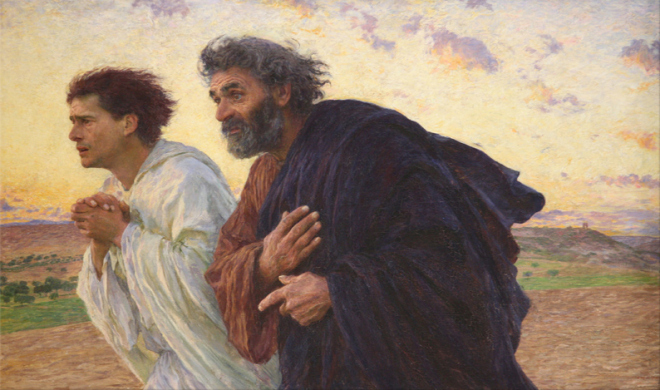
In the old days, on Easter night, the Russian peasants used to carry the blest fire home from Church. The light would scatter and travel in all directions through the darkness, and the desolation of the night would be pierced and dispelled as lamps came on in the windows of the farmhouses one by one. Even so the glory of God sleeps everywhere, ready to blaze out unexpectedly in created things. Even so His peace and His order lie hidden in the world, even the world of today, ready to reestablish themselves in His way, in His own good time: but never without the instrumentality of free options made by free men.

Merton, Thomas (1999-11-29). The New Man (Kindle Locations 2190-2215). Macmillan. Kindle Edition.

Thomas Merton— from Theology of Creativity


thomas merton

Excerpted from an essay which first  appeared in 1960 in  The American Benedictine Review. 

The creativity of the Christian person must be seen in relation to the creative vocation of the new Adam, mystical person of the “whole Christ.” The creative will of God has been at work in the cosmos since he said: “Let there be light.”  This creative fiat was not uttered merely at the dawn of time. All time and all history are a continued, uninterrupted creative act, a stupendous, ineffable mystery in which God has signified his will to associate man with himself in his work of creation. The will and power of the Almighty Father were not satisfied simply to make the world and turn it over to man to run it as best he could. The creative love of God was met, at first, by the destructive and self-centered recusal of man: an act of such incalculable consequences that it would have amounted to a destruction of God’s plan, if that were possible. But the creative work of God could not be frustrated by man’s sin. On the contrary, sin itself entered into the plan. If man was first called to share in the creative work of his heavenly Father, he now became involved in the “new creation,” the redemption of his own kind and the restoration of the cosmos, purified and transfigured, into the hands of the Father. God himself became man in order that in this way man could be most perfectly associated with him in this great work, the fullest manifestation of his eternal wisdom and mercy.

The Literary Essays of Thomas Merton,  New Directions

Cover of "The Literary Essays of Thomas M...

Cover via Amazon

from The Pursuit of God by A. W. Tozer (link at bottom for free Kindle addition)


 The Speaking Voice
In the beginning was the Word, and the Word was with God, and the Word was
God.
John 1:1

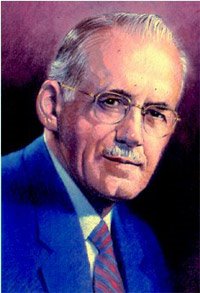
A.W. Tozer  (April 21, 1897 - May 12, 1963)

A.W. Tozer (April 21, 1897 – May 12, 1963)

An intelligent plain man, untaught in the truths of Christianity, coming upon this text, would likely conclude that John meant to teach that it is the nature of God to speak, to communicate His thoughts to others. And he would be right. A word is a medium by which thoughts are expressed, and the application of the term to the Eternal Son leads us to believe that self-expression is inherent in the Godhead, that God is forever seeking to speak Himself out to His creation. The whole Bible supports the idea. God is speaking. Not God spoke, but God is
speaking. He is by His nature continuously articulate. He fills the world with
His speaking Voice.
One of the great realities with which we have to deal is the Voice of God in His world. The briefest and only satisfying cosmogony is this: `He spake and it was done.’ The why of natural law is the living Voice of God immanent in His creation. And this word of God which brought all worlds into being cannot be understood to mean the Bible, for it is not a written or printed word at all,but the expression of the will of God spoken into the structure of all things.
This word of God is the breath of God filling the world with living
potentiality. The Voice of God is the most powerful force in nature, indeed the
only force in nature, for all energy is here only because the power-filled Word
is being spoken.
The Bible is the written word of God, and because it is written it is confined
and limited by the necessities of ink and paper and leather. The Voice of God,
however, is alive and free as the sovereign God is free. `The words that I speak
unto you, they are spirit, and they are life.’ The life is in the speaking
words. God’s word in the Bible can have power only because it corresponds to
God’s word in the universe. It is the present Voice which makes the written Word
all- powerful. Otherwise it would lie locked in slumber within the covers of a
book.
We take a low and primitive view of things when we conceive of God at the
creation coming into physical contact with things, shaping and fitting and
building like a carpenter. The Bible teaches otherwise: `By the word of the Lord
were the heavens made; and all the host of them by the breath of his mouth.
…For he spake, and it was done; he commanded, and it stood fast.’ (Ps 33:6,9)
`Through faith we understand that the worlds were framed by the word of God.’
(Heb 11:3) Again we must remember that God is referring ere not to His written
Word, but to His speaking Voice. His world-filling Voice is meant, that Voice
which antedates the Bible by uncounted centuries, that Voice which has not been
silent since the dawn of creation, but is sounding still throughout the full far
reaches of the universe.
The Word of God is quick and powerful. In the beginning He spoke to nothing, and
it became something. Chaos heard it and became order, darkness heard it and
became light. `And God said – – and it was so.’ (Gen 1:9) These twin phrases, as
cause and effect, occur throughout the Genesis story of the creation. The said
accounts for the so. The so is the said put into the continuous present. That
God is here and that He is speaking–these truths are back of all other Bible
truths; without them there could be no revelation at all. God did not write a
book and send it by messenger to be read at a distance by unaided minds. He
spoke a Book and lives in His spoken words, constantly speaking His words and
causing the power of them to persist across the years. God breathed on clay and
it became a man; He breathes on men and they become clay. `Return ye children of men,’ (Ps 90:3) was the word spoken at the Fall by which God decreed the death of every man, and no added word has He needed to speak. The sad procession of mankind across the face of the earth from birth to the grave is proof that His original Word was enough.

We have not given sufficient attention to that deep utterance in the Book of
John, `That was the true Light, which lighteth every man that cometh into the
world.’ (John 1:9) Shift the punctuation around as we will and the truth is
still there: the Word of God affects the hearts of all men as light in the soul.
In the hearts of all men the light shines, the Word sounds, and there is no
escaping them. Something like this would of necessity be so if God is alive and
in His world. And John says that it is so. Even those persons who have never
heard of the Bible have still been preached to with sufficient clarity to remove
every excuse from their hearts forever. `Which show the work of the law written
in their hearts, their conscience also bearing witness, and their thoughts the
mean while either accusing or else excusing one another.’ (Rom 2:15) `For the
invisible things of him from the creation of the world are clearly seen, being
understood by the things that are made, even his eternal power and Godhead; so
that they are without excuse.’ (Rom 1:20)
This universal Voice of God was by the ancient Hebrews often called Wisdom, and
was said to be everywhere sounding and searching throughout the earth, seeking
some response from the sons of men. The eighth chapter of the Book of Proverbs
begins, `Doth not wisdom cry? and understanding put forth her voice?’ The writer
then pictures wisdom as a beautiful woman standing `in the top of the high
places, by the way in the places of the paths.’ She sounds her voice from every
quarter so that no one may miss hearing it. `Unto you, O men, I call; and my
voice is to the sons of men.’ Then she pleads for the simple and the foolish to
give ear to her words. It is spiritual response for which this Wisdom of God is
pleading, a response which she has always sought and is but rarely able to
secure. The tragedy is that our eternal welfare depends upon our hearing, and we
have trained our ears not to hear.
This universal Voice has ever sounded, and it has often troubled men even when
they did not understand the source of their fears. Could it be that this Voice
distilling like a living mist upon the hearts of men has been the undiscovered
cause of the troubled conscience and the longing for immortality confessed by
millions since the dawn of recorded history? We need not fear to face up to
this. The speaking Voice is a fact. How men have reacted to it is for any
observer to note.
When God spoke out of heaven to our Lord, self-centered men who heard it
explained it by natural causes: they said, `It thundered.’ This habit of
explaining the Voice by appeals to natural law is at the very root of modern
science. In the living breathing cosmos there is a mysterious Something, too
wonderful, too awful [i.e. `awesome’] for any mind to understand. The believing
man does not claim to understand. He falls to his knees and whispers, `God.’ The
man of earth kneels also, but not to worship. He kneels to examine, to search,
to find the cause and the how of things. Just now we happen to be living in a
secular age. Our thought habits are those of the scientist, not those of the
worshipper. We are more likely to explain than to adore. `It thundered,’ we
exclaim, and go our earthly way. But still the Voice sounds and searches. The
order and life of the world depend upon that Voice, but men are mostly too busy
or too stubborn to give attention.
Everyone of us has had experiences which we have not been able to explain: a
sudden sense of loneliness, or a feeling of wonder or awe in the face of the
universal vastness. Or we have had a fleeting visitation of light like an
illumination from some other sun, giving us in a quick flash an assurance that
we are from another world, that our origins are divine. What we saw there, or
felt, or heard, may have been contrary to all that we had been taught in the
schools and at wide variance with all our former beliefs and opinions. We were
forced to suspend our acquired doubts while, for a moment, the clouds were
rolled back and we saw and heard for ourselves. Explain such things as we will,
I think we have not been fair to the facts until we allow at least the
possibility that such experiences may arise from the Presence of God in the
world and His persistent effort to communicate with mankind. Let us not dismiss
such an hypothesis too flippantly.
It is my own belief (and here I shall not feel bad if no one follows me) that
every good and beautiful thing which man has produced in the world has been the
result of his faulty and sin-blocked response to the creative Voice sounding
over the earth. The moral philosophers who dreamed their high dreams of virtue,
the religious thinkers who speculated about God and immortality, the poets and
artists who created out of common stuff pure and lasting beauty: how can we
explain them? It is not enough to say simply, `It was genius.’ What then is
genius? Could it be that a genius is a man haunted by the speaking Voice,
laboring and striving like one possessed to achieve ends which he only vaguely
understands? That the great man may have missed God in his labors, that he may
even have spoken or written against God does not destroy the idea I am
advancing. God’s redemptive revelation in the Holy Scriptures is necessary to
saving faith and peace with God. Faith in a risen Saviour is necessary if the
vague stirrings toward immortality are to bring us to restful and satisfying
communion with God. To me this is a plausible explanation of all that is best
outside of Christ. But you can be a good Christian and not accept my thesis.
The Voice of God is a friendly Voice. No one need fear to listen to it unless he
has already made up his mind to resist it. The blood of Jesus has covered not
only the human race but all creation as well. `And having made peace through the
blood of his cross, by him to reconcile all things unto himself; by him, I say,
whether they be things in earth, or things in heaven.’ (Col 1:20) We may safely
preach a friendly Heaven. The heavens as well as the earth are filled with the
good will of Him that dwelt in the bush (Ex. 3). The perfect blood of atonement
secures this forever.
Whoever will listen will hear the speaking Heaven. This is definitely not the
hour when men take kindly to an exhortation to listen, for listening is not
today a part of popular religion. We are at the opposite end of the pole from
there. Religion has accepted the monstrous heresy that noise, size, activity and
bluster make a man dear to God. But we may take heart. To a people caught in the tempest of the last great conflict God says, `Be still, and know that I am God,’
(Ps 46:10) and still He says it, as if He means to tell us that our strength and
safety lie not in noise but in silence.
It is important that we get still to wait on God. And it is best that we get
alone, preferably with our Bible outspread before us. Then if we will we may
draw near to God and begin to hear Him speak to us in our hearts. I think for
the average person the progression will be something like this: First a sound as
of a Presence walking in the garden. Then a voice, more intelligible, but still
far from clear. Then the happy moment when the Spirit begins to illuminate the
Scriptures, and that which had been only a sound, or at best a voice, now
becomes an intelligible word, warm and intimate and clear as the word of a dear
friend. Then will come life and light, and best of all, ability to see and rest
in and embrace Jesus Christ as Saviour and Lord and All.
The Bible will never be a living Book to us until we are convinced that God is
articulate in His universe. To jump from a dead, impersonal world to a dogmatic
Bible is too much for most people. They may admit that they should accept the
Bible as the Word of God, and they may try to think of it as such, but they find
it impossible to believe that the words there on the page are actually for them.
A man may say, `These words are addressed to me,’ and yet in his heart not feel
and know that they are. He is the victim of a divided psychology. He tries to
think of God as mute everywhere else and vocal only in a book.
I believe that much of our religious unbelief is due to a wrong conception of
and a wrong feeling for the Scriptures of Truth. A silent God suddenly began to
speak in a book and when the book was finished lapsed back into silence again
forever. Now we read the book as the record of what God said when He was for a
brief time in a speaking mood. With notions like that in our heads how can we
believe? The facts are that God is not silent, has never been silent. It is the
nature of God to speak. The second Person of the Holy Trinity is called the
word. The Bible is the inevitable outcome of God’s continuous speech. It is the
infallible declaration of His mind for us put into our familiar human words.
I think a new world will arise out of the religious mists when we approach our
Bible with the idea that it is not only a book which was once spoken, but a book
which is now speaking. The prophets habitually said, `Thus saith the Lord.’ They
meant their hearers to understand that God’s speaking is in the continuous
present. We may use the past tense properly to indicate that at a certain time a
certain word of God was spoken, but a word of God once spoken continues to be
spoken, as a child once born continues to be alive, or a world once created
continues to exist. And those are but imperfect illustrations, for children die
and worlds burn out, but the Word of our God endureth forever.
If you would follow on to know the Lord, come at once to the open Bible
expecting it to speak to you. Do not come with the notion that it is a thing
which you may push around at your convenience. It is more than a thing, it is a
voice, a word, the very Word of the living God. Lord, teach me to listen. The
times are noisy and my ears are weary with the thousand raucous sounds which
continuously assault them. Give me the spirit of the boy Samuel when he said to
Thee, `Speak, for thy servant heareth.’ Let me hear Thee speaking in my heart.
Let me get used to the sound of Thy Voice, that its tones may be familiar when
the sounds of earth die away and the only sound will be the music of Thy
speaking Voice. Amen.

The Pursuit of GodChapter 6by A. W. Tozer

from Living Water by Brother Yun


Cover of "Living Water: Powerful Teaching...

Cover via Amazon

Brother-Yun-Heavenly-ManOn numerous occasions, preachers in China have traveled to a remote mountainous area to visit a group of believers. Although nobody is told that they are coming, when the preachers arrive they often find the believers already gathered together and expecting them, sometimes even in the middle of the night! When asked how they knew the preachers were coming at that time, they reply, “The Lord told us to get ready because you were coming at this time.” In other places, the house churches had problems when undercover agents came along to spy on the believers and see if they could gather information that might be used against them later. The Christians prayed and asked God what they should do. The Lord told them to stop announcing the place and time of their meetings and instead just trust that the Holy Spirit would reveal the details to each person He wanted to come to the meeting. On the day of the next meeting, nobody except the leader knew where the church service would be held, or at what time, but one by one believers began to turn up, all having been told where to go while they were praying earlier that morning. This method is one way of making sure that only those people the Lord wants to fellowship together actually do so. It also put an immediate end to the unwanted visits by the undercover agents. The Bible is full of examples of God’s people hearing and following His voice. Listening is an integral part of having a relationship with someone. Can you imagine what kind of marriage it would be if a husband and wife never heard one another’s voice? So it is for a child of God who has a relationship with the Father. I am convinced that one of the reasons many Christians struggle to hear God’s voice is simply because they don’t take time to be quiet and listen. Their lives are so busy with irrelevant things that they go months at a time without ever stopping and quieting their hearts before the Lord. To hear God’s voice, you have to stop listening to your own heart and mind. You need to stop listening to the news and to people who love to air their worthless opinions. You also need to stop taking heed of the voice of Satan and giving attention to evil thoughts. Jesus told us, “When you pray, go into your room, close the door and pray to your Father, who is unseen. Then your Father, who sees what is done in secret, will reward you. And when you pray, do not keep on babbling like pagans, for they think they will be heard because of their many words. Do not be like them, for your Father knows what you need before you ask him” (Matt. 6:6–8).

Yun, Brother (2008-09-23). Living Water: Powerful Teachings from the International Bestselling Author of The Heavenly Man (pp. 132-133). Zondervan. Kindle Edition.

Thomas Merton, The New Man


All men were united in Adam. All were “one image” of God in Adam. “Adam is in us all.” We all sinned in Adam. Adam is saved and redeemed in us all. What does all this mean? It means simply, as St. Bernard says, that man’s creation in the image of God (ad imaginem) constituted all men as created “copies” of the Word Who is the eternal and uncreated Image of the Father. The potentiality in the human soul which makes man capable of being drawn to God is nothing else than a capacity to become more and more like the Word of God, and thus to participate in God’s own vision of Himself. St. Gregory of Nyssa says: thomas merton“The whole of human nature, from the first man to the last, is but one image of Him Who is.” When Adam was created in the image and likeness of God, we all were created in him, with a nature capable of being conformed to the Word of God. Therefore Adam, who contains all human nature in himself, and is therefore “humanity,” is created in the image of the Image of God, Who has already decided, from all eternity, to become man in Jesus Christ. Hence in his very creation, Adam is a representation of Christ Who is to come, and we too, from the very moment we come into existence, are potential representations of Christ simply because we possess the human nature which was created in Him and was assumed by Him in the Incarnation, saved by Him on the Cross and glorified by Him in His Ascension.

Thomas Merton, The New Man (Kindle Locations 1203-1214). Macmillan. Kindle Edition.

from The Problem of Pain, by C.S. Lewis


From the moment a creature becomes aware of God as God and of it’self as self, the terrible alternative of choosing God or self for the centre is opened to it. This sin is committed daily by young children and ignorant peasants as well as by sophisticated persons, by solitaries no less than by those who live in society: it is the fall in every individual life, and in each day of each individual life, the basic sin behind all particular sins: at this very moment you and I are either committing it, or about to

C.S. Lewis

C.S. Lewis

commit it, or repenting it. We try, when we wake, to lay the new day at God’s feet; before we have finished shaving, it becomes our day and God’s share in it is felt as a tribute which we must pay out of ‘our own’ pocket, a deduction from the time which ought, we feel, to be ‘our own’.

Lewis, C. S. (2009-05-28). The Problem of Pain (p. 70). Harper Collins, Inc.. Kindle Edition.

Architect and Governor of the universe


augustine

“..O Lord, to You most excellent and most good, You are Architect and Governor of the universe, thanks would be due You, O our God, even if you had not willed that I should survive my childhood.  For I existed even then; I lived and felt and was careful about my own well-being–a trace of that most mysterious unity from where I had my being.  I kept watch, by my inner sense, over the integrity of my outer senses, and even in these trifles and also in my thoughts about trifles, I learned to take pleasure in truth.  I was averse to being deceived; I had a vigorous memory; I was gifted with the power of speech, was softened by friendship, shunned sorrow, meanness, and ignorance.  Is not such an animated creature as this wonderful and praiseworthy? But all these are gifts of my God. I did not give them to myself. Moreover, they are good, and all together these gifts constitute myself. Good, then, is He that made me, and He is my God; and before Him will I rejoice exceedingly for every good gift which, even as a child, I had.  But this was my sin! That it was not in God the Creator, but in His creatures–myself and the rest–that I sought for pleasures, honors, and truths.  And I fell consequently into sorrows, troubles, and errors.  Thanks be to You, my joy, my pride, my confidence, my God–thanks be to You for Your gifts. Please preserve them in me.  For by this You will preserve me; and those things which You have given me will be developed and perfected, and I myself will be with You, for from You, comes my being.”

Augustine ca 285AD.2

Believing


Our love
Our love is all of God’s money
Everyone is a burning sun

-Jeff Tweedy

Belief is the locked up tangible thing,
of law that the dust can be blown off of,
taken from a bookshelf, objectified, crucified
pointed at, solid repository of ideological contusions,
Gnostic misdemeanors, white lies & black ones of unreality
no different from the adulterous
first degree murder of guilty abrasions on your soul & woeful
finger-pointing wrong in legalistic right…

“Liberals and fundamentalists are both humanists,” said the old preacher grinning as he cleaned the carburetor of his Buick with Joy from a yellow plastic bottle & a tooth brush

“One believes there is a better day a coming, all with a strong right arm  of correct politics, & culture change.

“The other believes there is a better day a coming, if you do everything the Bible say; both have made Man’s action the operative & left out God as the agent of change. ” Then after putting the air cleaner back together, he laughed and said, “Isn’t it interesting that moralism gets us only so far!”

Rolling up through time & space containerized in

This bone-bag existence of drunken pleasure & pain
& psychedelic sin
& death…

Thankfully,
Believing is..
alive
the BE Living,
the BE loving
Believing is..
Holy Spirit..
Who is…
fluid active running down the river & the red fish
in the river & the same thing and is this River of Life flowing from us..
living water of life on this planet flowing from us somehow..
that gets us to the other side
& brings us back
A-gain,
A resurrection
A dilation of time, in this space–from another one.
so the bone bag has some kin
w/ the reddening sky,
mist on the mountain
bird song, moon rising
star twinkle ’round Orion’s belt
& sun setting over placid ocean
& laughter of a four year old son,
keeper of His kingdom
the Life is..
the forgiving cry of the first born Son
Who is…
the Truth, blessed Yeshua
the Way, to get though this life w/joy,
perseverance, love &
everlasting knowledge..
“Our Father in heaven..”
Who is…
& because His name is..
so Hallowed
this is…
within us &
all so, “On earth as it is in Heaven.”

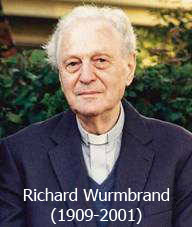
Richard Wurmbrand, “Preparing for the Underground Church”


richard

“God is the Truth. The Bible is the truth about the Truth. Theology is the truth about the truth about the Truth. A good sermon is the truth about the truth, about the truth, about the Truth. It is not the Truth. The Truth is God alone. Around this Truth there is a scaffolding of words, of theologies, and of exposition. None of these is of any help in times of suffering. It is only the Truth Himself Who is of help, and we have to penetrate through sermons, through theological books, through everything which is ‘words’ and be bound up with the reality of God himself.

I have told in the West how Christians were tied to crosses for four days and four nights. The crosses were put on the floor and other prisoners were tortured and made to fulfill their bodily necessities upon the faces and bodies of the crucified ones. I have since been asked: “Which bible verse helped and strengthened you in those circumstances?” My answer is: “NO Bible verse was of any help.” It is sheer cant and religious hypocrisy to say, “This Bible verse strengthens me, or that Bible verse helps me.” Bible verses alone are not meant to help. We knew Psalm 23.. “The Lord is my Shepherd; I shall not want…though I walk through the valley of the shadow of death…”

When you pass through suffering you realize that it was never meant by God that Psalm 23 should strengthen you. It is the Lord who can strengthen you, not the Psalm which speaks of Him so doing. It is not enough to have the Psalm. You must have the One about whom the Psalm speaks. We also knew the verse:  “My Grace is sufficient for thee.” But the verse is not sufficient. It is the Grace, which is sufficient, and not the verse.

Pastors and zealous witnesses who are handling the Word as a calling from God are in danger of giving Holy words more value than they really have. Holy words are only the means to arrive at the reality expressed by them. If you are united with the Reality, the Lord Almighty, evil loses its power over you; it cannot break the Lord Almighty. If you only have the words of the Lord almighty you can be very easily broken.” Richard Wurmbrand, “Preparing for the Underground Church”