 The Beginning of the Last Act (Matt 21:1-11)
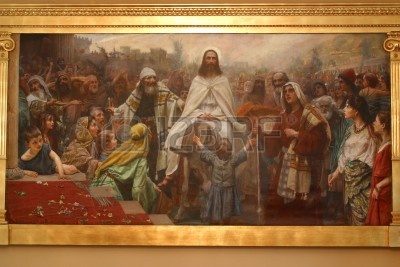
21:1-11 When they had come near to Jerusalem, and when they had come to Bethphage, to the Mount of Olives, then Jesus sent on two disciples ahead. “Go into the village which is facing you,” he said, “and immediately you will find an ass tethered, and a colt with her. Loose them, and bring them to me. And, if anyone says anything to you, say, ‘The Master needs them.’ Immediately he will send them on.” This was done that there might be fulfilled that which was spoken through the prophet, when he said, “Say to the daughter of Sion, Look you, your king comes to you, gentle, and riding upon an ass, and a colt, the foal of a beast who bears the yoke.” So the disciples went, and they carried out Jesus’ orders, and they brought the ass and the colt, and put their cloaks upon them; and he took his seat on them. The very large crowd spread their cloaks on the road. Others cut down branches from the trees and strewed them on the road; and the crowds who went in front and followed behind kept shouting, “Hosanna to the Son of David! Blessed in the name of the Lord is he who comes. Hosanna in the highest!” As he entered Jerusalem, the whole city was shaken. “Who is this?” they asked; and the crowds said, “This is the prophet, Jesus, who comes from Nazareth in Galilee.”

William Barclay 1907-1978
With this passage we embark on the last act in the drama of the life of Jesus; and here indeed is a dramatic moment.
It was the Passover time, and Jerusalem and the whole surrounding neighbourhood was crowded with pilgrims. Thirty years later a Roman governor was to take a census of the lambs slain in Jerusalem for the Passover and find that the number was not far off a quarter of a million. It was the Passover regulation that there must be a party of a minimum of ten for each lamb which means that at that Passover time more than two and a half million people had crowded their way into Jerusalem. The law was that every adult male Jew who lived within twenty miles of Jerusalem must come to the Passover; but not only the Jews of Palestine, Jews from every corner of the world made their way to the greatest of their national festivals. Jesus could not have chosen a more dramatic moment; it was into a city surging with people keyed up with religious expectations that he came.
Nor was this a sudden decision of Jesus, taken on the moment. It was something which he had prepared in advance. The whole tone of the story shows that he was carrying out plans which he had made ahead. He sent his disciples into “the village” to collect the ass and her foal. Matthew mentions Bethphage only (the pronunciation is not Bethphage with the age as in the English word page; the “e” at the end is pronounced as “ae”; the word is Bethphagae). But Mark also mentions Bethany (Mk 11:1). No doubt the village was Bethany. Jesus had already arranged that the ass and her foal should be waiting for him, for he must have had many friends in Bethany; and the phrase, “The Master needs them,” was a password by which their owner would know that the hour which Jesus had arranged had come.
So Jesus rode into Jerusalem. The fact that the ass had never been ridden before made it specially suitable for sacred purposes. The red heifer which was used in the ceremonies of cleansing must be a beast “upon which a yoke has never come” (Num 19:2; Deut 21:3); the cart on which the ark of the Lord was carried had to be a vehicle which had never been used for any other purpose (1 Sam 6:7). The special sacredness of the occasion was underlined by the fact that the ass had never been ridden by any man before.
The crowd received Jesus like a king. They spread their cloaks in front of him. That is what his friends had done when Jehu was proclaimed king (2 Ki 9:13). They cut down and waved the palm branches. That is what they did when Simon Maccabaeus entered Jerusalem after one of his most notable victories (1 Macc 13:51).
They greeted him as they would greet a pilgrim, for the greeting: “Blessed be he who enters in the name of the Lord” (Ps 118:26) was the greeting which was addressed to pilgrims as they came to the Feast.
They shouted “Hosanna!” We must be careful to see what this word means. Hosanna means Save now! and it was the cry for help which a people in distress addressed to their king or their god. It is really a kind of quotation from Ps 118:25: “Save us, we beseech Thee, O Lord.” The phrase, “Hosanna in the highest!” must mean, “Let even the angels in the highest heights of heaven cry unto God, Save now!”
It may be that the word hosanna had lost some of its original meaning; and that it had become to some extent only a cry of welcome and of acclamation, like “Hail!”; but essentially it is a people’s cry for deliverance and for help in the day of their trouble; it is an oppressed people’s cry to their saviour and their king.
Barclay’s Daily Study Bible (NT).





 52.
52.

 St. John One: One