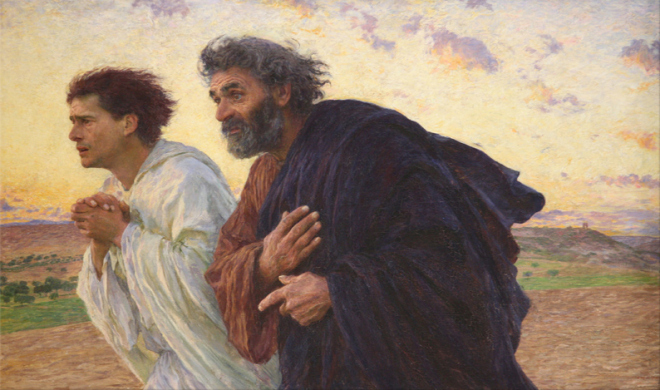
The Trinity can also be compared..
(written ca. 1360–87) from
Piers the Ploughman—by William Langland
The Trinity can also be compared to a torch or taper, which consist of wax and wick twined together, and a flame that flares from them both. And just as this wax, wick, and flame are used to light a fire, so the Father, the Son, and the Holy Ghost kindle among Christian people a fire of love and of faith which cleanses them from their sins. And as you sometimes see a torch whose flame is suddenly blown out, yet whose wick continues to smolder without setting fire to the matchwood, so the Holy Ghost is a God without mercy, and a Grace without life, to all those so depraved as to wish to quench true love, or destroy the very life which our Lord created.
‘Workmen who stay awake on winter nights are not cheered so much by glowing embers as they are by a blazing torch, or by a candle, or anything that gives out flame. So, the Father, the Son, and the Holy Ghost do not grant men grace or forgiveness of sins till the fire of the Holy Ghost begins to burn and to blaze. For the Holy Ghost glows by as an ember until true love lies down by His fire and blows it into flame; and then He flares out like a living fire, and warms the Father and the Son and melts their power into mercy. So, in winter, you can see icicles on the roofs of house, which once they feel the heat of the sun, melt in a minute into mist and water; and in the same way the grace of the Holy Ghost melts into mercy the great might of the Trinity—but only for those who practice mercy themselves.
Stuff Exists—Harold Eberle
Stuff exists; therefore, there had to be a stuff creator. There comes a time when people should quit arguing and just laugh at stupid ideas— and this includes the atheists’ most cherished belief. I don’t want to be rude; I want to make the obvious obvious. The acceptance of God’s existence is not a blind leap. Just the opposite is true— to not believe in a stuff creator is to be blind to the obvious. It is absurd not to believe in a stuff creator. Of course, we have lost the Western atheists in this discussion because the Scientific Revolution (and the Enlightenment that followed) set up in their minds a dichotomy of faith versus reason. Their definitions of faith and reason exclude God from the realm of reason. In reality, those categories are pure assumptions— false assumptions. Indeed, we cannot prove the existence of God to the atheist who refuses to let go of those assumed categories. In like fashion, we cannot prove the existence of bacteria to a person who refuses to look through a microscope and see the bacteria for himself. If, however, a person is willing to look through a microscope, then we can prove to him the existence of bacteria. Similarly, if an atheist is willing to look at the world, outside of his present dichotomous framework, then we can prove the existence of God. Here it is: stuff exists, so a stuff creator exists (or at least existed in the past). Atheistic readers may object and quickly argue that this is no argument for the existence of the Christian God. Indeed, I have not yet stated anything about this creator’s nature, and to argue against the Christian God at this point is to change the subject. It is to dodge the bullet, to hide behind a smoke screen. So long as we define God as the stuff creator, it is absurd not to accept God’s existence.
Eberle, Harold (2009-12-28). Christianity Unshackled: Are You A Truth Seeker (pp. 81-82). Destiny Image, Inc.. Kindle Edition.
Watch “Rupert Sheldrake at Litteraturhuset in Oslo (11.22.2012)” on YouTube
No greater Love–a memory
By James Ross Kelly
First North American Rights
Copyright 2013
About 2800 words
On the third of July, 1997 my friend of thirty-eight years, Steve Short, and his eighteen year old nephew were finishing a logging job on the Klamath River in Northern California. A weird thing happened on a particularly bad stretch of road and they lost three of their tires on the way back from a timber falling job. They had to return to finish up about two hours work and had started work at dawn and were on their way out. Because the side of the river they were on was so remote the three flat tires meant they faced a twenty-mile walk back to a phone.
Steve knew the river really well from drift-boat fishing salmon, and found a place nearby where he thought could be waded across safely, to get to a phone at a lodge on the other side. Steve had on heavy caulk boots as they started across. Caulk boots, called “Cork boots,” by most of the men who wear them, have rows of tiny metal spikes to keep your footing while walking on downed logs, and work very good on slippery rocks as well. The younger man had on conventional vibram sole boots, that are like walking on banana peels, when used in a west coast river. The eighteen year old also had a heavy backpack with a Stanley thermos, and some logging gear. The young man was Steve’s wife’s, sisters son, and had been in trouble and Steve had taken him under his wing. He had been giving him good paying work and teaching him a trade. Steve saw the boy, twenty yards away and down river from him–loose his footing and then swept into the current and down towards deeper water.
Steve had been an All-American full back in 1967 at Del Norte High School, in Crescent City, California. He lost a scholarship to UCLA because of getting into some “trouble,” after high school was now near 50 years old. He went after the young man in the same manner he followed his blockers at those Friday night games all over Northern California.
Steve Short was my best friend at Eagle Point Junior High School in a small logging town in southern Oregon from the 5th to the 8th grade. His family moved to Crescent City, California in 1963. Bill, his dad, bought a fishing boat and quit logging for Steve Wilson logging Company in Eagle Point for the open sea.
Every summer after that I would go to Crescent City to visit, and he would return the favor and come to Eagle Point and stay with us on our little farm. We wrote letters and signed each other’s names as “Esquire” for our own adolescent self-appointed nobility and never with a thought of becoming lawyers because we thought we were appointed by virtue of adolescence to make up our own rules. We’d get in mild trouble every time we got together. At sixteen, I remember going to matinee in Crescent City California with Steve and seeing the Sergio Leone, Clint Eastwood, film a “Fist Full Of Dollars,” and afterward buying hard and stale Paroudi cigars and choking them down and trying to look tough while driving through town in a 1955 Volkswagen.
After High School and when I’d been in the Army about three years of a 4 year enlistment I was in an outfit that made you enlist for the extra year which I was in the process of finishing up, I had to go to the Presido in San Francisco, and I went with another guy who then wanted to visit a friend of his in Letterman General Hospital, which is at the Presido. On our way up to him one of the giant Hospital elevator doors opened up there stood Steve in a hospital get-up. He saw me and broke into one of those big wide grins he used to have. He’d gotten Hepatitis in Vietnam, and got out of the country one month early. Steve had got drafted in 1969, was then married to his High School sweetheart Susan. He then enlisted to perhaps ease Susan’s fear of a Vietnam destination, and had a recruiter talk him into being a aircraft mechanic in the Army. In 1969, that eventually translated into the reality of being a door-gunner on a helicopter in Vietnam.
I got him out of the hospital and brought him, with his flight helmet, to our little apartment in Santa Rosa, where I lived with my new wife from Massachusetts. We were about 20 miles from the base I was stationed at, Two Rock Ranch Station. An Army Security Agency base that went under the cover of a communications facility. In reality we monitored the Russian Navy’s communication in the Pacific. Steve told me of some awful things he’d seen in Vietnam, his take on Vietnam was simply to explode a nuclear device on the DMZ and blow both countries, South and North into the ocean—it was a feeling that a lot of homecoming veteran’s shared after a bitter decade of war. Susan his wife and Steve’s mother Rosie, a lifelong Sunday school teacher, came down and picked him up at my place in a joyous homecoming. I saw him very irregularly over the years after that, I’d find myself stopping by in Crescent City every once in a while. After the army Steve became a timber faller in pretty much the last effort to harvest ancient redwoods.
“Yep, I chop down the great big-fat ones!” he’d say with wistful grin and his head cocked sideways. Steve had what was called a “pull show,” where they’d use two giant winches to lower the great trees without damaging any wood. Steve had each of his winches powered by powerful Ford V-8 engines. Steve would climb to the top of each great behemoth he was assigned, then attach cables from the winches and then he’d personally make an under cut the size of an American, middle class living room. And with his giant McCulloch chain saw he would sever the largest tree the Lord ever designed, and would gently lower each ancient giant down to the earth where we humans, like the eager Lilliputians we are, would go to work on them for the tiny pieces of wood that are now so valuable. In 1978 when they discontinued the model of chainsaw Steve used, the McCulloch company manufactured the most powerful saw ever made at that time, and had sold that model mostly for go-cart racing. Steve bought three of these engines before they became obsolete just for his special line of work. Susan and Steve had three girls. The last time I saw them altogether they were three little blond dolls toddling around a living room of suburban house a couple miles from the ocean in a rural area near the always misty Crescent City— all his girls are married with babies of their own now. Steve did well with his business and tried to get out of logging after he turned 40 or so, but eventually went back into it, although the pull shows were over, after all the “Great Big Fat Ones,” had been “chopped down,” and went onto the traditional timber falling that took him inland all over the Six Rivers National Forest, and farther away from home. He worked Hoot-owl logging jobs in the summer, starting work at 2:30 in the morning like he did that morning to drive inland to remote sections of an ever decreasing forested landscape to get started at dawn so enough work could be accomplished and the saws could be shut off, when the humidity began to plummet all to alleviate a fire danger because of the possibility that later in the day a tiny ember from a whirring piece of metal striking a rock like anger might smolder and then become a 500 to 5000 acre or even grater wildfire of wrath. The woods had been worked that way for half a century. With less and less being left with each passing decade and the millennium seeing this wide-scale livelihood that fed families and sustained local economies come almost to a halt.
When I came to the southern Oregon grade school in the 5th grade, I was an orphan, being raised by a maternal uncle and his saintly wife, my aunt. I came into a rough and tumble little school where most everybody’s Dad it seemed was a timber faller or a cattle rancher. I think God sent me Steve for a friend, I had no friends, and Steve became the best one I ever had to that point in my life. As the skinny little “four-eyed” kid I was, and because Steve was my friend, no one dreamed of picking on me. Somehow that allowed four years of breathing room that was incredibly important to who I am. Most everyone who has friends of this type are truly blessed. We had no particularly high art or hobbies, model cars, hunting and fishing and bike riding were the holiday arts that we practiced well. When we came of age things were less innocent, and neither of us at that time were regarded as saints but those exploit are other stories—this is the death of my close friend.
That July day, the day the before our independence celebration in 1997, a woman standing on a rock above the lodge side of the Klamath River, observed the two loggers trying to make it across the river. She saw Steve and his nephew’s attempt to wade the river, she saw the boy splash and struggle and swept down stream to deep water with the current then go under in swift water and saw Stevego after him. There was no sight of either of them for what she later described as several minutes, then the younger man came out of the water with a mighty force he made it to shore without his back pack. It is assumed that Steve got to the lad and got his pack off of him on the river bottom and then took on water and the weight of his boots kept him from making it the extra feet to the surface for a burst of air. This happened around nine-thirty in the morning. Steve’s wife Susan heard about it and shortly got some one in a jet boat to roar up the Klamath river to the accident scene. The Sheriffs Department and Susan and Steve’s friends searched for his body until early evening, when they finally found him on the bottom of the river in twenty feet of water. The Deputies tried to make Susan leave, but she would not, and stood by while they recovered Steve’s body. Susan then cradled Steve her husband of thirty years in her arms in the Sheriffs jet boat all they way back down the river, with the sun setting down to darkness and passing by the great trees they’d loved and lived in, and took down until the boat stopped with its sad cargo and the tide water mixed with the fresh water from all north California and central Oregon.
“I know there was a hand that met him, I know there was a jubilee, I know that Jesus precious arms were waiting and I know they’ll be there for you I know they’ll be there me.”
Steve Short was the finest man, Christian or other wise I’d ever known. Sadly to knock my own religion the finest examples of humans in my own life have not always been Christians. But I truly know, I do truly know someday I’ll see him again and he will break into one of those big wide grins he used to always have. After my divorce, Steve and I exchanged a lot of phone calls. We’d talked about some future fishing trips that never happened, but mostly we talked of God a lot, and how He’d changed both of our lives and how He’d been there all along when, we were just struggling through life thinking it was something we were carrying on by our own strength. I do not know why he took Him home. But Steve used to talk about knowing that being in heaven as 100 million times greater than being here. But here he lived finally as an example of what Jesus described as, there being no greater love, than giving your life for your friends, few Christians think of it as a commandment in the manner He really gave it, “I command you to love each other in the same way that I love you. And here is how to measure it—the greatest love is shown when people lay down their lives for their friends.” I know Steve would have done the same thing for me, “love each other in the same way that I love you.” There were those that grudged the loss of Steve’s life, for a lad that had been constantly “in trouble,” and who had a checkered past. Steve lost his scholarship to UCLA simply because the summer after graduating from High School, he had for very brief time hung with trouble, and ended up getting caught breaking into a liquor store and doing a month in jail for his efforts. Those same type of folks that were judging the boy’s future against the anguish and love they’d known for Steve, were the same kind of folks that wrote Steve off after his misadventure with the law. A mutual friend told me he would have done the same thing for any one he’d known for only five minutes..
His father, had a particularly hard time with Steve’s death. About two years after Steve had been gone I stopped by to spent some time with Steve’s Mom, Rosie and his Dad, Bill Short, Steve’s father. Bill had been a fishing boat captain, now retired who had as an infantryman fought his way over every bad inch of Americas second World War effort in Sicily and then over most of the geographical boot of Italy.
After the war he logged until he bought his fishing boat, taking time off to fish every chance he got, when the first spring salmon was over the Gold Ray Dam, most of his friends assumed Bill Short had already set out to catch it, riding his pan-head Harley-Davidson, out into the brushy trails next to the Rogue River. When Steve and I were in the 6th grade Bill took us both to Diamond lake at the very end of the fishing season we’d skittered 60 through the patches of snow up from Eagle Point, in the ’55 VW to troll for huge rainbow trout the biggest trout I’d ever seen, giant silvery bullets all of them caught by Bill while Steve and I shivered in the boat, and got a tongue lashings when we got our lines entangled with Captain Bill’s. During that era the schools and logging companies and mills would close for the first week of deer hunting season. Bill would as quick as could, run out opening day and find a buck no matter how large or small, kill it, dress it and be able to get in four or five days of the summer run steelhead fishing while all of his friends were still in hunting camp. After Bill had been fishing for twenty year’s he’d still moor his boat and run up the slippery banks of the smith river when the salmon were running, with his pole catching them for the pure fun of what his commercial operation would not quite satisfy. I tried, several times to leave that evening but Bill Short and I talked for over two hours more out in front of my pickup, after Rosie had gone to bed, on that late summer evening. I told his father, that I’d been reading about the first few centuries of the Christian church, and if the event that cost his son his life had occurred in the days of the early Christian Church, Steve would have been made a Saint for this act of saving the boy’s life. The bland objective journal of the region just reported a death, by drowning that went largely unnoticed and never mentioned what had happened. But there were those who knew him that thought of Steve in that Holy manner already—maybe it is that there is no difference between the early Church and the real Church. Despite the way humans including Christians, have tried to organize our cultures without God, there have been great and good men who have walked with our precious Savior, in manner that he intended us to. I told his father the truth that night, that Steve was simply the finest man I’d ever known.
By James Ross Kelly
First North American Rights
Copyright 2013
About 2800 words
Decreasing the Surplus Population
Decreasing the Surplus Population. The late Chuck Colson from 2009 that still widely reflects environmental purists notion of population control.
15 things not to say to a recovering fundamentalist
Watch “Bill Johnson – Compassion Leads to Miracles July 14 2013” on YouTube
“Sunset at Montmajour” by Van Gough, once was lost, now it’s found.
Gospel within the Gospel — Luke 15:11-32
Luke 15 begins with Jesus speaking to the tax collectors and others, and then the religious elite happen by, and begin to grumble about the company the Saviour keeps, with the intent to disparage his authority. Jesus tells three parables that in ever ascending power demonstrates the power of God to seek the lost and forgive —culminating in the description of the loving Father that “ while he was still a long way off, his father saw him and felt compassion for him, and ran and embraced him and kissed him. ” All men are at one time or another— either the elder brother, or the prodigal son. Each have a life problem that is self inflicted, each are forgiven, and each are beckoned to their proper place—the banqueting table.
Luke 15:11-32
New American Standard Bible (NASB)
The Prodigal Son11 And He said, “A man had two sons. 12 The younger of them said to his father, ‘Father, give me the share of the estate that falls to me.’ So he divided his [a]wealth between them. 13 And not many days later, the younger son gathered everything together and went on a journey into a distant country, and there he squandered his estate with loose living. 14 Now when he had spent everything, a severe famine occurred in that country, and he began to be impoverished. 15 So he went and [b]hired himself out to one of the citizens of that country, and he sent him into his fields to feed swine. 16 And he would have gladly filled his stomach with the [c]pods that the swine were eating, and no one was giving anything to him. 17 But when he came to [d]his senses, he said, ‘How many of my father’s hired men have more than enough bread, but I am dying here with hunger! 18 I will get up and go to my father, and will say to him, “Father, I have sinned against heaven, and [e]in your sight; 19 I am no longer worthy to be called your son; make me as one of your hired men.”’ 20 So he got up and came to [f]his father. But while he was still a long way off, his father saw him and felt compassion for him, and ran and [g]embraced him and kissed him. 21 And the son said to him, ‘Father, I have sinned against heaven and in your sight; I am no longer worthy to be called your son.’ 22 But the father said to his slaves, ‘Quickly bring out the best robe and put it on him, and put a ring on his hand and sandals on his feet; 23 and bring the fattened calf, kill it, and let us eat and celebrate; 24 for this son of mine was dead and has come to life again; he was lost and has been found.’ And they began to celebrate.
25 “Now his older son was in the field, and when he came and approached the house, he heard music and dancing. 26 And he summoned one of the servants and began inquiring what these things could be. 27 And he said to him, ‘Your brother has come, and your father has killed the fattened calf because he has received him back safe and sound.’ 28 But he became angry and was not willing to go in; and his father came out and began pleading with him. 29 But he answered and said to his father, ‘Look! For so many years I have been serving you and I have never [h]neglected a command of yours; and yet you have never given me a young goat, so that I might celebrate with my friends; 30 but when this son of yours came, who has devoured your [i]wealth with prostitutes, you killed the fattened calf for him.’ 31 And he said to him, ‘Son, you [j]have always been with me, and all that is mine is yours. 32 But we had to celebrate and rejoice, for this brother of yours was dead and has begun to live, and was lost and has been found.’”
Footnotes:
Luke 15:12 Lit living
Luke 15:15 Lit was joined to
Luke 15:16 I.e. of the carob tree
Luke 15:17 Lit himself
Luke 15:18 Lit before you
Luke 15:20 Lit his own
Luke 15:20 Lit fell on his neck
Luke 15:29 Or disobeyed
Luke 15:30 Lit living
Luke 15:31 Lit are always with me