Hell–from The Problem of Pain, by C.S. Lewis


I am not going to try to prove the doctrine tolerable. Let us make no mistake; it is not tolerable. But I think the doctrine can be shown to be moral, by a critique of the objections ordinarily made, or felt, against it.

C.S. Lewis

C.S. Lewis

First, there is an objection, in many minds, to the idea of retributive punishment as such. This has been partly dealt with in a previous chapter. It was there maintained that all punishment became unjust if the ideas of ill-desert and retribution were removed from it; and a core of righteousness was discovered within the vindictive passion its self, in the demand that the evil man must not be left perfectly satisfied with his own evil, that it must be made to appear to him what it rightly appears to others—evil. I said that Pain plants the flag of truth within a rebel fortress. We were then discussing pain which might still lead to repentance. How if it does not—if no further conquest than the planting of the flag ever takes place?

Let us try to be honest with ourselves. Picture to yourself a man who has risen to wealth or power by a continued course of treachery and cruelty, by exploiting for purely selfish ends the noble motions of his victims, laughing the while at their simplicity; who, having thus attained success, uses it for the gratification of lust and hatred and finally parts with the last rag of honour among thieves by betraying his own accomplices and jeering at their last moments of bewildered disillusionment. Suppose, further, that he does all this, not (as we like to imagine) tormented by remorse or even misgiving, but eating like a schoolboy and sleeping like a healthy infant—a jolly, ruddy-cheeked man, without a care in the world, unshakably confident to the very end that he alone has found the answer to the riddle of life, that God and man are fools whom he has got the better of, that his way of life is utterly successful, satisfactory, unassailable. We must be careful at this point. The least indulgence of the passion for revenge is very deadly sin. Christian charity counsels us to make every effort for the conversion of such a man: to prefer his conversion, at the peril of our own lives, perhaps of our own souls, to his punishment; to prefer it infinitely.

But that is not the question. Supposing he will not be converted, what destiny in the eternal world can you regard as proper for him? Can you really desire that such a man, remaining what he is (and he must be able to do that if he has free will) should be confirmed forever in his present happiness—should continue, for all eternity, to be perfectly convinced that the laugh is on his side? And if you cannot regard this as tolerable, is it only your wickedness—only spite—that prevents you from doing so? Or do you find that conflict between Justice and Mercy, which has sometimes seemed to you such an outmoded piece of theology, now actually at work in your own mind, and feeling very much as if it came to you from above, not from below? You are moved not by a desire for the wretched creature’s pain as such, but by a truly ethical demand that, soon or late, the right should be asserted, the flag planted in this horribly rebellious soul, even if no fuller and better conquest is to follow. In a sense, it is better for the creature its self, even if it never becomes good, that it should know its self a failure, a mistake. Even mercy can hardly wish to such a man his eternal, contented continuance in such ghastly illusion. Thomas Aquinas said of suffering, as Aristotle had said of shame, that it was a thing not good in its self; but a thing which might have a certain goodness in particular circumstances. That is to say, if evil is present, pain at recognition of the evil, being a kind of knowledge, is relatively good; for the alternative is that the soul should be ignorant of the evil, or ignorant that the evil is contrary to its nature, ‘either of which’, says the philosopher, ‘is manifestly bad’.* And I think, though we tremble, we agree.

The demand that God should forgive such a man while he remains what he is, is based on a confusion between condoning and forgiving. To condone an evil is simply to ignore it, to treat it as if it were good. But forgiveness needs to be accepted as well as offered if it is to be complete: and a man who admits no guilt can accept no forgiveness.

I have begun with the conception of Hell as a positive retributive punishment inflicted by God because that is the form in which the doctrine is most repellent, and I wished to tackle the strongest objection. But, of course, though Our Lord often speaks of Hell as a sentence inflicted by a tribunal, He also says elsewhere that the judgement consists in the very fact that men prefer darkness to light, and that not He, but His ‘word’, judges men** We are therefore at liberty—since the two conceptions, in the long run, mean the same thing—to think of this bad man’s perdition not as a sentence imposed on him but as the mere fact of being what he is. The characteristic of lost souls is ‘their rejection of everything that is not simply themselves’.***  Our imaginary egoist has tried to turn everything he meets into a province or appendage of the self. The taste for the other, that is, the very capacity for enjoying good, is quenched in him except in so far as his body still draws him into some rudimentary contact with an outer world. Death removes this last contact. He has his wish—to lie wholly in the self and to make the best of what he finds there. And what he finds there is Hell.

1 Summa Theol, I, IIae, Q. xxxix, Art. 1.

** John 3:19; 12:48.

*** See von Hügel, Essays and Addresses, 1st series, What do we mean by Heaven and Hell?

Lewis, C. S. (2009-05-28).  The Problem of Pain (p.123- 125). Harper Collins, Inc.. Kindle Edition.

Believing in the 21st Century:Chapter Three


an exhortation..as 
a lay Christian examines his faith..

By James Ross Kelly
The assertion of the crucifixion of Jesus of Nazareth as truth is accepted by most all accounts historically, but it is the next Chapter of John’s Gospel that Christ becomes the risen Savior of mankind—and when Christianity is presented to mankind as a Supernatural visitation by the Creator of the Universe. What may go against the humanist grain is that it must be asked given Christianity’s assertion of this truth— it must be seriously asked, ‘What do you say of a group of beings that would torture and kill their own Creator? Who kindly and humbly appeared to them preaching love and forgiveness and supreme fellowship with the whole of Creation of the universe? Given that this is true, if you accept that Jesus of Nazareth was exactly Who he said he was according to scripture previous to Chapter 19 of John’s Gospel—there is now a change that must take place in our essential view of humanity. And it must be said to all, that if Christendom’s message is true as the faithful proclaim it, that this event is the greatest definition of mankind! That humanity killed its Creator and proved itself inhuman for all time—juxtaposed with the Creator offering Himself as a sacrifice that all people might come into a relationship with Him and make themselves, with His divine help, at last truly humane! The greatest anguish turning into greatest joy! This the most important event in all of history—all previous scripture leads toward this event as prophesy and type. All subsequent scripture is then driven by this event, as is all commentary, preaching, doctrines and creeds. The saddest day brings forth the most happy day both then rapt into an inter-dimensional cleft that will guide the coiling of history toward its ultimate destiny. It is the death knell for the god of this world when the sentence, ‘It is finished.’ was uttered. But—it would be most likely not even a foot note in history, lost long ago in human memory if it were not for the following supernatural event that the caused all of paganism to begin a world-wide decent. But then again we must suspend and consider the rest of the story because the former is accepted fact even in an unbelieving world, now again, ‘what if just—as it is written’—this also is true?
John–Chapter 20 (NIV)

1Early on the first day of the week, while it was still dark, Mary Magdalene went to the tomb and saw that the stone had been removed from the entrance.
2So she came running to Simon Peter and the other disciple, the one Jesus loved, and said, “They have taken the Lord out of the tomb, and we don’t know where they have put him!”
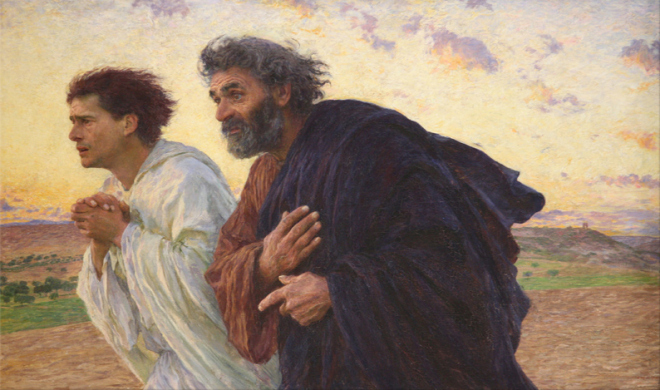
3So Peter and the other disciple started for the tomb.
4Both were running, but the other disciple outran Peter and reached the tomb first.
5He bent over and looked in at the strips of linen lying there but did not go in.
6Then Simon Peter, who was behind him, arrived and went into the tomb. He saw the strips of linen lying there,
7 as well as the burial cloth that had been around Jesus’ head. The cloth was folded up by itself, separate from the linen.
8 Finally the other disciple, who had reached the tomb first, also went inside. He saw and believed.
9(They still did not understand from Scripture that Jesus had to rise from the dead.)
10Then the disciples went back to their homes,
11but Mary stood outside the tomb crying. As she wept, she bent over to look into the tomb
12and saw two angels in white, seated where Jesus’ body had been, one at the head and the other at the foot.
13They asked her, “Woman, why are you crying?” “They have taken my Lord away,” she said, “and I don’t know where they have put him.”
14At this, she turned around and saw Jesus standing there, but she did not realize that it was Jesus.
15″Woman,” he said, “why are you crying? Who is it you are looking for?” Thinking he was the gardener, she said, “Sir, if you have carried him away, tell me where you have put him, and I will get him.”
16Jesus said to her, “Mary.” She turned toward him and cried out in Aramaic, “Rabboni!” (which means Teacher).
17Jesus said, “Do not hold on to me, for I have not yet returned to the Father. Go instead to my brothers and tell them, `I am returning to my Father and your Father, to my God and your God.’”
18Mary Magdalene went to the disciples with the news: “I have seen the Lord!” And she told them that he had said these things to her.
19On the evening of that first day of the week, when the disciples were together, with the doors locked for fear of the Jews, Jesus came and stood among them and said, “Peace be with you!”
20After he said this, he showed them his hands and side. The disciples were overjoyed when they saw the Lord.
21Again Jesus said, “Peace be with you! As the Father has sent me, I am sending you.”
22And with that he breathed on them and said, “Receive the Holy Spirit.
23If you forgive anyone his sins, they are forgiven; if you do not forgive them, they are not forgiven.”
24Now Thomas (called Didymus), one of the Twelve, was not with the disciples when Jesus came.
25So the other disciples told him, “We have seen the Lord!” But he said to them, “Unless I see the nail marks in his hands and put my finger where the nails were, and put my hand into his side, I will not believe it.”
26A week later his disciples were in the house again, and Thomas was with them. Though the doors were locked, Jesus came and stood among them and said, “Peace be with you!”
27Then he said to Thomas, “Put your finger here; see my hands. Reach out your hand and put it into my side. Stop doubting and believe.”
28Thomas said to him, “My Lord and my God!”
29Then Jesus told him, “Because you have seen me, you have believed; blessed are those who have not seen and yet have believed.”
30Jesus did many other miraculous signs in the presence of his disciples, which are not recorded in this book.
31But these are written that you may [1] believe that Jesus is the Christ, the Son of God, and that by believing you may have life in his name.

1.31 Some manuscripts “may continue to”

So the greatest of antinomies is resolved. The entirety of human kind has now been redeemed. And just like anyone unfamiliar or knowledgeable today they did not know they were redeemed. Some did not know they needed to be redeemed then, as they do not know it today. There are those who see who have not seen with the same eyes of Thomas, but with the inner light of truth, as it presents itself simply because it is the Truth and believe in that moment of revelation.

So we who have believed and yet have not seen have inherited this story as the foundation of Western culture—a foundation that may be fast crumbling, and a foundation that is having its ramparts stricken from most every side. Yet it is we who do believe who are left responsible for this message being passed on. The greatest of fallacies is that one has to be part of a graduated class in a seminary to pass this message on. People are often put to death spiritually in Seminaries and others become atheists or pantheists there. Others because of their seminary experience have had to abandon the organized Church rather than look themselves in the mirror because of the hypocrisy of one form or another they found abiding there. And many modern day religionists would charge upon pain of ecclesiastical crucifixion that one is forced to accept this system and live it and put this tradition on over Christ Jesus Himself. And yet it may be that despite all this our Seminaries are a separation process that does produce notable been and women of God.

High Pagan Rome began a precipitous but lengthy fall the day of the crucifixion. From its beginning they wanted no part in it. The religionists of the day wanted it done and done before dark and done their way and would not, could not, take in any form of mercy as an answer—they still can’t—leaving the Messiah on the Cross in the form of condemning legalism rather than loving redemption and the resurrected loving glory of a living God. The Pilate’s of this world are still here in comfortable bureaucracies agreeing to death sentences for some and long terms for others—as portions of Christ are chipped out of our culture on a daily basis in making environmental decisions based upon short term profit, at the expense long term health and human justice. Or, allowing the destiny designed by a loving God to play out in a myriad of aborted lives whose end has come for convenience and pleasures sake at the modern alter of the pagan god that requires human sacrifice for a middle-to-upper-class lifestyle. Just as the ritual and rites of pre-Christian pagan Celtic homes required the ritual sacrifice of the first born on its foundations before a structure was thought to be sound.1 The Pharisees and ruling Sanhedrin-like councils exist as parts of legislatures, courts and political parties and good ol’ boy networks and now it seems good ol’ girl networks.

So? —again, to those that aren’t convinced. Is it true? I believe with every fiber of my being that it-is-true. And not only true but the truth—the ultima veritas. And I believe this after having questioned it thoroughly and found the truth to be vital and living. God the Creator took the form of man and visited earth as humble carpenter. Here he preached the truth of love and redemption to all mankind to the holders of a covenant with Him and was then arrested, tried and killed both by the holders of that covenant and mankind in general in the form of authoritarian civilized Pagan Rome. By this act there is a final redemption for all people in all times and in all walks of life. And through this emerges all other truths and upon which all other truths depend. One adopts the creeds of Christianity not because they are mere words and the party line but because they are in essence the living truth that has been passed on for a length of time in space that surpasses the oldest living things on the planet.

Relationship to God and to one another Chuck Smith, Jr


t_chuckjr

The world s not going to be changed by Christians who merely go to church. the nature of the church in post-modernity has to be that of a spiritual community that strives to go beyond the modern concern for correct doctrine and institutionalism  A spiritual community is not based on dogma but on relationship to God and to one another.

Chuck Smith, Jr.,  The End of the World…as We Know It

Ever climb Mt. Theilsen Ernie?


280px-Mt_Thielsen_US162“Six times,” he wheezed,
from an
abrupt old man
kind of
certainty, &
then held up
one hand with fingers extended
w/an upward thumb from the other
to only waist height,
then let them down in
an exhaustion of age,
looking off the precipice
of his front porch,
he said,”Last time I was 79.”

The light would scatter and travel in all directions through the darkness–Thomas Merton


JCFRMSHIn the cool darkness of the spring night the priest and his ministers gather outside the door of the empty Church. The “new fire,” struck from flint, is enkindled and blessed. From this new fire the Paschal Candle will be lit. The marvelous Exsultet will then be sung, proclaiming the full meaning of the Easter mystery. Flame will be taken from the great candle, and multiplied throughout the building in all the different hanging lamps, and on the altar candles. As Mass is being prepared, “prophecies” will be chanted from various books of the Old Testament, showing how the types and figures hidden in the obscurity of the Old Law, have been brought to light in the glory of the resurrection. Each prophecy kindles a mystical light in the listening Church. This is a feast of light, a feast of life, celebrating not merely a past event but the present existential reality of the redemptive fact by which Christ communicates His life to us and unites us to Himself in one spirit.

Animate and inanimate creation join with the Church in her feast. Not only men are present to solemnize the mystery, but angelic spirits join with them in the liturgical celebration. The texts that are chanted, the prayers and blessings, are the richest in the liturgical year. They are a compendium of theology—theology not merely studied, not merely meditated, but lived. Through the medium of the liturgy, the Word Himself, uncreated Truth, enters into our spirits and becomes our theology. The first voice that speaks in the silent night is the cold flint. Out of the flint springs fire. The fire, making no sound, is the most eloquent preacher on this night that calls for no other sermon than liturgical action and mystery. That spark should spring from cold rock, reminds us that the strength, the life of God, is always deeply buried in the substance

The light that leaps out of darkness, the fire that comes from stone, symbolizes Christ’s conquest of death. He, Who is the source of all life, could never remain in death, could not see corruption. Death is not a reality, but the absence of a reality. And in Him there is nothing unreal. The fire that springs from the stone speaks, then, of His reality springing from the alienated coldness of our dead hearts, of our souls that have forgotten themselves, that have been exiled from themselves and from their God—and have lost their way in death. But there is nothing lost that God cannot find again. Nothing dead that cannot live again in the presence of His Spirit. No heart so dark, so hopeless, that it cannot be enlightened and brought back to itself, warmed back to the life of charity.  

In the old days, on Easter night, the Russian peasants used to carry the blest fire home from Church. The light would scatter and travel in all directions through the darkness, and the desolation of the night would be pierced and dispelled as lamps came on in the windows of the farmhouses one by one. Even so the glory of God sleeps everywhere, ready to blaze out unexpectedly in created things. Even so His peace and His order lie hidden in the world, even the world of today, ready to reestablish themselves in His way, in His own good time: but never without the instrumentality of free options made by free men.

Merton, Thomas (1999-11-29). The New Man (Kindle Locations 2190-2215). Macmillan. Kindle Edition.

Poetry, Symbolism and Typology—Thomas Merton


Cover of "The Literary Essays of Thomas M...

Cover via Amazon

thomas merton

Now the writers of the Bible were aware that they shared with other religions the cosmic symbols in which God has revealed Himself to all men. But they were also aware that pagan and idolatrous religions had corrupted this symbolism and perverted its original purity [Merton cites Romans 1:18 and 25] The Gentiles had “detained the truth of God in injustice” and “changed the truth of God into a lie.”
Creation had been given to man as a clean window through which the light of God could shine into men’s souls. Sun and moon, night and day, rain, the sea, the crops, the flowering tree, all these things were transparent. They spoke to man not of themselves only but of Him who made them. Nature was symbolic. But the progressive degradation of man after the fall led the Gentiles further and further from this truth. Nature became opaque. The nations were no longer able to penetrate the meaning of the world they lived in. Instead of seeing the sun a witness to the power of God they thought the sun was god. The whole universe became an enclosed system of myths. The meaning and the worth of creatures invested them with an illusory divinity.
Men still sensed that there was something to be venerated in the reality, in the peculiarity of living and growing things, but they no longer knew what that reality was. They became incapable of seeing that the goodness of the creature is only a vestige of God. Darkness settled upon the translucent universe. Men became afraid. Beings had a meaning which men could no longer understand. They became afraid of trees, of the sun, of the sea. These things had to be approached with superstitious rites. It began to seem that the mystery of their meaning, which had become hidden, was now a power that had to be placated and, if possible controlled with magic incantations.
Thus the beautiful living things which were all about us on this earth and which were the windows of heaven to every man, became infected with original sin. The world fell with man, and longs, with man, for regeneration. The symbolic universe, which had now become a labyrinth of myths and magic rites, the dwelling place of a million hostile spirits, ceased altogether to speak to most men of God and told them only of themselves. The symbols which would have raised man above himself to God now became myths, and as such they were simply projections of man’s own biological drives. His deepest appetites, now full of shame, became his darkest fears.
The corruption of cosmic symbolism can be understood by a simple comparison. It was like what happens to a window when a room ceases to receive light from the outside. As long as it is daylight, we see through our windowpane. When night comes, we can still see through it if there is no light inside our room. When our lights go on, then we see only ourselves and our own room reflected in the pane. Adam in Eden could see through creation as through a window. God shone through the windowpane as bright as the light of the sun. Abraham and the patriarchs and David and the holy men of Israel—the chosen race that preserved intact the testimony of God—could still see through the window as one looks out by night from a darkened room and sees the moon and stars. But the Gentiles had begun to forget the sky, and to light lamps of their own, and presently it seemed to them that the reflection of their own room in the window was the “world beyond.” They began to worship what they themselves were doing. And what they were doing was too often an abomination. Nevertheless, something of the original purity of natural revelation remained in the great religions for the East. It is found in the Upanishads in the Baghavad Gita. But the pessimism of Buddha was a reaction against the degeneration of nature by polytheism. Henceforth for the mysticism of the East, nature would no longer be symbol but illusion. Buddha knew too well that the reflections in the window were only projections of our own existence and our own desires, but did not know that this was a window and that there could be sunlight outside the glass.

from “Poetry, Symbolism, and Typology,” The Literary Essays of Thomas Merton, pp 333-335,  New Directions 1985. Originally from Merton’s Bread in the Wilderness, a study of the Psalms of the Old Testament as poetry, New Directions, 1953

After Last Call


The big dog greyhound
just left going south
& the cops picked up
an  eighty-five year
old escapee from a rest
home, it’s twelve o’clock
almost a full moon & the
wind whips waves some-
where in the north Atlantic
sea, there’s three nickels
on this bar & my wife,
your smile this night is
worth a sun tan in the Fiji
islands or love after this
barstool is one hour up
turned & the old janitor
sweeps the floor while
most of this town sleeps
and the greyhound whines
twenty inch tires still
four hours from San Francisco