“Please don’t think functionally with God. Don’t just ask
Him to do stuff. Ask Him what He wants to be for you, and
then ask Him, “What do I get to be in return for You? What
do I get to become as a result of Your presence in my
life?” If every circumstance promotes an upgrade in
relationship with God, what is your focus going to be? If
you know that a situation is about your upgrade, what is
your focus going to be?”
Category / Trinitarian Christianity

Physical Evidence of Jesus Christ — Unwrapping The Shroud of Turin. You decide–YouTube
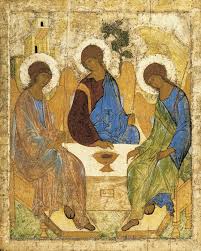
The Athanasian Creed: the first creed in which the equality of the three persons of the Trinity is explicitly stated.
(1) Whosoever will be saved, before all things it is necessary that he hold the catholic faith;
(2) Which faith except every one do keep whole and undefiled, without doubt he shall perish everlastingly.
(3) And the catholic faith is this: That we worship one God in Trinity, and Trinity in Unity;
(4) Neither confounding the persons, nor dividing the substance.
(5) For there is one Person of the Father, another of the Son and another of the Holy Spirit.
(6) But the Godhead of the Father, of the Son, and of the Holy Spirit is all one, the glory equal, the majesty co-eternal.
(7) Such as the Father is, such is the Son and such is the Holy Spirit.
(8) The Father uncreate, the Son uncreate, and the Holy Spirit uncreate.
(9) The Father incomprehensible, the Son incomprehensible, and the Holy Spirit incomprehensible. (10) The Father eternal, the Son eternal, and the Holy Spirit eternal.
(11) And yet they are not three eternals, but one eternal.
(12) As also there are not three uncreated nor three incomprehensibles, but one uncreated and one incomprehensible.
(13) So likewise the Father is almighty, the Son almighty, and the Holy Spirit almighty;
(14) And yet they are not three almighties, but one almighty.
(15) So the Father is God, the Son is God, and the Holy Spirit is God;
(16) And yet they are not three Gods, but one God.
(17) So likewise the Father is Lord, the Son Lord, and the Holy Spirit Lord;
(18) And yet they are not three Lords, but one Lord.
(19) For like as we are compelled by the Christian verity to acknowledge every person by himself to be God and Lord;
(20) so are we forbidden by the catholic religion to say: There are three Gods or three Lords.
(21) The Father is made of none, neither created nor begotten.
(22) The Son is of the Father alone; not made nor created, but begotten.
(23) The Holy Spirit is of the Father and of the Son; neither made, nor created, nor begotten, but proceeding.
(24) So there is one Father, not three Fathers; one Son, not three Sons; one Holy Spirit, not three Holy Spirits.
(25) And in this Trinity none is afore, nor after another; none is greater, or less than another.
(26) But the whole three persons are co-eternal, and co-equal.
(27) So that in all things, as aforesaid, the Unity in Trinity and the Trinity in Unity is to be worshipped.
(28) He therefore that will be saved must thus think of the Trinity.
(29) Furthermore it is necessary to everlasting salvation that he also believe rightly the incarnation of our Lord Jesus Christ.
(30) For the right faith is that we believe and confess that our Lord Jesus Christ, the Son of God, is God and man.
(31) God of the substance of the Father, begotten before the worlds; and man of the substance of His mother, born in the world.
(32) Perfect God and perfect man, of a reasonable soul and human flesh subsisting.
(33) Equal to the Father as touching His Godhead, and inferior to the Father as touching His manhood.
(34) Who, although He is God and man, yet He is not two, but one Christ.
(35) One, not by conversion of the Godhead into flesh, but by taking of the manhood into God. (36) One altogether, not by the confusion of substance, but by unity of person.
(37) For as the reasonable soul and flesh is one man, so God and man is one Christ;
(38) Who suffered for our salvation, descended into hell, rose again the third day from the dead;
(39) He ascended into heaven, He sitteth on the right hand of the Father, God Almighty;
(40) From thence He shall come to judge the living and the dead.
(41) At whose coming all men shall rise again with their bodies;
(42) And shall give account of their own works.
(43) And they that have done good shall go into life everlasting, and they that have done evil into everlasting fire.
(44) This is the catholic faith, which except a man believe faithfully, he cannot be saved.
Never did the Holy Fathers accept Aristotle’s metaphysics
Met. Hierotheos Vlachos
The Holy Fathers teach that natural and metaphysical categories do not exist but speak rather of the created and uncreated. Never did the Holy Fathers accept Aristotle’s metaphysics.
Watch “Freewill & Fellowship in Growing Up In God by Graham Cooke.” on YouTube
John 1:1 — “it is not simply that the Word was with God” from Holloman’s Apologetics Commentary on the Bible
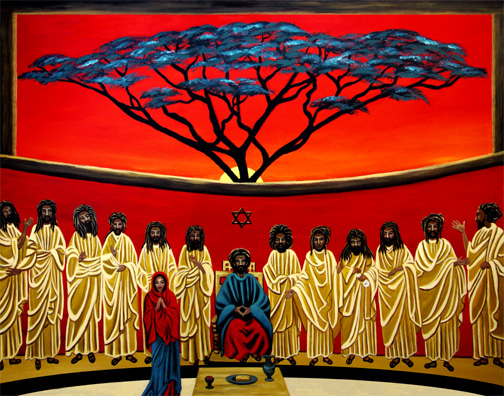
In the beginning was the Word, and the Word was with God, and the Word was God (John 1:1):
In this opening verse of John’s Gospel, God is set in relation to the Word. The Word, which in verses 14-18 is clearly identified as Jesus Christ, is an eternal being that existed prior to creation. However, it is not simply that the Word was with God (so, too, was Isaiah’s personified Word and Wisdom), but John refers to the Word itself as God. This is quite a claim coming from a Jewish monotheist. From the patristic era (Arius) to the present (Jehovah’s Witnesses), some have argued that, because there is no definite article in front of theos, this verse merely identifies Jesus as a god rather than as God. Interestingly, around 1950 there was a change in how Jehovah’s Witnesses dealt with this verse. Before 1950, they carried a copy of the American Standard Version of the Bible. However, the problem they faced was that the ASV rendered verse 1 accurately with the phrase “the Word was God.” In an effort to resolve the difficulty this rendering posed for its theology, the Watchtower Society (the Jehovah’s Witnesses’ publishing group) issued its own translation of the Bible, which rendered the verse as “the Word was a god” (Reed 1986, 71). However, there are several reasons why this translation is inaccurate.
First, John, as a monotheistic Jew, would not have referred to another person as “a god.” The Jews had no place for demigods in their belief system. Second, if John had placed a definite article before theos, he would have abandoned the distinction between the two persons he established in the previous clause (“the Word was with God”). Third, the view defended by Jehovah’s Witnesses misunderstands Greek syntax. It is common in Greek for a predicate noun to be specific without having an article. For example, later in this chapter reference is made to Nathanael’s confession of Jesus, “you are the King of Israel” (1:49), with no article being before “King” in the Greek (for other NT examples of this construction, see 8:39; 17:17; Rom 14:17; Gal 4:25; Rev 1:20). From these examples, it is clear that the lack of an article in Greek does not necessarily imply indefiniteness (“a” god). Finally, John could have used the word theios if he were simply trying to say that Jesus was “divine” (i.e., that he had God-like qualities) rather than being God himself. The anarthrous (article-less) theos is most likely used to explain that Jesus “shared the essence of the Father though they differed in person” (Wallace 1996, 269). As D. A. Carson explains, “In fact, if John had included the article, he would have been saying something quite untrue. He would have been so identifying the Word with God that no divine being could exist apart from the Word. In that case, it would be nonsense to say (in the words of the second clause of this verse) that the Word was with God” (1991, 117).
The Word was with God, and the Word was God (1:1): Critics often say that the Christian doctrine of the Trinity is unbiblical. While it is true that no verse specifically spells out that God is “three divine persons in one essence,” as our historic creeds have stated, the fact is the biblical witness demands the Trinitarian doctrine. The present verse disproves any monistic model of God, for the Word is at one and the same time “with” God, meaning there is some way of making distinction between Word and God, while at the same time the Word is God. Hence from this verse one would conclude that there are at least two personal beings united in the one godhead. A sampling of other verses supporting Trinitarianism includes Genesis 1:26; Isaiah 9:6; Matthew 28:19; 1 Corinthians 2:10; and Colossians 1:17.
Holman Apologetics Commentary on the Bible – Gospels to Acts.
page 505
The Mystery of Jesus’ Sacrifice –Richard Wurmbrand
Suppose you were living 2,000 years ago in Palestine, that you were sinful, heavy with guilt, and Jesus told you, “Your sin is grave and deserves punishment. ‘The wages of sin are death.’ But tomorrow I will be flogged and crowned with a crown of thorns for you—I invite you to assist them when they drive nails into My hands and feet and fix Me to a cross. I will cry in anguish, and I will share the sorrow of My mother whose heart will be pierced by compassion for Me as if by a sword. You should be there to hear My cries. And when I have died, you shall know that your sins are forgiven forever, that I was your substitute, your scapegoat. This is how a man gets saved. Will you accept My suffering for your offense, or do you prefer to bear the punishment yourself?” What would you have answered?
I believe that this dilemma should be placed before a soul seeking salvation. Fifteen hundred years before the historical birth of Christ the Bible says, “Today I have begotten You” (Psalm 2:7). It also says to the penitent 2,000 years after Golgotha, “Today I die for you.” Jesus’ life and death are outside of time and space.
Would you accept? More than once in Communist prisons I have seen a pastor receive a beating to the blood in place of another prisoner. A name would be called and the pastor would simply say, “It is I.” In Auschwitz, Maximilian Kolbe, a priest, offered to take the place of a Pole sentenced to death by the Nazis. The Pole was the father of many children. The commandant of the camp accepted the substitution and the Pole was spared. Kolbe died by asphyxiation. Had you been that Pole, what would you have decided?
I lived many years in an isolated subterranean prison cell, in timelessness, something akin to the weightlessness experienced by astronauts. Just as they know no difference between heavy and light, I knew no distinction between past, present, and future. In my prison cell Jesus’ presence was immediate. His life did not belong to the past, nor was it a series of successive events. He put before me the problem I have just put to you. He told me, “You are a sinner and are condemned to eternal punishment for your transgressions, but I am ready to save you. Because of your sin, I will endure rejection, flogging, being spat upon, being crowned with a crown of thorns, the pains of crucifixion, and the agony of seeing my mother brokenhearted at the foot of the cross. My blood will cleanse you from all sin.” I had to decide whether or not to accept the sacrifice of the innocent Son of God for my sins. I believed that to accept would be a greater wickedness than all I might ever have done in my life and I flatly refused this proposal. Jesus was glad about my “No.”
Then came the real question, the thing He had had in mind from the beginning. “What if I incorporate your being into Mine, if you become part of My body, if you deny yourself as an independent self, and I will live in you henceforth and you will be ‘crucified with me’ (Galatians 2:20), ‘buried with me’ (Romans 6:4), and share the fellowship of My suffering (Philippians 3:10)? People in churches will sing, ‘safe in arms of Jesus,’ while you will be safe as an arm of Jesus, nailed like His to a cross, but also imparting goodness like His. Do you wish to become My co-worker for the salvation of mankind, alleviating sufferings, filling up ‘what is lacking in the afflictions of Christ’
I have accepted this proposal. Christians are meant to have the same vocation as their King, that of cross-bearers. It is this consciousness of a high calling and of partnership with Jesus which brings gladness in tribulation, which makes Christians enter prisons for their faith with the joy of a bridegroom entering the bridal room.
When George Vins, the general secretary of the Baptist Union of the USSR, was sentenced for his faith, believers in the courtroom covered him with flowers. His little daughter, hoisted on a stool, recited in front of the Communist judges, “Father, with Christ you are free in prison, and freedom without Him is prison.” The believers waiting outside the building received him with a Christian hymn.
The relative of a Christian prisoner in Red China said to someone who sympathized with her, “You should not feel sorry for us, for if he were not in that slave labor camp, how could the others here come to know the gospel of the Lord Jesus?”
In the same spirit we should receive the crosses of poverty, racial discrimination, personal betrayals, unfaithfulness of marriage partners, rebellion of children, and all other sorrows of life.
A man who smugly accepts Christ’s dying for him and shouts Hallelujah about the innocent Son of God receiving punishment he himself deserves should be more severely punished than before. The gospel, the good news, is the privilege of becoming a member of the Body of Christ, of suffering, of dying in pain with Him, and also of being resurrected with Him in glory.
Because sacrifice is implicit in a conversion, the call of an evangelist has the name “altar call.” Every being placed upon the altar in Jerusalem—lambs, rams, and pigeons—died. Someone dies for you. This time it is not an animal, but the Son of God. He has decreed it and nothing you can do will change His mind. You can only ask for the privilege of henceforth being able to sacrifice yourself as well, for the glory of God and for the good of your fellowmen. In return you receive the right to die to sin and to the world and its laws.
The reality of a conversion is in becoming one with Him. It is shameful and abominable to accept His substitutionary death otherwise.
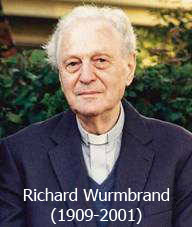
Wurmbrand, Richard (2000-01-01). 100 Prison Meditations: Cries of Truth from Behind the Iron Curtain *(Kindle Locations 93-134). Living Sacrifice Book Company. Kindle Edition.
* Available for $1.00 on Kindle
U2 Connections: Eugene Peterson and The Message
 U2 Connections: Eugene Peterson.
Eugene Peterson, theologian, pastor, poet and translator of The Message bible. U2 uses The Message Bible in concerts and some lyrics.

The Promised Helper (John 14:15-17)—William Barclay
The Promised Helper (John 14:15-17)
14:15-17 “If you love me, keep my commandments; and I will ask the Father and he will give you another helper to be with you for ever, I mean the Spirit of Truth. The world cannot receive him, because it does not see him or know him. But you know him because he remains among you and will be within you.”

William Barclay 1907-1978
To John there is only one test of love and that is obedience. It was by his obedience that Jesus showed his love of God; and it is by our obedience that we must show our love of Jesus. C. K. Barrett says: “John never allowed love to devolve into a sentiment or emotion. Its expression is always moral and is revealed in obedience.” We know all too well how there are those who protest their love in words but who, at the same time, bring pain and heartbreak to those whom they claim to love. There are children and young people who say that they love their parents, and who yet cause them grief and anxiety. There are husbands who say they love their wives and wives who say they love their husbands, and who yet, by their inconsiderateness and their irritability and their thoughtless unkindness bring pain the one to the other. To Jesus real love is not an easy thing. It is shown only in true obedience.
But Jesus does not leave us to struggle with the Christian life alone. He would send us another Helper. The Greek word is the word parakletos which is really untranslatable. The King James Version renders it Comforter, which, although hallowed by time and usage, is not a good translation. Moffatt translates it Helper. It is only when we examine this word parakletos in detail that we catch something of the riches of the doctrine of the Holy Spirit. It really means someone who is called in; but it is the reason why the person is called in which gives the word its distinctive associations. The Greeks used the word in a wide variety of ways. A parakletos (might be a person called in to give witness in a law court in someone’s favour; he might be an advocate called in to plead the cause of someone under a charge which would issue in serious penalty; he might be an expert called in to give advice in some difficult situation; he might be a person called in when, for example, a company of soldiers were depressed and dispirited to put new courage into their minds and hearts. Always a parakletos is someone called in to help in time of trouble or need. Comforter was once a perfectly good translation. It actually goes back to Wicliffe, the first person to use it. But in his day it meant much more than it means now. The word comes from the Latin fortis which means brave; and a comforter was someone who enabled some dispirited creature to be brave. Nowadays comfort has to do almost solely with sorrow; and a comforter is someone who sympathizes with us when we are sad. Beyond a doubt the Holy Spirit does that, but to limit his work to that function is sadly to belittle him. We often talk of being able to cope with things. That is precisely the work of the Holy Spirit. He takes away our inadequacies and enables us to cope with life. The Holy Spirit substitutes victorious for defeated living.
So what Jesus is saying is: “I am setting you a hard task, and I am sending you out on a very difficult engagement. But I am going to send you someone, the parakletos , who will guide you as to what to do and enable you to do it.”
Jesus went on to say that the world cannot recognize the Spirit. By the world is meant that section of men who live as if there was no God. The point of Jesus’ saying is: we can see only what we are fitted to see. An astronomer will see far more in the sky than an ordinary man. A botanist will see far more in a hedgerow than someone who knows no botany. Someone who knows about art will see far more in a picture than someone who is quite ignorant of art. Someone who understands a little about music will get far more out of a symphony than someone who understands nothing. Always what we see and experience depends on what we bring to the sight and the experience. A person who has eliminated God never listens for him; and we cannot receive the Holy Spirit unless we wait in expectation and in prayer for him to come to us.
The Holy Spirit gate-crashes no man’s heart; He waits to be received. So when we think of the wonderful things which the Holy Spirit can do, surely we will set apart some time amidst the bustle and the rush of life to wait in silence for his coming.
Barclay’s Daily Study Bible (NT).
Hallelujah is the highest praise!–YouTube
 St. John One: One