
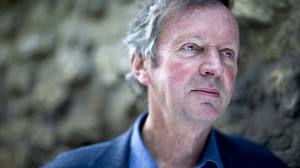
David Berlinski
THE IDEA that human beings have been endowed with powers and properties not found elsewhere in the animal kingdom—or the universe, so far as we can tell—arises from a simple imperative: Just look around. It is an imperative that survives the invitation fraternally to consider the great apes. The apes are, after all, behind the bars of their cages and we are not. Eager for the experiments to begin, they are impatient for their food to be served. They seem impatient for little else. After years of punishing trials, a few of them have been taught the rudiments of various primitive symbol systems. Having been given the gift of language, they have nothing to say. When two simian prodigies meet, they fling their signs at one another. More is expected, but more is rarely forthcoming. Experiments conducted by Dorothy Cheney and Robert Seyfarth—and they are exquisite—indicate that like other mammals, baboons have a rich inner world, something that only the intellectual shambles of behavioral psychology could ever have placed in doubt. Simian social structures are often intricate. Chimpanzees, bonobos, and gorillas reason; they form plans; they have preferences; they are cunning; they have passions and desires; and they suffer. The same is true of cats, I might add. In much of this, we see ourselves. But beyond what we have in common with the apes, we have nothing in common, and while the similarities are interesting, the differences are profound. If human beings are as human beings think they are, then religious ideas about what they are gain purchase. These ideas are ancient. They have arisen spontaneously in every culture. They have seemed to men and women the obvious conclusions to be drawn from just looking around. An enormous amount of intellectual effort has accordingly been invested in persuading men and women not to look around. “The idea that human minds are the product of evolution is ‘unassailable fact.’ ” Thus Nature in an editorial. Should anyone have missed the point, Nature made it again: “With all deference to the sensibilities of religious people, the idea that man was created in the image of God can surely be put aside.” Those not willing to put such sentiments aside, the scientific community has concluded, are afflicted by a form of intellectual ingratitude.
Berlinski, David (2009-08-26). The Devil’s Delusion: Atheism and its Scientific Pretensions (pp. 155-157). Perseus Books Group. Kindle Edition.







 St. John One: One