I AM A CONVINCED UNIVERSALIST — by William Barclay


William Barclay 1907-1978

William Barclay 1907-1978

I am a convinced universalist. I believe that in the end all men will be gathered into the love of God. In the early days Origen was the great name connected with universalism. I would believe with Origen that universalism is no easy thing. Origen believed that after death there were many who would need prolonged instruction, the sternest discipline, even the severest punishment before they were fit for the presence of God. Origen did not eliminate hell; he believed that some people would have to go to heaven via hell. He believed that even at the end of the day there would be some on whom the scars remained. He did not believe in eternal punishment, but he did see the possibility of eternal penalty. And so the choice is whether we accept God’s offer and invitation willingly, or take the long and terrible way round through ages of purification.

Gregory of Nyssa offered three reasons why he believed in universalism. First, he believed in it because of the character of God. “Being good, God entertains pity for fallen man; being wise, he is not ignorant of the means for his recovery.” Second, he believed in it because of the nature of evil. Evil must in the end be moved out of existence, “so that the absolutely non-existent should cease to be at all.” Evil is essentially negative and doomed to non-existence. Third, he believed in it because of the purpose of punishment. The purpose of punishment is always remedial. Its aim is “to get the good separated from the evil and to attract it into the communion of blessedness.” Punishment will hurt, but it is like the fire which separates the alloy from the gold; it is like the surgery which removes the diseased thing; it is like the cautery which burns out that which cannot be removed any other way.

But I want to set down not the arguments of others but the thoughts which have persuaded me personally of universal salvation.

First, there is the fact that there are things in the New Testament which more than justify this belief. Jesus said: “I, when I am lifted up from the earth, will draw all men to myself” (John 12:32). Paul writes to the Romans: “God has consigned all men to disobedience that he may have mercy on all” (Rom. 11:32). He writes to the Corinthians: “As in Adam all die, so also in Christ shall all be made alive” (1 Cor. 15:22); and he looks to the final total triumph when God will be everything to everyone (1 Cor. 15:28). In the First Letter to Timothy we read of God “who desires all men to be saved and to come to the knowledge of the truth,” and of Christ Jesus “who gave himself as a ransom for all” (1 Tim 2:4-6). The New Testament itself is not in the least afraid of the word all.

Second, one of the key passages is Matthew 25:46 where it is said that the rejected go away to eternal punishment, and the righteous to eternal life. The Greek word for punishment is kolasis, which was not originally an ethical word at all. It originally meant the pruning of trees to make them grow better. I think it is true to say that in all Greek secular literature kolasis is never used of anything but remedial punishment. The word for eternal is aionios. It means more than everlasting, for Plato – who may have invented the word – plainly says that a thing may be everlasting and still not be aionios. The simplest way to out it is that aionios cannot be used properly of anyone but God; it is the word uniquely, as Plato saw it, of God. Eternal punishment is then literally that kind of remedial punishment which it befits God to give and which only God can give.

Third, I believe that it is impossible to set limits to the grace of God. I believe that not only in this world, but in any other world there may be, the grace of God is still effective, still operative, still at work. I do not believe that the operation of the grace of God is limited to this world. I believe that the grace of God is as wide as the universe.

Fourth, I believe implicitly in the ultimate and complete triumph of God, the time when all things will be subject to him, and when God will be everything to everyone (1 Cor. 15:24-28). For me this has certain consequences. If one man remains outside the love of God at the end of time, it means that that one man has defeated the love of God – and that is impossible. Further, there is only one way in which we can think of the triumph of God. If God was no more than a King or Judge, then it would be possible to speak of his triumph, if his enemies were agonizing in hell or were totally and completely obliterated and wiped out. But God is not only King and Judge, God is Father – he is indeed Father more than anything else. No father could be happy while there were members of his family for ever in agony. No father would count it a triumph to obliterate the disobedient members of his family. The only triumph a father can know is to have all his family back home. The only victory love can enjoy is the day when its offer of love is answered by the return of love. The only possible final triumph is a universe loved by and in love with God.

[Quoted from William Barclay: A Spiritual Autobiography, pg 65-67, William B Eerdmans Publishing Company, Grand Rapids, 1977.]

Professor of Divinity and Biblical Criticism at Glasgow University and the author of many Biblical commentaries and books, including a translation of the New Testament, Barclay New Testament, and The Daily Study Bible Series.

The Promised Helper (John 14:15-17)—William Barclay


The Promised Helper (John 14:15-17)

14:15-17 “If you love me, keep my commandments; and I will ask the Father and he will give you another helper to be with you for ever, I mean the Spirit of Truth. The world cannot receive him, because it does not see him or know him. But you know him because he remains among you and will be within you.”

William Barclay 1907-1978

William Barclay 1907-1978

To John there is only one test of love and that is obedience. It was by his obedience that Jesus showed his love of God; and it is by our obedience that we must show our love of Jesus. C. K. Barrett says: “John never allowed love to devolve into a sentiment or emotion. Its expression is always moral and is revealed in obedience.” We know all too well how there are those who protest their love in words but who, at the same time, bring pain and heartbreak to those whom they claim to love. There are children and young people who say that they love their parents, and who yet cause them grief and anxiety. There are husbands who say they love their wives and wives who say they love their husbands, and who yet, by their inconsiderateness and their irritability and their thoughtless unkindness bring pain the one to the other. To Jesus real love is not an easy thing. It is shown only in true obedience.
But Jesus does not leave us to struggle with the Christian life alone. He would send us another Helper. The Greek word is the word parakletos which is really untranslatable. The King James Version renders it Comforter, which, although hallowed by time and usage, is not a good translation. Moffatt translates it Helper. It is only when we examine this word parakletos  in detail that we catch something of the riches of the doctrine of the Holy Spirit. It really means someone who is called in; but it is the reason why the person is called in which gives the word its distinctive associations. The Greeks used the word in a wide variety of ways. A parakletos (might be a person called in to give witness in a law court in someone’s favour; he might be an advocate called in to plead the cause of someone under a charge which would issue in serious penalty; he might be an expert called in to give advice in some difficult situation; he might be a person called in when, for example, a company of soldiers were depressed and dispirited to put new courage into their minds and hearts. Always a parakletos is someone called in to help in time of trouble or need. Comforter was once a perfectly good translation. It actually goes back to Wicliffe, the first person to use it. But in his day it meant much more than it means now. The word comes from the Latin fortis which means brave; and a comforter was someone who enabled some dispirited creature to be brave. Nowadays comfort has to do almost solely with sorrow; and a comforter is someone who sympathizes with us when we are sad. Beyond a doubt the Holy Spirit does that, but to limit his work to that function is sadly to belittle him. We often talk of being able to cope with things. That is precisely the work of the Holy Spirit. He takes away our inadequacies and enables us to cope with life. The Holy Spirit substitutes victorious for defeated living.
So what Jesus is saying is: “I am setting you a hard task, and I am sending you out on a very difficult engagement. But I am going to send you someone, the parakletos , who will guide you as to what to do and enable you to do it.”
Jesus went on to say that the world cannot recognize the Spirit. By the world is meant that section of men who live as if there was no God. The point of Jesus’ saying is: we can see only what we are fitted to see. An astronomer will see far more in the sky than an ordinary man. A botanist will see far more in a hedgerow than someone who knows no botany. Someone who knows about art will see far more in a picture than someone who is quite ignorant of art. Someone who understands a little about music will get far more out of a symphony than someone who understands nothing. Always what we see and experience depends on what we bring to the sight and the experience. A person who has eliminated God never listens for him; and we cannot receive the Holy Spirit unless we wait in expectation and in prayer for him to come to us.
The Holy Spirit gate-crashes no man’s heart; He waits to be received. So when we think of the wonderful things which the Holy Spirit can do, surely we will set apart some time amidst the bustle and the rush of life to wait in silence for his coming.
Barclay’s Daily Study Bible (NT).

Shall We Burn One Another at the Stake?–Michael Brown


Michael Brown

Michael Brown

Shall We Burn One Another at the Stake?.

Authentic Fire

Profile | How is God the Creator? (William Dembski) | Closer to Truth


DembskiProfile | How is God the Creator? (William Dembski) | Closer to Truth.

Peace doesn’t come upon us in the new covenant; it did in the old–Graham Cooke


graham cooke“Peace doesn’t come upon us in the new covenant; it did in the old. In the new
covenant it rises up because Christ is within. God doesn’t speak to us from
outside, He speaks to us from in here. God doesn’t speak to our head, He speaks
to our heart. He speaks to the inner man and that thought rises up and takes
possession of our thinking.”

Top Five Myths Christians (and Non-Christians) Often Believe About Intelligent Design | Hard-Core Christianity


by Melissa Cain Travis

http://hcchristian.wordpress.com/2012/10/24/top-five-myths-christians-and-non-christians-often-believe-about-intelligent-design/

Our God Jesus Christ: Testimonies from Early Church Fathers


god-jesus-christOur God Jesus Christ: Testimonies from Early Church Fathers.

▶ Willie & Phil Robertson talk about A&E editing in fake bleeps and editing out Phil praying in Jesus’ name – YouTube


Hallelujah is the highest praise!–YouTube


https://www.youtube.com/watch?v=tjjNu1nj0lc&feature=youtube_gdata_player

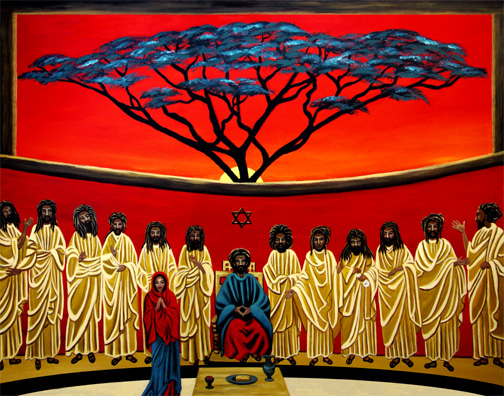
last supper