from Believing in the 21st Century:Chapter Seven
an exhortation..as
a lay Christian examines his faith..
By James Ross Kelly
So again, how does any one judge this veracity? Some say it is truth in that it is mythological truth. I must say adamantly I know I know Him, not the myth of Him. Myth operates as powerful archetype in the human psyche. However the Gospel of John and all the Gospels are presented not as mythos. There is a sense that it could be viewed as a real myth (cf., C.S. Lewis through the Shadowlands, Sibley). Still it comes to us as a story. A story that is told as a true story. It survives as a compelling story from ancient times. Yet again, there seems to be a media friendly secular scholastic conjecture that there was an epistemological cabal involved. One which in a carefully orchestrated fiction was designed to belie and foster a following. Well if so, the purveyors of it all paid with their lives and made no money in doing so, nor any material gain whatsoever. Too many things stack up that surge against this secular conceit.
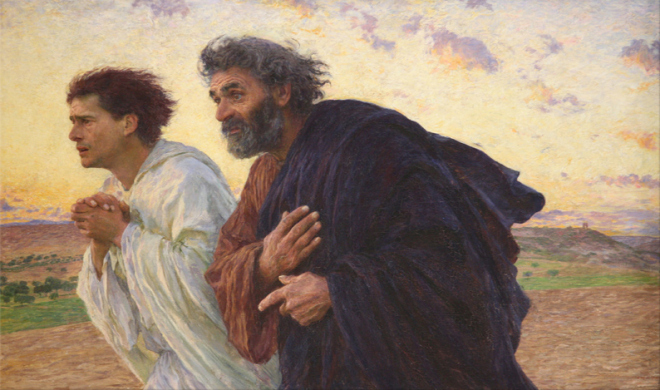
The reality is that the message spread of the good news that a Savior came to earth and died for all people on the planet throughout the Judeo/Roman/Hellenistic Mediterranean in less than twenty years. All the time the message was accompanied by the same miracles that were evidenced during Christ Jesus’s lifetime— and all done mostly through working class men of the times. The letters of the New Testament were written to various Mediterranean cultures and appeared synchronously through all the trade routes with small congregations of believers in their wake. Matthew was written to the Jewish congregations. Mark mostly likely is an account given from Peter to a disciple named John Mark and was for a population in Rome. Luke was written from a Greek view point by a Physician who traveled with Paul who interviewed the principals involve with the story. Many of these men had seen, walked with, and touched the Christ. All three may have drawn from the extant Gospel of Mark or another now lost early Manuscript referred to by scholars as ‘Q’ (meaning source).3 A manuscript which may have been from Peter’s own hand. John was written later. Do they differ? Yes, slightly. . As evidenced by John’s setting the record straight about who, got to the tomb first. But in context they do not differ in content and purpose. Jesus is the Messiah by all Gospel accounts. Attempts to make it other than that, by some form of “Christological” fabrication on the part of early or later believers comes from a doubting world that has not given the Gospel message its objective due—as simply being exactly what it is purported to be—Good News! It purports to be the Good News of a message from God for the salvation of mankind! All mankind for all time! There is nothing quite like this. A critical examination of the Gospels for what they are as “a story” and a truly objective look at the Archeological record of the manuscripts themselves has an unmistakable presentiment that there has been no other phenomenon like it.
Some have suggested that the disciples, during the years following Jesus death, simply fabricated their accounts of Jesus as the advent of an ecclesiastical cabal. These critics say that the disciples, in an attempt to enhance the authority of Jesus Christ, then published the story that Jesus “claimed to be,” God and was resurrected. Anyone should consider the historical evidence fairly before giving any credence to this conjecture of history. First, the apostles were continually threatened and pressured to deny their Lord Jesus Christ during their ministry. To this end they were constantly under the pressure of torture and martyrdom. However, none of these men who spent time with Jesus chose to save their lives by denying their faith in Him, nor did they deny the fact that He was Who-He-claimed-to-be.
Papyri fragments exist of portions of the New Testament:1. Chester Beatty Biblical Papyri (dated 200-250 A.D.)was made public in 1931 and contains the Gospels, Acts, Paul’s Epistles, and Revelation. 2. Payprus Bodmer Ii (dated 200 A.D.)this discovery announced in 1956 contains fourteen chapters of John, and portions of the last seven chapters.3.John Rylands Mss (dated 130 A.D.). This is oldest fragment of the new Testament books. “Because of its early date and location (Egypt), some distance from the traditional place of composition (Asia Minor), this portion of the Gospel of John tends to confirm the traditional date of the composition of the Gospel.“ General Introduction To The Bible, Geisler & Nix
Recent Biblical scholarship into the “Historical Jesus,” such as the “Jesus Seminar,” and others, claim late dates of the Authorship of the Gospels. Most of these sources deny that the Gospel of John was written by the Apostle John and put a late date (2nd or 3rd Century) on its authorship. There is really little evidence to support these claims. Yet there is much evidence that shows tradition is correct and that the Author of the Gospel that claims Christ’s Deity was the Apostle John, “the disciple whom Jesus loved.” W. Graham Scroggie in his critical work, Guide to the Gospels provides ample objective evidence to refute this Modern, Post-Modern and de-constructionist notion about authorship of the Gospel of John.
Indirect Internal Evidence [that the author of the Gospel of John was the Apostle John]
(a)The Author was a Jew.
He is familiar with Jewish opinions and customs, his composition is impressed with Jewish characteristics, he is penetrated with the spirit of the Jewish dispensation. the vocabulary, the structure of the sentences, the symmetry and arrangement of the thoughts, are essentially Hebrew. The Old Testament is the source of the religious life of the writer. His Jewish opinions and hopes are taken up into and transfigured by his Christian faith, but the Jewish foundation underlies his whole narrative. The Evangelist vindicates the Law as of Divine authority.
(b) The Author was a Jew of Palestine.
This was proved by his local knowledge. He speaks of places with an unaffected precision, as familiar in every case with the scene which he wishes to recall; he moves about in a country which he knows ( “John 1:28; “2:1; “2:11; “3:23; “4:46; “11:18, “11:54; “21:1, “21:2). The writer of the Fourth Gospel is evidently at home in Jerusalem as it was before its fall in AD 70 ( “5:2; “9:7; “18:1; “19:13;* “19:17; “19:20; “19:41). He has an accurate knowledge of the Temple and its ritual (“2:14-16; “2:20; “10:22; especially chapters. “7 , “8). The author’s quotations from the old Testament show that he was not dependent on the Septuagint (LXX), but was acquainted with the original Hebrew.
(c) The Author was an Eye-witness to what he describes.
His narrative is marked by minute details of persons, and time, an number, and place, and manner, which cannot but have come from a direct experience.Persons: “John 6:5, “6:7; “7:21; “14:5; “14:8; “14:22; “13:25; “3:1;”7:50; “19:39; “11:1; “12:1; “12:4; “13:2; “13:26;”18:10; “18:13;;”18:26;
Time: “John 2:13; “2:23; “5:1; “6:4; “7:2; “10:22; also “1:29, “1:35, “1:43; “2:1 ;”12:1; “12:12; “13:1; “19:31; “20:1, “20:26; “4:6 “4:52; “19:14; “13:30 “18:28; “20:1, “21:4;”6:16; “20:19; “3:2Number:”1:35; “2:6; “6:9, “6:19; “19:3; “21:8, “21:11; also, “4:18; “5:5; “7:5; “19:39
Place: “John 1:28; “3:23; “4:46; “5:14; “6:59; “8:20; “10:40; “11:30, “11:54; “11:56; “18:1
Manner: “1:35-51; “8:10-20; “18:1 “5:27; “21:1-14
Other details: “John 6:9; “11:32; “12:3, “12:13; “13:30; “18:3; “19:3; “20:7; “21:17; also, “13:24; “18:6; “19:5; “21:20
(d) The Author was an Apostle
This follows almost necessarily from the character of the scenes, which he describes. He exhibits intimate acquaintances with the feelings of the ‘the disciples.’ He knows their thoughts at critical moments (“John 2:11; “2:17; “2:22; “6:19; “6:60; “12:16; “13:22; “13:28; “21:12). He had an intimate knowledge of Jesus (” 11:33; “13:21; “2:24; “4:1; “5:6; “6:15; “7:1; “16:19; “6:6; “6:61; “6:64; “13:1; “13:3; “13:11; “18:4; “19:28).
(e) The Author was the Apostle John
As the writer is exact in defining the names in his Gospel (“1:42; “11:16; “20:24; “21:2; “6:71; “12:4;”13:2; “13:26;”14:22) it is presumed that the unnamed person of “13:23; “19:26; “20:2; “21:7; “21:20 is himself. If someone else had written this gospel it is unthinkable that he would not have mentioned by name so distinguished an Apostle as John. W. Graham Scroggie. Guide to the Gospels pp.135-139 — summary of an argument from Westcott.