Author / James Ross Kelly

Watch “Freewill & Fellowship in Growing Up In God by Graham Cooke.” on YouTube
Watch “Exodus of Israel from Egypt – REVEALED – Hard Evidence in Red Sea” on YouTube
Mall Santa
John 1:1 — “it is not simply that the Word was with God” from Holloman’s Apologetics Commentary on the Bible
In the beginning was the Word, and the Word was with God, and the Word was God (John 1:1):

In this opening verse of John’s Gospel, God is set in relation to the Word. The Word, which in verses 14-18 is clearly identified as Jesus Christ, is an eternal being that existed prior to creation. However, it is not simply that the Word was with God (so, too, was Isaiah’s personified Word and Wisdom), but John refers to the Word itself as God. This is quite a claim coming from a Jewish monotheist. From the patristic era (Arius) to the present (Jehovah’s Witnesses), some have argued that, because there is no definite article in front of theos, this verse merely identifies Jesus as a god rather than as God. Interestingly, around 1950 there was a change in how Jehovah’s Witnesses dealt with this verse. Before 1950, they carried a copy of the American Standard Version of the Bible. However, the problem they faced was that the ASV rendered verse 1 accurately with the phrase “the Word was God.” In an effort to resolve the difficulty this rendering posed for its theology, the Watchtower Society (the Jehovah’s Witnesses’ publishing group) issued its own translation of the Bible, which rendered the verse as “the Word was a god” (Reed 1986, 71). However, there are several reasons why this translation is inaccurate.
First, John, as a monotheistic Jew, would not have referred to another person as “a god.” The Jews had no place for demigods in their belief system. Second, if John had placed a definite article before theos, he would have abandoned the distinction between the two persons he established in the previous clause (“the Word was with God”). Third, the view defended by Jehovah’s Witnesses misunderstands Greek syntax. It is common in Greek for a predicate noun to be specific without having an article. For example, later in this chapter reference is made to Nathanael’s confession of Jesus, “you are the King of Israel” (1:49), with no article being before “King” in the Greek (for other NT examples of this construction, see 8:39; 17:17; Rom 14:17; Gal 4:25; Rev 1:20). From these examples, it is clear that the lack of an article in Greek does not necessarily imply indefiniteness (“a” god). Finally, John could have used the word theios if he were simply trying to say that Jesus was “divine” (i.e., that he had God-like qualities) rather than being God himself. The anarthrous (article-less) theos is most likely used to explain that Jesus “shared the essence of the Father though they differed in person” (Wallace 1996, 269). As D. A. Carson explains, “In fact, if John had included the article, he would have been saying something quite untrue. He would have been so identifying the Word with God that no divine being could exist apart from the Word. In that case, it would be nonsense to say (in the words of the second clause of this verse) that the Word was with God” (1991, 117).
The Word was with God, and the Word was God (1:1): Critics often say that the Christian doctrine of the Trinity is unbiblical. While it is true that no verse specifically spells out that God is “three divine persons in one essence,” as our historic creeds have stated, the fact is the biblical witness demands the Trinitarian doctrine. The present verse disproves any monistic model of God, for the Word is at one and the same time “with” God, meaning there is some way of making distinction between Word and God, while at the same time the Word is God. Hence from this verse one would conclude that there are at least two personal beings united in the one godhead. A sampling of other verses supporting Trinitarianism includes Genesis 1:26; Isaiah 9:6; Matthew 28:19; 1 Corinthians 2:10; and Colossians 1:17.
Holman Apologetics Commentary on the Bible – Gospels to Acts.
page 505
Charasmatic Catholicism Grows In Latino Communities–From NPR News
 A Different Kind Of Catholicism Grows In Latino Communities http://n.pr/1gMpCYp
Andrew Cuomo Puts Up a ‘Catholics Need Not Reside’ Sign in New York | National Review Online
The Mystery of Jesus’ Sacrifice –Richard Wurmbrand
Suppose you were living 2,000 years ago in Palestine, that you were sinful, heavy with guilt, and Jesus told you, “Your sin is grave and deserves punishment. ‘The wages of sin are death.’ But tomorrow I will be flogged and crowned with a crown of thorns for you—I invite you to assist them when they drive nails into My hands and feet and fix Me to a cross. I will cry in anguish, and I will share the sorrow of My mother whose heart will be pierced by compassion for Me as if by a sword. You should be there to hear My cries. And when I have died, you shall know that your sins are forgiven forever, that I was your substitute, your scapegoat. This is how a man gets saved. Will you accept My suffering for your offense, or do you prefer to bear the punishment yourself?” What would you have answered?
I believe that this dilemma should be placed before a soul seeking salvation. Fifteen hundred years before the historical birth of Christ the Bible says, “Today I have begotten You” (Psalm 2:7). It also says to the penitent 2,000 years after Golgotha, “Today I die for you.” Jesus’ life and death are outside of time and space.
Would you accept? More than once in Communist prisons I have seen a pastor receive a beating to the blood in place of another prisoner. A name would be called and the pastor would simply say, “It is I.” In Auschwitz, Maximilian Kolbe, a priest, offered to take the place of a Pole sentenced to death by the Nazis. The Pole was the father of many children. The commandant of the camp accepted the substitution and the Pole was spared. Kolbe died by asphyxiation. Had you been that Pole, what would you have decided?
I lived many years in an isolated subterranean prison cell, in timelessness, something akin to the weightlessness experienced by astronauts. Just as they know no difference between heavy and light, I knew no distinction between past, present, and future. In my prison cell Jesus’ presence was immediate. His life did not belong to the past, nor was it a series of successive events. He put before me the problem I have just put to you. He told me, “You are a sinner and are condemned to eternal punishment for your transgressions, but I am ready to save you. Because of your sin, I will endure rejection, flogging, being spat upon, being crowned with a crown of thorns, the pains of crucifixion, and the agony of seeing my mother brokenhearted at the foot of the cross. My blood will cleanse you from all sin.” I had to decide whether or not to accept the sacrifice of the innocent Son of God for my sins. I believed that to accept would be a greater wickedness than all I might ever have done in my life and I flatly refused this proposal. Jesus was glad about my “No.”
Then came the real question, the thing He had had in mind from the beginning. “What if I incorporate your being into Mine, if you become part of My body, if you deny yourself as an independent self, and I will live in you henceforth and you will be ‘crucified with me’ (Galatians 2:20), ‘buried with me’ (Romans 6:4), and share the fellowship of My suffering (Philippians 3:10)? People in churches will sing, ‘safe in arms of Jesus,’ while you will be safe as an arm of Jesus, nailed like His to a cross, but also imparting goodness like His. Do you wish to become My co-worker for the salvation of mankind, alleviating sufferings, filling up ‘what is lacking in the afflictions of Christ’
I have accepted this proposal. Christians are meant to have the same vocation as their King, that of cross-bearers. It is this consciousness of a high calling and of partnership with Jesus which brings gladness in tribulation, which makes Christians enter prisons for their faith with the joy of a bridegroom entering the bridal room.
When George Vins, the general secretary of the Baptist Union of the USSR, was sentenced for his faith, believers in the courtroom covered him with flowers. His little daughter, hoisted on a stool, recited in front of the Communist judges, “Father, with Christ you are free in prison, and freedom without Him is prison.” The believers waiting outside the building received him with a Christian hymn.
The relative of a Christian prisoner in Red China said to someone who sympathized with her, “You should not feel sorry for us, for if he were not in that slave labor camp, how could the others here come to know the gospel of the Lord Jesus?”
In the same spirit we should receive the crosses of poverty, racial discrimination, personal betrayals, unfaithfulness of marriage partners, rebellion of children, and all other sorrows of life.
A man who smugly accepts Christ’s dying for him and shouts Hallelujah about the innocent Son of God receiving punishment he himself deserves should be more severely punished than before. The gospel, the good news, is the privilege of becoming a member of the Body of Christ, of suffering, of dying in pain with Him, and also of being resurrected with Him in glory.
Because sacrifice is implicit in a conversion, the call of an evangelist has the name “altar call.” Every being placed upon the altar in Jerusalem—lambs, rams, and pigeons—died. Someone dies for you. This time it is not an animal, but the Son of God. He has decreed it and nothing you can do will change His mind. You can only ask for the privilege of henceforth being able to sacrifice yourself as well, for the glory of God and for the good of your fellowmen. In return you receive the right to die to sin and to the world and its laws.
The reality of a conversion is in becoming one with Him. It is shameful and abominable to accept His substitutionary death otherwise.
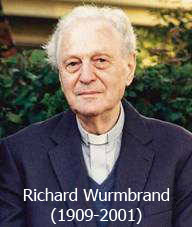
Wurmbrand, Richard (2000-01-01). 100 Prison Meditations: Cries of Truth from Behind the Iron Curtain *(Kindle Locations 93-134). Living Sacrifice Book Company. Kindle Edition.
* Available for $1.00 on Kindle
The Deity of Jesus is Not a Late Legend

Oil painting of Christ Resurrected painted from
the Shroud of Turin–2004 by Patricia Baehr Ross
from James Kelly collection
 St. John One: One