Reasons To Believe : Q&A: Is the Moon’s Recession Evidence for a Young Earth?.
Author / James Ross Kelly

Twenty-five years


A Conference with N. T. Wright: Interpreting Paul for the Future of the World
Review of Defining Inerrancy

Defining Inerrancy: Affirming a Defensible Faith for a New Generation, by J. P. Holding and Nick Peters, published by Tekton E-Bricks on 22 May 2014, is intended to be a response to Norm Geisler and Bill Roach’s Defending Inerrancy—and so much more. Both have a similar cover and similar title. Defining Inerrancy, however, is a gloves-off defense and affirmation of a version of inerrancy that many are not acquainted with. That is, many except those who are Old and New Testament scholars.
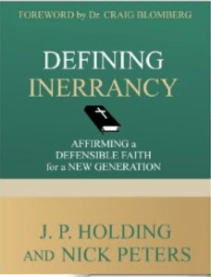

Defining Inerrancy also interacts heavily with Norm Geisler and David Farnell’s The Jesus Quest, a book published just last March. The info on Amazon says that the eBook is the equivalent of 98 pages long, based on the number of “page turns” on a Kindle. A preliminary Word draft of Defining Inerrancy, sent to me by the authors, weighs in at just 74…
View original post 1,522 more words
Reasons To Believe : Did Life Grease the Wheels on Plate Tectonics?


Wanderlust Productions | ‘God’s Not Dead’ and How Christian Films Are Kind of Like Horror Movies

Mother of newborn to be executed in Sudan because she will not recant Christ

Daniel Wani holds his newborn daughter for the first time.
Persecution Blog: By Choosing Christ, Her Children Will Be Orphans.
Overflowing love of God–N.T. Wright
 Jesus’ valuation of each human being is based not on
abstract egalitarian ideals, but on the overflowing love of
God, which, like a great river breaking its banks into a
parched countryside, irrigates those parts of human society
which until now had remained barren and unfruitful.
Wright, Tom (2001-01-19). Luke for Everyone (New Testament
for Everyone) (p. 131). SPCK. Kindle Edition.
Alpha Week 3 | Why Did Jesus Die? | Toby Flint | Summer 2014 – YouTube
God is Love (Grounds for the Trinity)

 Tertullian (c. 160-220 AD) is officially given credit for coining the term “Trinity” to refer to the triune nature of the Godhead (Father, Son, and Holy Spirit).
The Biblical text, specifically the NT, references the Father, Son, and Spirit in about 120 different passages (e.g. Matt 28:18-20; Jn 14-17; Acts 2:32-33, etc.), though not all references use the three together.
While “Trinity” is not actually used in the Scripture, all orthodox Christian traditions have accepted the term as a sufficient way of describing the three-in-one relationship of God, including my own denomination, the MCUSA.
Those that don’t embrace Trinitarian theology are Unitarians, Jehovah’s Witnesses, Oneness Pentecostals, Mormons, Christian Scientists, etc. According to orthodoxy, these so-called “Christian” groups are heretical (or cultic) for being anti-Trinitarian, and for other reasons related to Christology.
The Trinity Revealed by Jesus & the Apostles
I’ve heard skeptics and YouTube atheists claim that Constantine is responsible for belief in the Trinity, and for it becoming…
View original post 738 more words

