Tag / God
Christians, then, believe that an evil power has made himself for the present the Prince of this World.–C. S. Lewis

C.S. Lewis
Christians, then, believe that an evil power has made himself for the present the Prince of this World. And, of course, that raises problems. Is this state of affairs in accordance with God’s will, or not? If it is, He is a strange God, you will say: and if it is not, how can anything happen contrary to the will of a being with absolute power? But anyone who has been in authority knows how a thing can be in accordance with your will in one way and not in another. It may be quite sensible for a mother to say to the children, ‘I’m not going to go and make you tidy the schoolroom every night. You’ve got to learn to keep it tidy on your own.’ Then she goes up one night and finds the Teddy bear and the ink and the French Grammar all lying in the grate. That is against her will. She would prefer the children to be tidy. But on the other hand, it is her will which has left the children free to be untidy. The same thing arises in any regiment, or trade union, or school. You make a thing voluntary and then half the people do not do it. That is not what you willed, but your will has made it possible. It is probably the same in the universe. God created things which had free will. That means creatures which can go either wrong or right. Some people think they can imagine a creature which was free but had no possibility of going wrong; I cannot. If a thing is free to be good it is also free to be bad. And free will is what has made evil possible. Why, then, did God give them free will? Because free will, though it makes evil possible, is also the only thing that makes possible any love or goodness or joy worth having. A world of automata—of creatures that worked like machines—would hardly be worth creating. The happiness which God designs for His higher creatures is the happiness of being freely, voluntarily united to Him and to each other in an ecstasy of love and delight compared with which the most rapturous love between a man and a woman on this earth is mere milk and water. And for that they must be free.
Lewis, C. S. (2009-05-28). Mere Christianity (pp. 47-48). Harper Collins, Inc.. Kindle Edition.
Bishop Michael Byrnes | Alpha in a Catholic Context – YouTube
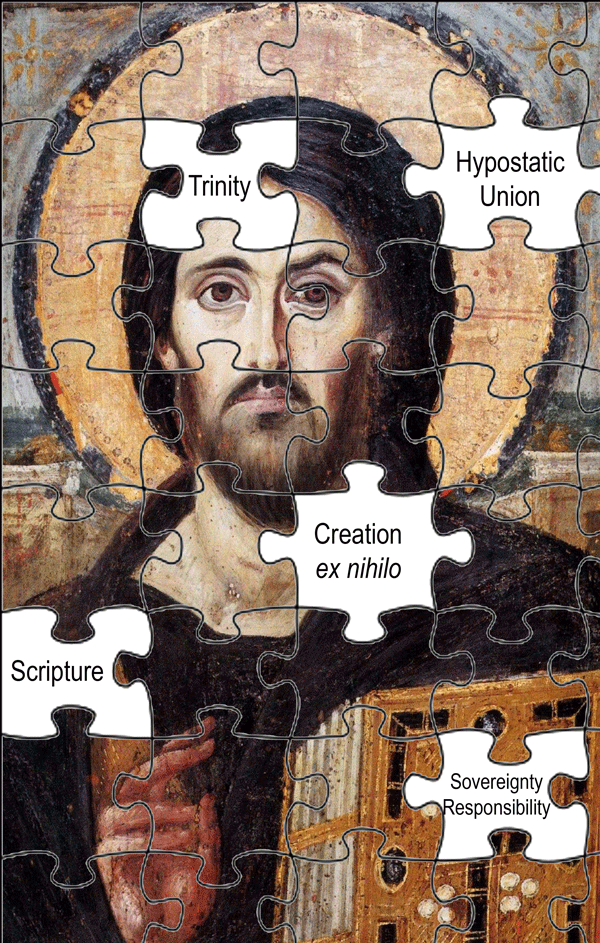
The Five Great Mysteries of the Christian Faith | Parchment and Pen
Profile | Does Consciousness Lead to God? (Rupert Sheldrake) | Closer to Truth

John MacArthur, You Are Fighting Against God–Darren Wilson

An Apologetics Reading Plan for Beginners – Apologetics 315
CADRE Comments: More Scientists Beleieve In God Than Atheists Want to Think
In a civilization like ours – C.S. Lewis
C.S. Lewis
In a civilization like ours, I feel that everyone has to come to terms with the claims of Jesus Christ upon his life, or else be guilty of inattention or of evading the question. – C.S. Lewis
Read the book of Leviticus and then turn to Acts— from “What is so Amazing about Grace?” by Phillip Yancy
You need only read the book of Leviticus and then turn to Acts to sense the seismic change. Whereas Old Testament worshipers purified themselves before entering the temple and presented their offerings to God through a priest, in Acts God’s followers (good Jews, most of them) were meeting in private homes and addressing God with the informal Abba. It was a familiar term of family affection like “Daddy,” and before Jesus no one would have thought of applying such a word to Yaweh, the Sovereign Lord of the Universe. After him it became the standard word used by the early Christians to address God in prayer.
Earlier, I drew a parallel of a visitor in the White House. No such visitor I said, could expect to barge into the Oval Office to see the President without an appointment. There are exceptions. During John F. Kennedy’s administration, photographers sometimes captured a winsome scene. Seated around the President’s desk in gray suits, cabinet members are debating matters of world consequence, such as the Cuban missile crisis. Meanwhile, a toddler, the two-year-old John-John, crawls atop the huge Presidential desk, oblivious to White House protocol and the weighty matters of state. John-John was simply visiting his daddy, and sometimes to his father’s delight he would wander into the Oval Office with nary a knock.
That is the kind of shocking accessibility conveyed in Jesus’ word Abba. God may be Sovereign Lord of the Universe, but through his Son, God has made himself as approachable as any doting human father. In Romans 8. Paul brings the image of intimacy even closer. God’s Spirit lives inside us, he says, and when we do not know what we ought to pray “the Spirit himself intercedes for us with groans that words cannot express.”
We need not approach God by a ladder of hierarchy, anxious about cleanliness issues. If God’s kingdom had a “no Oddballs Allowed,” sign posted, none of us could get in, Jesus came to demonstrate that a perfect and holy God welcomes pleas for help from a widow with two mites and from a Roman centurion and a miserable publican and a thief on a cross. We need only call out “Abba” or failing that simply groan. God has come that close.


Phillip Yancy, What is so Amazing about Grace? Zondervan 1997, page 152
 St. John One: One