 http://www.relevantmagazine.com/slices/pope-francis-evolution-compatible-existence-god
Tag / God
Sacred Steel: The Steel Guitar Tradition of the House of God Churches
Cultivating an Influential Lifestyle
The Mother of the Lord–Richard Wurmbrand
Wurmbrand wrote this and other sermons (With God in Solitary Confinement) in his head while in solitary confinement for three years under communist rule in Rumania, committed them to rhyming verse in memory, and then he wrote them down when he was released. While in solitary confinement prisoners communicated by tapping Morse code on the pipes from their cells.
Dear brothers and sisters,
WE LIVE ON VERY LITTLE. A rich child with many toys is bored with them. A child in the slums has a box, and pushes it around. He calls it a car, a wagon, an engine. He has a stick and rides on it, and calls it a horse.
So we live on little things, but enrich them by our imagination.
Our telegraph through the wall functions perfectly. In the fourth cell to my right is a girl from the Underground Church, who has been severely tortured but does not betray. She is only eighteen. Her name is Mary.
This communication started in me a series of thoughts that I wish to share with you.
Mary—what a holy name!
Primitive peoples have always had their goddesses as well as their gods. They have, in a distorted form, a basically sound intuition, or perhaps something of the primary revelation has remained with them. There is a feminine aspect in the Godhead. Scholars who are privileged to study the Holy Scriptures in the original languages know that ruah, the Hebrew word for “spirit,” is a feminine noun. In Genesis 1:2, if you translate literally you must read, “And the Spirit of God moved in a feminine manner [merahefet] upon the face of the waters.” In Aramaic, the language spoken by Jesus, the word for “spirit” is also feminine—ruha.
The angel who appeared to Joseph in a dream told him that his bride, Mary, “will bring forth a Son, and you shall call His name JESUS” (in Hebrew “Jeshuah,” again a feminine word). It is as though we were to call a boy Helen or Katherine.
A man with a female name. It was this mystery that was expressed in the outward appearance of an orthodox priest: he had to have a beard, but wear a woman’s robe.
Whenever I feel God near me in this solitary cell, I always have the impression that there is also a female presence. John the Evangelist, in conditions similar to mine—alone, exiled on Patmos—saw God sitting on the throne. “And He who sat there was like a jasper and a sardus stone” (Revelation 4:2,3). But there also appeared to him in heaven what was to him a great wonder, as it was to me: “a woman clothed with the sun, with the moon under her feet, and on her head a garland of twelve stars” (Revelation 12:1). Commentators make all kinds of guesses about who this woman might symbolize. We have the explanation in the very beginning of the Bible, “God created man in His own image; in the image of God He created him; male and female He created them” (Genesis 1:27). This is the image of God: male and female. So there is a female aspect in the Godhead. The Kabbala calls it “the Matrona.” God has all the perfections; He cannot be limited to the male ones.
When I was arrested under the Nazis, I saw prisoners being taken out to exercise in the prison yard. Each one was handcuffed behind his back, and they were chained one to another, so that they had to walk in a circle. A Catholic priest, noticing this, exclaimed, “A human rosary!” And, as he had no beads, he said his “Hail, Marys,” seeing every man chained to him as a knot in the rosary.
An incident like this can move the heart of a Protestant, too.
I would never consent to call Mary “Queen of heaven,” “Leader of the angelic hosts,” “Queen of the Church,” “Queen of mankind,” and so on, because I would not like to leave God unemployed. But my love and respect for her was certainly increased with my experiences in prisons.
And now, when I hear about the tortured Mary near me, my thoughts go to the mother of the Lord.
The genealogy of Jesus, as recounted by Matthew, gives forty-two generations from Abraham to Christ. But count them and you will find that only forty-one are enumerated, including Christ. Matthew was a publican, so we may presume that he knew how to count. Why did he list forty-one and say that there are forty-two? If this was a simple error, how is it that it has been perpetuated for twenty centuries? You can see that Matthew wished to hide a mystery by the fact that he really pretends to give forty-two names by a cunning device. He has three sets of fourteen names each. He repeats the name of Jechonias, the last in the second series, as the first in the third, so that the inattentive reader may never observe that one of the alleged forty-two is missing. Who is this missing forty-second link?
Another biblical curiosity: nearly all the women of the Gospels are named Mary. We have Mary, the virgin; Mary Magdalene; Mary of Bethany; Mary the mother of James and Joseph; Mary the wife of Cleopas; and one simply called “the other Mary.” This makes six. If we had one Mary more, we would have the holy number seven. Is one Mary missing? By the cross there stood only Marys, four of them. The relevant Bible verse sounds very strange: “There stood by the cross of Jesus His mother, and His mother’s sister, Mary…”
(John 19:25). But the mother’s name was Mary. Two sisters don’t have the same name. What if Mary (in Hebrew Miriam, “the star of the sea,” the star that shows the way to those who sail on the ocean of spirituality) is not used in the Bible as a name only? Perhaps it was also a title given to a certain type of Christian woman in the early church, as the Communists call each other “comrade,” and as there are titles in the army. So anybody can become a Mary, just as anybody can become a comrade, or a major in the army. A third mystery: Jesus said, “Whoever does the will of My Father in heaven is My brother and sister and mother” (Matthew 12:50). He is the first-born among many brethren. It is easy to understand what it means to hold Him in the relationship of a brother. But how can one become His mother? He says that this is possible, too.
It is a great privilege to be God’s child, but how much greater a privilege to have God as one’s Child! Jesus tells us that this is possible for us.
Nestorius fought against calling Mary Theotokos (the one who gives birth to God), but a general council of the church defeated him. Christ is God. And Mary and Joseph held God as a baby in their arms. They washed Him, cared for Him, fed Him, and brought Him up. God was dependent upon them. Mary is unique as the first and the greatest mother of God. But this experience is not entirely reserved for her. Jesus says that the one who fulfills His will can be His mother, can be with Him in the relationship a mother has toward her child.
What does all this mean?
The highest form of love is that of a mother for her child. The child’s love toward its mother contains a grain of self-interest; it turns to its mother for every need. The child’s love toward its father is similar: Father gives the pocket money. In every human love some kind of interest is mixed. Only a mother’s love is totally selfsacrificing. She gives everything for her children, expecting nothing in return.
Mary, the mother of God, gave everything for Jesus. After the resurrection, when He showed Himself to so many, comforting their sad hearts, He did not show Himself to His mother. There was a purpose in this. Perhaps He offered her, by this, the highest opportunity: to give to God without requiring anything in return.
Those who have attained this spiritual position bear the title of a “Mary.” I think that this should be the sense of the Catholic word “marianite.” Then Protestants could not object.
And now we come back to the one missing link in the genealogy of Jesus. Perhaps the genealogy of Jesus according to Matthew is not merely a historical succession, but a ladder of initiation.
You begin by identifying yourself with Abraham, the father of all the faithful; you pass through the experience of Isaac sacrificed by his father, as Christians in many countries have to deprive their children of a happy childhood in order to remain faithful to Christ. You then become Jacob, who saw the angels ascending and descending, to teach him that in the spiritual life you cannot stop at any point. If you do not advance, you slide back. God is at the top of the ladder. Sweet communion with Him in the highest sense of the word is possible only there. You continue the initiation, reliving the lives of Judah and all the others until you arrive at the stage of Mary, of being toward God as a mother is toward her child. The Mary of two thousand years ago gave birth to Jesus Christ, the historical person of whom the Gospels speak.
But you too can have your meeting with the archangel Gabriel. Christ can be conceived in your heart, as a result of the forty preceding experiences of communion with saints of all the ages. You can be a Mary with self-sacrificing love, who wishes only to give, not asking anything in exchange. The Christ in you, the hope of glory, will be the forty-second person in the chain. Your aim will have been accomplished.
You will concentrate on one thing, to serve God who is your Child. You will not depart from this, not even when the Communists tempt you with their promises of release if you betray; not even when you are tortured.
Hail, Mary, my beloved sister in the fourth cell; God is with you. Blessed are you among women, and blessed is the fruit of your heart. But why is this granted to me, that the mother of my Lord should sit near me in a royal prison cell? For indeed, as soon as the tapping through the wall of the cell gave me knowledge of your presence and of your faithfulness, my babe leapt in my heart for joy.
God help us all to arrive at the final, missing link in Matthew’s genealogy. Amen.
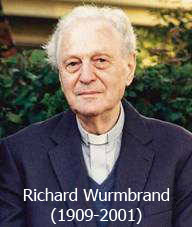
Wurmbrand, Richard (2011-11-08). With God in Solitary Confinement (Kindle Locations 281-333). Living Sacrifice Book Company. Kindle Edition.
Joyfully Vulnerable to God’s Goodness–Graham Cooke
Seven Days that divided the World–John Lennox
The Spirit of Truth (John 16:12-15)–William Barclay

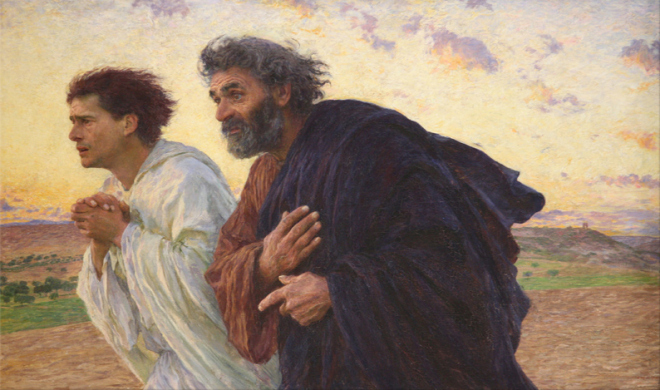
Eugene Burnand
John 16:12-15 “I have many things to say to you, but you cannot bear them now. When the Spirit of Truth has come, he will lead you into all the truth. For he will not speak on his own authority and out of his own knowledge, but he will speak all that he will hear, and he will tell you of the things to come. He will glorify me, for he will take of the things which belong to me, and will tell you of them. All things that the Father has are mine. That is why I said that the Spirit will take of the things which belong to me, and tell them to you.”
To Jesus the Holy Spirit is the Spirit of Truth, whose great work is to bring God’s truth to men. We have a special name for this bringing of God’s truth to men; we call it revelation, and no passage in the New Testament shows us what we might call the principles of revelation better than this one.
(i) Revelation is bound to be a progressive process. Many things Jesus knew he could not at that moment tell his disciples, because they were not yet able to receive them. It is only possible to tell a man as much as he can understand. We do not start with the binomial theorem when we wish to teach a boy algebra; we work up to it. We do not start with advanced theorems when we wish to teach a child geometry; we approach them gradually. We do not start with difficult passages when we teach a lad Latin or Greek; we start with the easy and the simple things. God’s revelation to men is like that. He teaches men what they are able and fit to learn. This most important fact has certain consequences.
(a) It is the explanation of the parts of the Old Testament which sometimes worry and distress us. AT that stage they were all of God’s truth that men could grasp. Take an actual illustration—in the Old Testament there are many passages which call for the wiping out of men and women and children when an enemy city is taken. At the back of these passages there is the great thought that Israel must not risk the taint of any heathen and lower religion. To avoid that risk, those who do not worship the true God must be destroyed. That is to say, the Jews had at that stage grasped the fact that the purity of religion must be safeguarded; but they wished to preserve that purity by destroying the heathen. When Jesus came, men came to see that the way to preserve that purity is to convert the heathen. The people of the Old Testament times had grasped a great truth, but only one side of it. Revelation has to be that way; God can reveal only as much as a man can understand.
(b) It is the proof that there is no end to God’s revelation. One of the mistakes men sometimes make is to identify God’s revelation solely with the Bible. That would be to say that since about A.D. 120, when the latest book in the New Testament was written, God has ceased to speak. But God’s Spirit is always active; he is always revealing himself. It is true that his supreme and unsurpassable revelation came in Jesus; but Jesus is not just a figure in a book, he is a living person and in him God’s revelation goes on. God is still leading us into greater realization of what Jesus means. He is not a God who spoke up to A.D. 120 and is now silent. He is still revealing his truth to men.
(ii) God’s revelation to men is a revelation of all truth. It is quite wrong to think of it as confined to what we might call theological truth. The theologians and the preachers are not the only people who are inspired. When a poet delivers to men a great message in words which defy time, he is inspired. When H. F. Lyte wrote the words of Abide with me he had no feeling of composing them; he wrote them as to dictation. A great musician is inspired. Handel, telling of how he wrote The Hallelujah Chorus, said: “I saw the heavens opened, and the Great White God sitting on the Throne.” When a scientist discovers something which will help the world’s toil and make life better for men, when a surgeon discovers a new technique which will save men’s lives and ease their pain, when someone discovers a new treatment which will bring life and hope to suffering humanity, that is a revelation from God. All truth is God’s truth, and the revelation of all truth is the work of the Holy Spirit.
(iii) That which is revealed comes from God. He is alike the possessor and the giver of all truth. Truth is not men’s discovery; it is God’s gift. It is not something which we create; it is something already waiting to be discovered. At the back of all truth there is God.
(iv) Revelation is the taking of the things of Jesus and revealing their significance to us. Part of the greatness of Jesus is his inexhaustibleness. No man has ever grasped all that he came to say. No man has fully worked out all the significance of his teaching for life and for belief, for the individual and for the world, for society and for the nation. Revelation is a continual opening out of the meaning of Jesus.
There we have the crux of the matter. Revelation comes to us, not from any book or creed, but from a living person. The nearer we live to Jesus, the better we will know him. The more we become like him, the more he will be able to tell us. To enjoy his revelation we must accept his mastery.
Favorite Miracle–Bill Johnson
The Future of Man–Pierre Teilhard de Chardin
It is perfectly possible that in the general spectrum of Life the line ending in Man was originally no more than one psychic radiation among countless others. But it happened, for some reason of hazard, position or structure, that this sole ray (this is an experiential fact) among the millions contrived to pass the critical barrier separating the Unreflective from the Reflective—that is to say, to enter the sphere of intelligence, foresight and freedom of action. Because it did so (and although in a sense, I must repeat, this ray was only one attempt among many) the whole essential stream of terrestrial biological evolution is now flowing through the breach which has been made. The cosmic tide may at one time have seemed to be immobilized, lost in the vast reservoir of living forms; but through the ages the level of consciousness was steadily rising behind the barrier, intil finally, by means of the human brain (the most ‘centro-complex’ organism yet achieved to our knowledge in the universe) there has occurred, at a first ending of time, the breaking of the dykes, followed by what is now in progress, the flooding of Thought over the entire surface of the biosphere.
Thus regarded, everything in history of the world takes shape, and what is better, everything goes on.
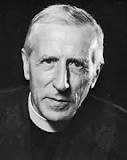
from an Essay, “Turmoil or Genesis?” by
Pierre Teilhard de Chardin, in The Future of Man. 1969 Harper Torchbook, pp 228-228
 St. John One: One