Tag / Christ
Reasons To Believe : Genesis Creation Days: An Interview with Dr. T. David Gordon
Indirect Internal Evidence—that the author of the Gospel of John was the Apostle John
Recent Biblical scholarship into the “Historical Jesus,” such as the “Jesus Seminar,” and others, claim late dates of the Authorship of the Gospels. Most of these sources deny that the Gospel of John was written by the Apostle John and put a late date (2nd or 3rd Century) on its authorship. There is really little evidence to support these claims. Yet there is much evidence that shows tradition is correct and that the Author of the Gospel that claims Christ’s Deity was the Apostle John, “the disciple whom Jesus loved.” W. Graham Scroggie in his critical work, Guide to the Gospels provides ample objective evidence to refute this Modern, Post-Modern and deconstructionist notion about authorship of the Gospel of John.
Indirect Internal Evidence [that the author of the Gospel of John was the Apostle John]
(a)The Author was a Jew
‘He is familiar with Jewish opinions and customs, his composition is impressed with Jewish characteristics, he is penetrated with the spirit of the Jewish dispensation. the vocabulary, the structure of the sentences, the symmetry and arrangement of the thoughts, are essentially Hebrew. The Old Testament is the source of the religious life of the writer. His Jewish opinions and hopes are taken up into and transfigured by his Christian faith, but the Jewish foundation underlies his whole narrative. The Evangelist vindicates the Law as of Divine authority.
(b) The Author was a Jew of Palestine
This was proved by his local knowledge. He speaks of places with an unaffected precision, as familiar in every case with the scene which he wishes to recall; he moves about in a country which he knows ( “John 1:28; “2:1; “2:11; “3:23; “4:46; “11:18, “11:54; “21:1, “21:2).The writer of the Fourth Gospel is evidently at home in Jerusalem as it was before its fall in AD 70 ( “5:2; “9:7; “18:1; “19:13;* “19:17; “19:20; “19:41). He has an accurate knowledge of the Temple and its ritual (“2:14-16; “2:20; “10:22; especially chapters. “7 , “8). The author’s quotations from the old Testament show that he was not dependent on the Septuagint (LXX), but was acquainted with the original Hebrew.
(c) The Author was an Eye-witness to what he Describes
His narrative is marked by minute details of persons, and time, an number, and place, and manner, which cannot but have come from a direct experience.
Persons:“John 6:5, “6:7; “7:21; “14:5; “14:8; “14:22; “13:25; “3:1;“7:50; “19:39; “11:1;
“12:1; “12:4; “13:2; “13:26;“18:10; “18:13;;“18:26;
Time: “John 2:13; “2:23; “5:1; “6:4; “7:2; “10:22; also “1:29, “1:35, “1:43;
“2:1 ;“12:1; “12:12; “13:1; “19:31; “20:1, “20:26; “4:6“4:52; “19:14; “13:30“18:28;
“20:1, “21:4;“6:16; “20:19; “3:2
Number:“1:35; “2:6; “6:9, “6:19; “19:3; “21:8, “21:11; also, “4:18; “5:5; “7:5; “19:39
Place: “John 1:28; “3:23; “4:46; “5:14; “6:59; “8:20; “10:40; “11:30, “11:54; “11:56; “18:1
Manner: “1:35-51; “8:10-20; “18:1“5:27; “21:1-14
Other details:“John 6:9; “11:32; “12:3, “12:13; “13:30; “18:3; “19:3; “20:7; “21:17; also, “13:24; “18:6; “19:5; “21:20
(d) The Author was an Apostle
This follows almost necessarily from the character of the scenes, which he describes. He exhibits intimate acquaintances with the feelings of the ‘the disciples.’ He knows their thoughts at critical moments (“John 2:11; “2:17; “2:22; “6:19; “6:60; “12:16; “13:22; “13:28; “21:12). He had an intimate knowledge of Jesus (” 11:33; “13:21; “2:24; “4:1; “5:6; “6:15; “7:1; “16:19; “6:6; “6:61; “6:64; “13:1; “13:3; “13:11; “18:4; “19:28).
(e) The Author was the Apostle John
As the writer is exact in defining the names in his Gospel (“1:42; “11:16; “20:24; “21:2; “6:71; “12:4;“13:2; “13:26;“14:22) it is presumed that the unnamed person of “13:23; “19:26; “20:2; “21:7; “21:20 is himself. If someone else had written this gospel it is unthinkable that he would not have mentioned by name so distinguished an Apostle as John.
W. Graham Scroggie. Guide to the Gospels pp.135-139 — summary of an argument from Westcott.
King Jesus

Graham Cook: The Nature of God, Part 1 – YouTube
When Old Men Begin to Dream – YouTube
We need not wait for Him. He is waiting for us.
William Graham Scroggie
We need not wait for Him. He is waiting for us. In this place and moment He is offering Himself to us as the source of strength and satisfaction, as well as the place for safety, and if we would but receive Him, fear will be exchanged for trust, doubt for certainty, ineffectiveness for success, defeat for victory, and sadness for joy. We have tried trying and have failed; why not now try trusting? We have wrought in our own strength and have found it to be weakness; why not now take hold of His strength? The faith we once exercised from passion of divine life, let us now exercise for the experience of abounding life; and as Christ met us then, so He meets us now.
W. Graham Scroggie, Land of Life of Rest, London 1950 pp 82-84 [study of the Book of Joshua]
excerpt from “In God’s Underground,” by Richard Wurmbrand
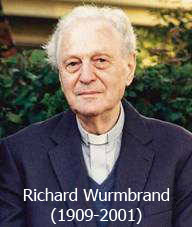
excerpt from In God’s Underground by Richard Wurmbrand
By Richard Wurmbrand
Copyright 1968 The voice of the Martyrs
[Wurmbrand relates this story from his life during World War Two to comfort a fellow prisoner in the Communist gulag they shared; who has betrayed another prisoner out of fear and at the time could not forgive himself]
When Rumania entered the war on Germany’s side, a pogrom began in which many thousands of Jews were killed or deported. At Iasi alone 11,000 were massacred in a day. My wife, who shares my Protestant faith, is also of Jewish origin. We lived in Bucharest, from which the Jews were not deported, but her parents, one of her brothers, three sisters and other relatives who lived in Bocovine were taken to Transmistria, a wild border Province which the Rumanians had captured from Russia. Jews who were not murdered at the end of this journey were left to starve, and there Sabina’s family died.
I had to break this news. She recovered herself and said, “I will not weep. You are entitled to a happy wife, and Mihai to a happy mother, and our Church to a servant with courage.” If she shed tears in private I do not know, but from that day I never saw Sabina weep again.Some time later our landlord, a good Christian, told me sadly of a man who was staying in the house while on leave from the front. “I knew him before the war,” he said, “but he’s changed completely. He has become a brute who likes to boast of how he volunteered to exterminate Jews in Transmistria and killed hundreds with his own hands.”
I was deeply distressed and I decided to pass the night in prayer. To avoid disturbing Sabina, who was unwell and who would have wished to join in my vigil in spite of that, I went upstairs after supper to the landlords flat to pray with him. Lounging in an armchair was a giant of a man whom the landlord introduced as Borila, the killer of Jews from Transmistria. When he rose he was even taller than I, and there seemed to be about him an aura of horror that was like a smell of blood. Soon he was telling us of his adventures in war and of the Jews he had slaughtered.“It is a frightening story,” I said, “but I do not fear for the Jews-God will compensate them for what they have suffered. I ask myself with anguish what will happen to their murderers when they stand before God’s judgement.”
An ugly scene was prevented by the landlord who said we were both guests in his house, and turned the talk into more neutral channels. The murderer proved to be not only a murderer. Nobody is only one thing. He was a pleasant talker, and eventually it came out that he had a great love of music.
He mentioned that while serving in the Ukraine he had been captivated by the songs there. “I wish I could hear them again,” he said.
I knew some of these old songs. I thought to myself, looking at Borila, “the fish has entered my net!”
“If you’d like to hear some of them,” I told him, “come to my flat-I’m no pianist, but I can play a few Ukrainian melodies.”
The landlord, his wife and daughter accompanied us. My wife was in bed. She was used to my playing softly at night and did not wake up. I played the folk-songs, which are live with feeling, and I could see that Borila was deeply moved. I remembered how when King Saul was afflicted by an evil spirit, the boy David had played the harp before him.
I stopped and turned to Borila. “I’ve something very important to say to you,” I told him.
“Please speak,” he said.“If you look through that curtain you can see someone is asleep in the next room. It’s my wife, Sabina. Her parents, her sisters, and her twelve-year old brother have been killed with the rest of the family. You told me that you had killed hundreds of Jews near Golta, and that is where they were taken.” Looking into his eyes, I added, “You yourself don’t know who you have shot, so we can assume that you are the murderer of her family.”
He jumped up, his eyes blazing, looking as if he were about to strangle me.
I held up my hand and said, “Now -let’s try an experiment. I shall wake my wife and tell her who you are, and what you have done. I can tell you what will happen. My wife will not speak one word of reproach! She’ll embrace you as if you were her brother. She’ll bring you supper, the best things she has in the house.”
“Now if Sabina who is a sinner like all, can forgive and love like this, imagine how Jesus, who is perfect Love, can forgive and love you! Only return to Him-and everything you have done will be forgiven!”
Borila was not heartless: within, he was consumed by guilt and misery at what he had done, and he had shaken his brutal talk at us as a crab its claws. One tap at his weak spot, and his defenses crumbled. The music had already moved his heart, and now came-instead of the attack he expected-words of forgiveness. His reaction was amazing. He jumped up and tore at his collar with both hands, so that his shirt was rent apart. “Oh God, what shall I do, what shall I do?” He cried. He put his head in his hands, and sobbed noisily as he rocked himself back and forth. “I’m a murderer, I’m cloaked in blood, what shall I do?” Tears ran down his cheeks.
I cried “In the name of the Lord Jesus Christ, I command the devil of hatred to go out of your soul!”
Borila fell on his knees trembling, and we began to pray aloud. He knew no prayers; he simply asked again and again for forgiveness and said that he hoped and knew it would be granted. We were on our knees together for some time; then we stood up and embraced each other, and I said, “I promised to make an experiment. I shall keep my word.”
I went into the other room and found my wife still sleeping calmly. She was very weak and exhausted at that time. I woke her gently and said, “There is a man here whom you must meet. We believe he has murdered your family, but he has repented, and now he is our brother.”
She came out in her dressing gown and put out her arms to embrace him: then both began to weep and to kiss each other again and again. I have never seen a bride and bridegroom kiss with such love and passion and purity as this murderer and the survivor among his victims. Then, as I foretold, Sabina went to the kitchen to bring him food.
While she was away the thought came to me that Borila’s crime had been so terrible that some further lesson was needed. I went to the next room and returned with my son, Mihai, who was then two, asleep in my arms. It was only a few hours since Borila had boasted to us how he had killed Jewish children in their parents arms, and now he was horrified; the sight was an unbearable reproach. He expected me to accuse him.But I said, “Do you see how quietly he sleeps? You are also like a newborn child who can rest in the Father’s arms. The blood that Jesus shed can cleanse you.”
Borila’s happiness was very moving: he stayed with us that night and when he awoke the next day, he said, “It’s a long time since I slept like that.”
St. Augustine says, “Anima humana naturaliter Christiana est“–the human soul is naturally Christian. Crime is against one’s own nature, the result of social pressure or many other causes, and what a relief it is to cast it off as he had done!
In the morning Borila wanted to meet our Jewish friends and I took him to many Hebrew Christian homes. Everywhere he told his story, and he was received as the returning prodigal son. Then, with a New Testament which I gave him, he went to join his Regiment in another town.
Borila later came to say that his unit has been ordered to the front. “What shall I do? He asked. “I’ll have to start killing again.”I said, “No, you’ve killed more than a soldier needs to already. I don’t mean that a Christian shouldn’t defend his country if it is attacked. But you, personally, shouldn’t kill anymore-better allow others to kill you. The bible doesn’t forbid that!”…
[later] Greigore explained how he had served with Borila in Transmistria, where they had massacred the Jews. “When we went to Russia again, he was a changed man,” he said. “We couldn’t understand it. He put aside his weapons and instead of taking lives, he saved them. He volunteered to rescue the wounded under fire, and in the end he saved his officer.”
excerpt from In God’s Underground by Richard Wurmbrand
By Richard Wurmbrand
Copyright 1968 The voice of the Martyrs
Believing in the 21st Century:Chapter Six
an exhortation..as
a lay Christian examines his faith..
By James Ross Kelly
True to the fact that in reality Jesus Christ is always about His Fathers business down through the centuries out of this constant harangue of our culture comes a generation of Christians not content with the standard fare of Christian worship and the 19th Century hymnology and you find “Christian Rock” streaming across the airwaves that, if you flip through the dials and hear this music and stop to listen for the rhythm and blues riff of Rock and Roll you begin to hear lyrics balming the radio waves as pure Christian praise and worship. Listen:
“The greatest single cause of atheism in the world today is Christians who acknowledge Jesus with their lips [in Church] and walk out the door and deny Him by their lifestyle— that is what an unbelieving world simply finds unbelievable.” This comes not from Billy Graham’s crusade pulpit, but from a spoken intro to one of the songs on the dread locked hard rocking 1995, DC Talk, Album, Jesus Freak. This intro follows with the lyrics:
Is this one for the people ? Is this one for the Lord? Or do I simply serenade for things I must afford? You can jumble them together, my conflict still remains For holiness is calling, in the midst of courting fame… Copyright 1995 In The Mix Music (A Division of The Forefront Communications Group, Inc.) (BMI) All Rights Reserved
This is deep abiding faith. Same deep abiding faith written from the quill pen of the 3rd Century Saint, but blasted over the airwaves at the end of this one. Same God, same travail of reaching out and knowing how unholy each of us are in His presence and the same existential angst of a world gone wrong and having to live in the middle of its humanity. Looking heavenward is not as an upward outer leap into flat earth theology as some would suggest of present day Christendom, but a direction toward an inter-dimensional leap to the arms of Father God of the universe—Who inhabits congress with our own life because He created it!
Is it patriarchal? I think not. And I think not in the least, for inside this truth women ( to whom he first appeared after the resurrection) have roles of supreme significance. But at the same time Christ wasn’t going to a divine ‘mother.’ For Christians fitting Lord Jesus into a politically correct new age scheme courts blasphemy. But in His going and again in His expected coming, we all now have a new role in that there is a feminine quality of all of us as believers in the waiting for the groom. The waiting for God in our lives is a sanctification that has no patriarchal male gender related stigma to it at all, in fact—quite the opposite. The most macho of men have become believers of the almighty God come to earth and become the feminine receptors of the body of Christ as a bride waits for the bride groom in loving waiting desire. This is not patriarchal. Trying to fit into a feminist de-constructionist scheme will be always the square man made plug fitting into an ever elusive divine receptacle that will retreat at light speed leaving something only human.
“There is neither male nor female: for ye are all one in Christ Jesus.” Galatians 3:28 KJV
Believing in the 21st Century:Chapter Five
an exhortation..as
a lay Christian examines his faith..
By James Ross Kelly
Of my mind and my experience this Way, my walk with Christ Jesus, for myself is the most excellent Way—as it has been for countless others. This is because it is experiential truth and at the same time the truth behind all things that are true. Men and women who know God have always felt the pain of the worlds rejection and mocking disbelief, as if the foot steps of our blessed savior to bloody Calvary have never ended in an unending historical example of the mythic Sisyphus, torture and disgrace one after another, rolling up the hill, time after time and time again. And though endlessly exposited upon, this most excellent Way, is really attained only by waiting upon Him and in the practice of humility. God comes to us waiting on Him some in an instant and other after decade according to His own divine will. Is this easy? In a word, ‘no’ Is it attainable, in another word ‘yes,’ gloriously ‘yes,’ a thousand times yes attested by millions that have known this Truth to be so.
People who have trouble with the concept of‘ ‘Father’ to be current politically incorrect thinking and offer up an apostasy which calls the thinking of “Our Father,” as a patriarchal oppression may have issues which sadly are borne out in the universal necessity for an archetype of a kind and loving, but austere father in our humanity. The lack of which at this moment is a dynamic; so our cultural and sociological pundits tell us—we are sadly lacking and suffering for want of—in finding out who we are as men and women. It has been said that a person approaches God the same way that they have had to approach their own earthly father. And to our own cultures demise, we have to contend with a train wreck of absent, over working, or uncaring and unloving fathers many of whom have spawned and coldly left a throng of unbelieving children in an era of an unbelieving cultural malaise. Unbelieving, or incapable in believing, in the sense of an all encompassing love of a heavenly Father—because the reality of the absence of an earthly humane father makes a heavenly Father unimaginable!
Or a “can’t believe” media manufactured X-generation sliding on the sex saturated video culture— which rejects whole-sale, the notion handed down to us by our own “fore-fathers,” and because of this inattention and the selfish self-centered denial of children, born often out of passion instead of out of love— to this progeny. There is only one antidote for this poison— the Father Himself. Not the idea and concept of the Father but the real thing.
“..O Lord, to You most excellent and most good, You are Architect and Governor of the universe, thanks would be due You, O our God, even if you had not willed that I should survive my childhood. For I existed even then; I lived and felt and was careful about my own well-being–a trace of that most mysterious unity from where I had my being. I kept watch, by my inner sense, over the integrity of my outer senses, and even in these trifles and also in my thoughts about trifles, I learned to take pleasure in truth. I was averse to being deceived; I had a vigorous memory; I was gifted with the power of speech, was softened by friendship, shunned sorrow, meanness, and ignorance. Is not such an animated creature as this wonderful and praiseworthy? But all these are gifts of my God. I did not give them to myself. Moreover, they are good, and all together these gifts constitute myself. Good, then, is He that made me, and He is my God; and before Him will I rejoice exceedingly for every good gift which, even as a child, I had. But this was my sin! That it was not in God the Creator, but in His creatures–myself and the rest–that I sought for pleasures, honors, and truths. And I fell consequently into sorrows, troubles, and errors. Thanks be to You, my joy, my pride, my confidence, my God–thanks be to You for Your gifts. Please preserve them in me. For by this You will preserve me; and those things which You have given me will be developed and perfected, and I myself will be with You, for from You, comes my being.” Augustine ca 285AD.2
Augustine brought up in Afro-European pagan society tells us like it is from seventeen hundred years ago. What is our culture but obsessed with, “my own well being..” and the post modern new age neo-pagan fashion is precisely, “not in God the Creator, but in His creatures—[ourselves] and the rest–that I [we] sought for pleasures, honors, and truths.”
2 adapted to modern English from public domain translation by Albert C. Outler, Ph.D., Confessions of St. Augustine, Chapter 14
 St. John One: One