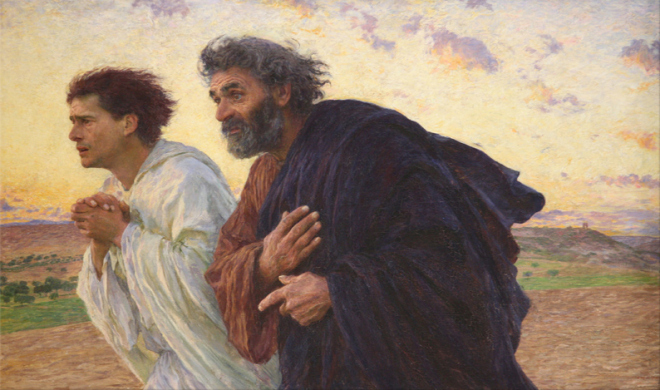

The Didache (pronounced /ˈdɪdəkiː/; Koine Greek: Διδαχή, Didachē “Teaching”; Modern Greek [ðiðaˈxi]) is the common name of an early Christian writing (dated by some scholars to the late first/early second century although John Robinson argues that it is first generation, dating it c. 40-60 AD). The Didache is an anonymous work that was virtually lost until a Greek manuscript of the Didache was rediscovered in 1873 by Philotheos Bryennios, Metropolitan of Nicomedia in the Codex Hierosolymitanus.
The Teaching of the Lord by the Twelve Apostles to the Gentiles (or Nations).
I.
1. There are two Ways, one of Life and one of Death; but there is a great difference between the two Ways.
2. Now the Way of Life is this: First, Thou shalt love God who made thee; secondly, thy neighbor as thyself; and all things whatsoever thou wouldst not have done to thee, neither do thou to another.
3. Now the teaching of these [two] words [of the Lord] is this: Bless those who curse you, and pray for your enemies, and fast for those who persecute you; for what thank is there if ye love those who love you? Do not even Gentiles the same? But love ye those who hate you, and ye shall not have an enemy.
4. Abstain from fleshly and bodily [worldly] lusts. If any one give thee a blow on the right cheek turn to him the other also, and thou shalt be perfect. If any one press thee to go with him one mile, go with him two; if any one take away thy cloak, give him also thy tunic; if any one take from thee what is thine, ask it not back, as indeed thou canst not.
5. Give to every one that asketh thee, and ask not back, for the Father wills that from our own blessings we should give to all. Blessed is he that gives according to the commandment, for he is guiltless. Woe to him that receives; for if any one receives, having need, he shall be guiltless, but he that has not need shall give account, why he received and for what purpose, and coming into distress he shall be strictly examined concerning his deeds, and he shall not come out thence till he have paid the last farthing.
6. But concerning this also it hath been said, “Let thine alms sweat (drop like sweat) into thy hands till thou know to whom thou shouldst give.”
II.
1. And the second commandment of the Teaching is:
2. Thou shalt not kill. Thou shalt not commit adultery; thou shalt not corrupt boys; thou shalt not commit fornication. Thou shalt not steal. Thou shalt not use witchcraft; thou shalt not practice sorcery. Thou shalt not procure abortion, nor shalt thou kill the new-born child. Thou shalt not covet thy neighbor’s goods.
3. Thou shalt not forswear thyself (swear falsely). Thou shalt not bear false witness. Thou shalt not speak evil; thou shalt not bear malice.
4. Thou shalt not be double-minded nor double-tongued; for duplicity of tongue is a snare of death.
5. Thy speech shall not be false, nor vain, but fulfilled by deed.
6. Thou shalt not be covetous, nor rapacious, nor a hypocrite, nor malignant, nor haughty. Thou shalt not take evil counsel against thy neighbor.
7. Thou shalt not hate any one, but some thou shalt rebuke and for some thou shalt pray, and some thou shalt love above thine own soul (or, life).
III.
1. My child, flee from every evil, and from every thing that is like unto it.
2. Be not prone to anger, for anger leadeth to murder; nor given to party spirit, nor contentious, nor quick-tempered (or, passionate); for from all these things murders are generated.
3. My child, be not lustful, for lust leadeth to fornication; neither be a filthy talker, nor an eager gazer, for from all these are generated adulteries.
4. My child, be not an observer of birds [for divination] for it leads to idolatry; nor a charmer (enchanter), nor an astrologer, nor a purifier (a user of purifications or expiations), nor be thou willing to look on those things; for from all these is generated idolatry.
5. My child, be not a liar, for lying leads to theft; nor avaricious, nor vainglorious, for from all these things are generated thefts.
6. My child, be not a murmurer, for it leads to blasphemy; neither self-willed (presumptuous), nor evil-minded, for from all these things are generated blasphemies.
7. But be thou meek, for the meek shall inherit the earth.
8. Be thou long-suffering, and merciful, and harmless, and quiet, and good, and trembling continually at the words which thou hast heard.
9. Thou shalt not exalt thyself, nor shalt thou give audacity (presumption) to thy soul. Thy soul shall not be joined to the lofty, but with the just and lowly shalt thou converse.
10. The events that befall thee thou shalt accept as good, knowing that nothing happens without God.
IV.
1. My child, thou shalt remember night and day him that speaks to thee the word of God, and thou shalt honor him as the Lord, for where the Lordship is spoken of, there is the Lord.
2. And thou shalt seek out day by day the faces of the saints, that thou mayest rest upon their words.
3. Thou shalt not desire (make) division, but shalt make peace between those at strife. Thou shalt judge justly; thou shalt not respect a person (or, show partiality) in rebuking for transgressions.
4. Thou shalt not be double-minded (doubtful in thy mind) whether it shall be or not.
5. Be not one that stretches out his hands for receiving, but draws them in for giving.
6. If thou hast [anything], thou shalt give with thy hands a ransom for thy sins.
7. Thou shalt not hesitate to give, nor in giving shalt thou murmur, for thou shalt know who is the good recompenser of the reward.
8. Thou shalt not turn away him that needeth, but shalt share all things with thy brother, and shalt not say that they are thine own; for if you are fellow-sharers in that which is imperishable (immortal), how much more in perishable (mortal) things?
9. Thou shalt not take away thy hand from thy son or from thy daughter, but from [their] youth up thou shalt teach [them] the fear of God.
10. Thou shalt not in thy bitterness lay commands on thy man-servant (bondman), or thy maid-servant (bondwoman), who hope in the same God, lest they should not fear Him who is God over [you] both; for He comes not to call [men] according to the outward appearance (condition), but [he comes] on those whom the Spirit has prepared.
11. But ye, bondmen, shall be subject to our (your) masters as to the image of God in reverence (modesty) and fear.
12. Thou shalt hate all hypocrisy, and everything that is not pleasing to the Lord.
13. Thou shalt not forsake the commandments of the Lord, but thou shalt keep what thou hast received, neither adding [thereto] nor taking away [therefrom].
14. In the congregation (in church) thou shalt confess thy transgressions, and thou shalt not come to thy prayer (or, place of prayer) with an evil conscience.
This is the way of life.
V.
1. But the way of death is this. First of all it is evil and full of curse; murders, adulteries, lusts, fornications, thefts, idolatries, witchcrafts, sorceries, robberies, false-witnessings, hypocrisies, double-heartedness, deceit, pride, wickedness, self-will, covetousness, filthy-talking, jealousy, presumption, haughtiness, boastfulness.
2. Persecutors of the good, hating truth, loving a lie, not knowing the reward of righteousness, not cleaving to that which is good nor to righteous judgment, watchful not for that which is good but for that which is evil; far from whom is meekness and endurance, loving vanity, seeking after reward, not pitying the poor, not toiling with him who is vexed with toil, not knowing Him that made them, murderers of children, destroyers of the handiwork of God, turning away from the needy, vexing the afflicted, advocates of the rich, lawless judges of the poor, wholly sinful.
May ye, children, be delivered from all these.
VI.
1. Take heed that no one lead thee astray from this way of teaching, since he teacheth thee apart from God.
2. For if indeed thou art able to bear the whole yoke of the Lord thou shalt be perfect; but if thou art not able, do what thou canst.
3. And as regards food, bear what thou canst, but against idol-offerings be exceedingly on thy guard, for it is a service of dead gods.
VII.
1. Now concerning baptism, baptize thus: Having first taught all these things, baptize ye into the name of the Father, and of the Son, and of the Holy Spirit, in living water.
2. And if thou hast not living water, baptize into other water; and if thou canst not in cold, then in warm (water).
3. But if thou hast neither, pour [water] thrice upon the head in the name of the Father, and of the Son, and of the Holy Spirit.
4. But before Baptism let the baptizer and the baptized fast, and any others who can; but thou shalt command the baptized to fast for one or two days before.
VIII.
1. Let not your fasts be with the hypocrites, for they fast on the second and fifth day of the week; but ye shall fast on the fourth day, and the preparation day (Friday).
2. Neither pray ye as the hypocrites, but as the Lord commanded in His Gospel, so pray ye: “Our Father, who art in heaven, hallowed be Thy Name. Thy Kingdom come. Thy will be done, as in heaven, so on earth. Give us this day our daily (needful) bread. And forgive us our debt as we also forgive our debtors. And bring us not into temptation, but deliver us from the evil one (or, from evil). For Thine is the power and the glory for ever.”
3. Pray thus thrice a day.
IX.
1. Now as regards the Eucharist (the Thank-offering), give thanks after this manner:
2. First for the cup: “We give thanks to Thee, our Father, for the holy vine of David Thy servant, which thou hast made known to us through Jesus, Thy servant: to Thee be the glory for ever.”
3. And for the broken bread: “We give thanks to Thee, our Father, for the life and knowledge which Thou hast made known to us through Jesus, Thy servant: to Thee be the glory for ever.
4. “As this broken bread was scattered upon the mountains and gathered together became one, so let Thy church be gathered together from the ends of the earth into Thy kingdom, for Thine is the glory and the power through Jesus Christ for ever.”
5. But let no one eat or drink of your Eucharist, except those baptized into the name of the Lord; for as regards this also the Lord has said: “Give not that which is holy to the dogs.”
X.
1. Now after being filled, give thanks after this manner:
2. “We thank Thee, Holy Father, for Thy Holy Name, which Thou hast caused to dwell (tabernacle) in our hearts, and for the knowledge and faith and immortality which Thou hast made known to us through Jesus Thy Servant, to Thee be the glory for ever.
3. “Thou, O, Almighty Sovereign, didst make all things for Thy Name’s sake; Thou gavest food and drink to men for enjoyment that they might give thanks to Thee; but to us Thou didst freely give spiritual food and drink and eternal life through Thy Servant.
4. “Before all things we give thanks to Thee that Thou art mighty; to Thee be the glory for ever.
5. “Remember, O Lord, Thy Church to deliver her from all evil and to perfect her in Thy love; and gather her together from the four winds, sanctified for Thy kingdom which Thou didst prepare for her; for Thine is the power and the glory for ever.
6. “Let grace come, and let this world pass away. Hosanna to the God of David. If any one is holy let him come, if any one is not holy let him repent. Maranatha. Amen.”
7. But permit the Prophets to give thanks as much as [in what words] they wish.
XI.
1. Whosoever then comes and teaches you all the things aforesaid, receive him.
2. But if the teacher himself being perverted teaches another teaching to the destruction [of this], hear him not, but if [he teach] to the increase of righteousness and the knowledge of the Lord, receive him as the Lord.
3. Now with regard to the Apostles and Prophets, according to the decree (command) of the gospel, so do ye.
4. Let every Apostle that cometh to you be received as the Lord.
5. But he shall not remain [longer than] one day; and, if need be, another [day] also; but if he remain three [days] he is a false prophet.
6. And when the Apostle departeth, let him take nothing except bread [enough] till he reach his lodging (night-quarters). But if he ask for money, he is a false prophet.
7. And every prophet who speaks in the spirit ye shall not try or prove; for every sin shall be forgiven, but this sin shall not be forgiven.
8. Not every one that speaks in the spirit is a Prophet, but only if he has the behavior (the ways) of the Lord. By their behavior then shall the false prophet and the [true] Prophet be known.
9. And no Prophet that orders a table in the spirit eats of it [himself], unless he is a false prophet.
10. And every Prophet who teaches the truth if he does not practice what he teaches, is a false prophet.
11. And every approved, genuine Prophet, who makes assemblies for a worldly mystery, but does not teach [others] to do what he himself does, shall not be judged by you; for he has his judgment with God (or, his judgment is in the hands of God); for so did also the ancient Prophets.
12. But whosoever says in the spirit: Give me money or any other thing, ye shall not listen to him; but if he bid you to give for others that lack, let no one judge him.
XII.
1. Let every one that comes in the name of the Lord be received, and then proving him ye shall know him; for ye shall have understanding right and left.
2. If indeed he who comes is a wayfarer, help him as much as ye can; but he shall not remain with you longer than two or three days, unless there be necessity.
3. If he wishes to settle among you, being a craftsman (artisan), let him work and eat (earn his living by work).
4. But if he has not handicraft (trade), provide according to your understanding that no Christian shall live idle among you.
5. And if he will not act thus he is a Christ-trafficker. Beware of such.
XIII.
1. But every true Prophet who wishes to settle among you is worthy of his food (or, support).
2. Likewise a true Teacher is himself worthy, like the workman, of his food.
3. Therefore thou shalt take and give all the first-fruit of the produce of the wine-press and threshing-floor, of oxen and sheep, to the Prophets; for they are your chief-priests.
4. But if ye have no Prophet, give to the poor.
5. If thou preparest bread, take the first fruit and give according to the commandment.
6. Likewise when thou openest a jar of wine or of oil, take the first-fruit and give to the Prophets.
7. And of silver, and raiment, and every possession, take the first-fruit, as may seem good to thee, and give according to the commandment.
XIV.
1. And on the Lord’s Day of the Lord come together, and break bread, and give thanks, having before confessed your transgressions, that your sacrifice may be pure.
2. Let no one who has a dispute with his fellow come together with you until they are reconciled, that your sacrifice may not be defiled.
3. For this is that which was spoken by the Lord: “In every place and time offer me a pure sacrifice, for I am a great King, saith the Lord, and my name is wonderful among the Gentiles.”
XV.
1. Elect therefore for yourselves Bishops and Deacons worthy of the Lord, men meek, and not lovers of money, and truthful, and approved; for they too minister to you the ministry of the Prophets and Teachers.
2. Therefore despise them not, for they are those that are the honored [men] among you with the Prophets and Teachers.
3. And reprove one another not in wrath, but in peace, as ye have [it] in the gospel; and with every one that transgresses against another let no one speak, nor let him hear [a word] from you until he repents.
4. But so do your prayers and alms and all your actions as ye have [it] in the gospel of our Lord.
XVI.
1. Watch over your life; let not your lamps be quenched and let not your loins be unloosed, but be ye ready; for ye know not the hour in which our Lord comes.
2. But be ye frequently gathered together, seeking the things that are profitable for your souls; for the whole time of your faith shall not profit you except in the last season ye be found perfect.
3. For in the last days the false prophets and destroyers shall be multiplied, and the sheep shall be turned into wolves, and love shall be turned into hate.
4. For when lawlessness increases, they shall hate and persecute, and deliver up one another; and then shall appear the world-deceiver as Son of God, and shall do signs and wonders, and the earth shall be delivered into his hands, and he shall commit iniquities which have never yet come to pass from the beginning of the world.
5. And then shall the race of men come into the fire of trial, and many shall be offended and shall perish; but they who endure in their faith shall be saved from under the curse itself.
6. And then shall appear the signs of the truth: first the sign of opening in heaven; then the sign of the voice of the trumpet; and the third, the resurrection of the dead.
7. Not, however, of all, but as was said, “The Lord shall come, and all the saints with him.”
8. Then shall the world see the Lord coming upon the clouds of heaven.
This version of The Didache was originally published in 1885 by Funk & Wagnalls, Publishers (New York). The translation was made by Philip Schaff from the Jerusalem Manuscript of the Didache. The copyright has expired, so that this translation is now in the public domain. Anyone may freely copy, print and republish this document. No permission is needed.


 )
)

 St. John One: One