Reasons To Believe : Genesis Creation Days: An Interview with Dr. T. David Gordon.
Category / Religion
When Old Men Begin to Dream – YouTube
excerpt from “In God’s Underground,” by Richard Wurmbrand
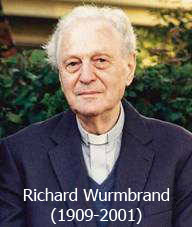
excerpt from In God’s Underground by Richard Wurmbrand
By Richard Wurmbrand
Copyright 1968 The voice of the Martyrs
[Wurmbrand relates this story from his life during World War Two to comfort a fellow prisoner in the Communist gulag they shared; who has betrayed another prisoner out of fear and at the time could not forgive himself]
When Rumania entered the war on Germany’s side, a pogrom began in which many thousands of Jews were killed or deported. At Iasi alone 11,000 were massacred in a day. My wife, who shares my Protestant faith, is also of Jewish origin. We lived in Bucharest, from which the Jews were not deported, but her parents, one of her brothers, three sisters and other relatives who lived in Bocovine were taken to Transmistria, a wild border Province which the Rumanians had captured from Russia. Jews who were not murdered at the end of this journey were left to starve, and there Sabina’s family died.
I had to break this news. She recovered herself and said, “I will not weep. You are entitled to a happy wife, and Mihai to a happy mother, and our Church to a servant with courage.” If she shed tears in private I do not know, but from that day I never saw Sabina weep again.Some time later our landlord, a good Christian, told me sadly of a man who was staying in the house while on leave from the front. “I knew him before the war,” he said, “but he’s changed completely. He has become a brute who likes to boast of how he volunteered to exterminate Jews in Transmistria and killed hundreds with his own hands.”
I was deeply distressed and I decided to pass the night in prayer. To avoid disturbing Sabina, who was unwell and who would have wished to join in my vigil in spite of that, I went upstairs after supper to the landlords flat to pray with him. Lounging in an armchair was a giant of a man whom the landlord introduced as Borila, the killer of Jews from Transmistria. When he rose he was even taller than I, and there seemed to be about him an aura of horror that was like a smell of blood. Soon he was telling us of his adventures in war and of the Jews he had slaughtered.“It is a frightening story,” I said, “but I do not fear for the Jews-God will compensate them for what they have suffered. I ask myself with anguish what will happen to their murderers when they stand before God’s judgement.”
An ugly scene was prevented by the landlord who said we were both guests in his house, and turned the talk into more neutral channels. The murderer proved to be not only a murderer. Nobody is only one thing. He was a pleasant talker, and eventually it came out that he had a great love of music.
He mentioned that while serving in the Ukraine he had been captivated by the songs there. “I wish I could hear them again,” he said.
I knew some of these old songs. I thought to myself, looking at Borila, “the fish has entered my net!”
“If you’d like to hear some of them,” I told him, “come to my flat-I’m no pianist, but I can play a few Ukrainian melodies.”
The landlord, his wife and daughter accompanied us. My wife was in bed. She was used to my playing softly at night and did not wake up. I played the folk-songs, which are live with feeling, and I could see that Borila was deeply moved. I remembered how when King Saul was afflicted by an evil spirit, the boy David had played the harp before him.
I stopped and turned to Borila. “I’ve something very important to say to you,” I told him.
“Please speak,” he said.“If you look through that curtain you can see someone is asleep in the next room. It’s my wife, Sabina. Her parents, her sisters, and her twelve-year old brother have been killed with the rest of the family. You told me that you had killed hundreds of Jews near Golta, and that is where they were taken.” Looking into his eyes, I added, “You yourself don’t know who you have shot, so we can assume that you are the murderer of her family.”
He jumped up, his eyes blazing, looking as if he were about to strangle me.
I held up my hand and said, “Now -let’s try an experiment. I shall wake my wife and tell her who you are, and what you have done. I can tell you what will happen. My wife will not speak one word of reproach! She’ll embrace you as if you were her brother. She’ll bring you supper, the best things she has in the house.”
“Now if Sabina who is a sinner like all, can forgive and love like this, imagine how Jesus, who is perfect Love, can forgive and love you! Only return to Him-and everything you have done will be forgiven!”
Borila was not heartless: within, he was consumed by guilt and misery at what he had done, and he had shaken his brutal talk at us as a crab its claws. One tap at his weak spot, and his defenses crumbled. The music had already moved his heart, and now came-instead of the attack he expected-words of forgiveness. His reaction was amazing. He jumped up and tore at his collar with both hands, so that his shirt was rent apart. “Oh God, what shall I do, what shall I do?” He cried. He put his head in his hands, and sobbed noisily as he rocked himself back and forth. “I’m a murderer, I’m cloaked in blood, what shall I do?” Tears ran down his cheeks.
I cried “In the name of the Lord Jesus Christ, I command the devil of hatred to go out of your soul!”
Borila fell on his knees trembling, and we began to pray aloud. He knew no prayers; he simply asked again and again for forgiveness and said that he hoped and knew it would be granted. We were on our knees together for some time; then we stood up and embraced each other, and I said, “I promised to make an experiment. I shall keep my word.”
I went into the other room and found my wife still sleeping calmly. She was very weak and exhausted at that time. I woke her gently and said, “There is a man here whom you must meet. We believe he has murdered your family, but he has repented, and now he is our brother.”
She came out in her dressing gown and put out her arms to embrace him: then both began to weep and to kiss each other again and again. I have never seen a bride and bridegroom kiss with such love and passion and purity as this murderer and the survivor among his victims. Then, as I foretold, Sabina went to the kitchen to bring him food.
While she was away the thought came to me that Borila’s crime had been so terrible that some further lesson was needed. I went to the next room and returned with my son, Mihai, who was then two, asleep in my arms. It was only a few hours since Borila had boasted to us how he had killed Jewish children in their parents arms, and now he was horrified; the sight was an unbearable reproach. He expected me to accuse him.But I said, “Do you see how quietly he sleeps? You are also like a newborn child who can rest in the Father’s arms. The blood that Jesus shed can cleanse you.”
Borila’s happiness was very moving: he stayed with us that night and when he awoke the next day, he said, “It’s a long time since I slept like that.”
St. Augustine says, “Anima humana naturaliter Christiana est“–the human soul is naturally Christian. Crime is against one’s own nature, the result of social pressure or many other causes, and what a relief it is to cast it off as he had done!
In the morning Borila wanted to meet our Jewish friends and I took him to many Hebrew Christian homes. Everywhere he told his story, and he was received as the returning prodigal son. Then, with a New Testament which I gave him, he went to join his Regiment in another town.
Borila later came to say that his unit has been ordered to the front. “What shall I do? He asked. “I’ll have to start killing again.”I said, “No, you’ve killed more than a soldier needs to already. I don’t mean that a Christian shouldn’t defend his country if it is attacked. But you, personally, shouldn’t kill anymore-better allow others to kill you. The bible doesn’t forbid that!”…
[later] Greigore explained how he had served with Borila in Transmistria, where they had massacred the Jews. “When we went to Russia again, he was a changed man,” he said. “We couldn’t understand it. He put aside his weapons and instead of taking lives, he saved them. He volunteered to rescue the wounded under fire, and in the end he saved his officer.”
excerpt from In God’s Underground by Richard Wurmbrand
By Richard Wurmbrand
Copyright 1968 The voice of the Martyrs
C. S.Lewis—Heaven

We are very shy nowadays of even mentioning heaven. We are afraid of the jeer about ‘pie in the sky’, and of being told that we are trying to ‘escape’ from the duty of making a happy world here and now into dreams of a happy world elsewhere. But either there is ‘pie in the sky’ or there is not. If there is not, then Christianity is false, for this doctrine is woven into it’s whole fabric. If there is, then this truth, like any other, must be faced, whether it is useful at political meetings or no. Again, we are afraid that heaven is a bribe, and that if we make it our goal we shall no longer be disinterested. It is not so. Heaven offers nothing that a mercenary soul can desire. It is safe to tell the pure in heart that they shall see God, for only…
View original post 864 more words
Hell–from The Problem of Pain, by C.S. Lewis
I am not going to try to prove the doctrine tolerable. Let us make no mistake; it is not tolerable. But I think the doctrine can be shown to be moral, by a critique of the objections ordinarily made, or felt, against it.

C.S. Lewis
First, there is an objection, in many minds, to the idea of retributive punishment as such. This has been partly dealt with in a previous chapter. It was there maintained that all punishment became unjust if the ideas of ill-desert and retribution were removed from it; and a core of righteousness was discovered within the vindictive passion its self, in the demand that the evil man must not be left perfectly satisfied with his own evil, that it must be made to appear to him what it rightly appears to others—evil. I said that Pain plants the flag of truth within a rebel fortress. We were then discussing pain which might still lead to repentance. How if it does not—if no further conquest than the planting of the flag ever takes place?
Let us try to be honest with ourselves. Picture to yourself a man who has risen to wealth or power by a continued course of treachery and cruelty, by exploiting for purely selfish ends the noble motions of his victims, laughing the while at their simplicity; who, having thus attained success, uses it for the gratification of lust and hatred and finally parts with the last rag of honour among thieves by betraying his own accomplices and jeering at their last moments of bewildered disillusionment. Suppose, further, that he does all this, not (as we like to imagine) tormented by remorse or even misgiving, but eating like a schoolboy and sleeping like a healthy infant—a jolly, ruddy-cheeked man, without a care in the world, unshakably confident to the very end that he alone has found the answer to the riddle of life, that God and man are fools whom he has got the better of, that his way of life is utterly successful, satisfactory, unassailable. We must be careful at this point. The least indulgence of the passion for revenge is very deadly sin. Christian charity counsels us to make every effort for the conversion of such a man: to prefer his conversion, at the peril of our own lives, perhaps of our own souls, to his punishment; to prefer it infinitely.
But that is not the question. Supposing he will not be converted, what destiny in the eternal world can you regard as proper for him? Can you really desire that such a man, remaining what he is (and he must be able to do that if he has free will) should be confirmed forever in his present happiness—should continue, for all eternity, to be perfectly convinced that the laugh is on his side? And if you cannot regard this as tolerable, is it only your wickedness—only spite—that prevents you from doing so? Or do you find that conflict between Justice and Mercy, which has sometimes seemed to you such an outmoded piece of theology, now actually at work in your own mind, and feeling very much as if it came to you from above, not from below? You are moved not by a desire for the wretched creature’s pain as such, but by a truly ethical demand that, soon or late, the right should be asserted, the flag planted in this horribly rebellious soul, even if no fuller and better conquest is to follow. In a sense, it is better for the creature its self, even if it never becomes good, that it should know its self a failure, a mistake. Even mercy can hardly wish to such a man his eternal, contented continuance in such ghastly illusion. Thomas Aquinas said of suffering, as Aristotle had said of shame, that it was a thing not good in its self; but a thing which might have a certain goodness in particular circumstances. That is to say, if evil is present, pain at recognition of the evil, being a kind of knowledge, is relatively good; for the alternative is that the soul should be ignorant of the evil, or ignorant that the evil is contrary to its nature, ‘either of which’, says the philosopher, ‘is manifestly bad’.* And I think, though we tremble, we agree.
The demand that God should forgive such a man while he remains what he is, is based on a confusion between condoning and forgiving. To condone an evil is simply to ignore it, to treat it as if it were good. But forgiveness needs to be accepted as well as offered if it is to be complete: and a man who admits no guilt can accept no forgiveness.
I have begun with the conception of Hell as a positive retributive punishment inflicted by God because that is the form in which the doctrine is most repellent, and I wished to tackle the strongest objection. But, of course, though Our Lord often speaks of Hell as a sentence inflicted by a tribunal, He also says elsewhere that the judgement consists in the very fact that men prefer darkness to light, and that not He, but His ‘word’, judges men** We are therefore at liberty—since the two conceptions, in the long run, mean the same thing—to think of this bad man’s perdition not as a sentence imposed on him but as the mere fact of being what he is. The characteristic of lost souls is ‘their rejection of everything that is not simply themselves’.*** Our imaginary egoist has tried to turn everything he meets into a province or appendage of the self. The taste for the other, that is, the very capacity for enjoying good, is quenched in him except in so far as his body still draws him into some rudimentary contact with an outer world. Death removes this last contact. He has his wish—to lie wholly in the self and to make the best of what he finds there. And what he finds there is Hell.
1 Summa Theol, I, IIae, Q. xxxix, Art. 1.
** John 3:19; 12:48.
*** See von Hügel, Essays and Addresses, 1st series, What do we mean by Heaven and Hell?
Lewis, C. S. (2009-05-28). The Problem of Pain (p.123- 125). Harper Collins, Inc.. Kindle Edition.
Believing in the 21st Century:Chapter Six
an exhortation..as
a lay Christian examines his faith..
By James Ross Kelly
True to the fact that in reality Jesus Christ is always about His Fathers business down through the centuries out of this constant harangue of our culture comes a generation of Christians not content with the standard fare of Christian worship and the 19th Century hymnology and you find “Christian Rock” streaming across the airwaves that, if you flip through the dials and hear this music and stop to listen for the rhythm and blues riff of Rock and Roll you begin to hear lyrics balming the radio waves as pure Christian praise and worship. Listen:
“The greatest single cause of atheism in the world today is Christians who acknowledge Jesus with their lips [in Church] and walk out the door and deny Him by their lifestyle— that is what an unbelieving world simply finds unbelievable.” This comes not from Billy Graham’s crusade pulpit, but from a spoken intro to one of the songs on the dread locked hard rocking 1995, DC Talk, Album, Jesus Freak. This intro follows with the lyrics:
Is this one for the people ? Is this one for the Lord? Or do I simply serenade for things I must afford? You can jumble them together, my conflict still remains For holiness is calling, in the midst of courting fame… Copyright 1995 In The Mix Music (A Division of The Forefront Communications Group, Inc.) (BMI) All Rights Reserved
This is deep abiding faith. Same deep abiding faith written from the quill pen of the 3rd Century Saint, but blasted over the airwaves at the end of this one. Same God, same travail of reaching out and knowing how unholy each of us are in His presence and the same existential angst of a world gone wrong and having to live in the middle of its humanity. Looking heavenward is not as an upward outer leap into flat earth theology as some would suggest of present day Christendom, but a direction toward an inter-dimensional leap to the arms of Father God of the universe—Who inhabits congress with our own life because He created it!
Is it patriarchal? I think not. And I think not in the least, for inside this truth women ( to whom he first appeared after the resurrection) have roles of supreme significance. But at the same time Christ wasn’t going to a divine ‘mother.’ For Christians fitting Lord Jesus into a politically correct new age scheme courts blasphemy. But in His going and again in His expected coming, we all now have a new role in that there is a feminine quality of all of us as believers in the waiting for the groom. The waiting for God in our lives is a sanctification that has no patriarchal male gender related stigma to it at all, in fact—quite the opposite. The most macho of men have become believers of the almighty God come to earth and become the feminine receptors of the body of Christ as a bride waits for the bride groom in loving waiting desire. This is not patriarchal. Trying to fit into a feminist de-constructionist scheme will be always the square man made plug fitting into an ever elusive divine receptacle that will retreat at light speed leaving something only human.
“There is neither male nor female: for ye are all one in Christ Jesus.” Galatians 3:28 KJV
Believing in the 21st Century:Chapter Five
an exhortation..as
a lay Christian examines his faith..
By James Ross Kelly
Of my mind and my experience this Way, my walk with Christ Jesus, for myself is the most excellent Way—as it has been for countless others. This is because it is experiential truth and at the same time the truth behind all things that are true. Men and women who know God have always felt the pain of the worlds rejection and mocking disbelief, as if the foot steps of our blessed savior to bloody Calvary have never ended in an unending historical example of the mythic Sisyphus, torture and disgrace one after another, rolling up the hill, time after time and time again. And though endlessly exposited upon, this most excellent Way, is really attained only by waiting upon Him and in the practice of humility. God comes to us waiting on Him some in an instant and other after decade according to His own divine will. Is this easy? In a word, ‘no’ Is it attainable, in another word ‘yes,’ gloriously ‘yes,’ a thousand times yes attested by millions that have known this Truth to be so.
People who have trouble with the concept of‘ ‘Father’ to be current politically incorrect thinking and offer up an apostasy which calls the thinking of “Our Father,” as a patriarchal oppression may have issues which sadly are borne out in the universal necessity for an archetype of a kind and loving, but austere father in our humanity. The lack of which at this moment is a dynamic; so our cultural and sociological pundits tell us—we are sadly lacking and suffering for want of—in finding out who we are as men and women. It has been said that a person approaches God the same way that they have had to approach their own earthly father. And to our own cultures demise, we have to contend with a train wreck of absent, over working, or uncaring and unloving fathers many of whom have spawned and coldly left a throng of unbelieving children in an era of an unbelieving cultural malaise. Unbelieving, or incapable in believing, in the sense of an all encompassing love of a heavenly Father—because the reality of the absence of an earthly humane father makes a heavenly Father unimaginable!
Or a “can’t believe” media manufactured X-generation sliding on the sex saturated video culture— which rejects whole-sale, the notion handed down to us by our own “fore-fathers,” and because of this inattention and the selfish self-centered denial of children, born often out of passion instead of out of love— to this progeny. There is only one antidote for this poison— the Father Himself. Not the idea and concept of the Father but the real thing.
“..O Lord, to You most excellent and most good, You are Architect and Governor of the universe, thanks would be due You, O our God, even if you had not willed that I should survive my childhood. For I existed even then; I lived and felt and was careful about my own well-being–a trace of that most mysterious unity from where I had my being. I kept watch, by my inner sense, over the integrity of my outer senses, and even in these trifles and also in my thoughts about trifles, I learned to take pleasure in truth. I was averse to being deceived; I had a vigorous memory; I was gifted with the power of speech, was softened by friendship, shunned sorrow, meanness, and ignorance. Is not such an animated creature as this wonderful and praiseworthy? But all these are gifts of my God. I did not give them to myself. Moreover, they are good, and all together these gifts constitute myself. Good, then, is He that made me, and He is my God; and before Him will I rejoice exceedingly for every good gift which, even as a child, I had. But this was my sin! That it was not in God the Creator, but in His creatures–myself and the rest–that I sought for pleasures, honors, and truths. And I fell consequently into sorrows, troubles, and errors. Thanks be to You, my joy, my pride, my confidence, my God–thanks be to You for Your gifts. Please preserve them in me. For by this You will preserve me; and those things which You have given me will be developed and perfected, and I myself will be with You, for from You, comes my being.” Augustine ca 285AD.2
Augustine brought up in Afro-European pagan society tells us like it is from seventeen hundred years ago. What is our culture but obsessed with, “my own well being..” and the post modern new age neo-pagan fashion is precisely, “not in God the Creator, but in His creatures—[ourselves] and the rest–that I [we] sought for pleasures, honors, and truths.”
2 adapted to modern English from public domain translation by Albert C. Outler, Ph.D., Confessions of St. Augustine, Chapter 14
Believing in the 21st Century:Chapter Four
an exhortation..as
a lay Christian examines his faith..
By James Ross Kelly
Christian orthodoxy has not left this culture, it thrives–in spite of the media’s demeanor of ignorance it thrives in a vibrant way and is in no danger of death as some would assert. This is because this truth is Living Truth. The future may bring a final onslaught, or attack, or pogrom from the current coexistence with the secular portion of our culture. Currently to many there is waning hope that that future is distant. Such violent affronts are presently on-fire in other cultures such as China, Laos, Vietnam, Pakistan and the Sudan where Christianity for one reason or another is viewed as a threat to the ruling order and demands inner allegiance to something other than the Living God of Christianity. Preceded by this has been seven decades of Soviet Russia, and a before that two decades of fascist Europe. Many in the Church believe this will again becoming an end time scenario in our Western world. History of this century has shown that counter doctrine to orthodoxy demands a lock-step subservience to this end—with the true church going underground—nominal Christianity apostatizing to state religion with Christ relegated to academic mythos. The killing fields of Babi Yar, and Cambodia are just two of long list of the results of this 100 year trend.
The God I worship is Father God, Creator of the universe who is outside of space and time as object of our reality. My God exists both in and outside of space and time in fluid conjunctive extra-dimensional spatial reality. My God loves us, my God cares for us, and though He seems dimensionless to our own gaze. He was never invisible in the interior dimension which exists, and is comprehended in one simple way—by His leave and by our own humility through acceptance of His son Christ Jesus, His brief sojourn on the planet earth and the redemptive act done for all time for us all by His death on the cross.
This act is now history, but it is one of an eternal redemptive glorification that was the end and defeat by proxy of all pagan death cults—one which was replaced by the self-sacrifice of the living God who by this loving act through His Holy spirit instituted the Christian Church in an eternal love feast meant for all people of this planet. That the church has fallen short of exemplary stewardship in its temporal charge of eternal matters cannot be argued. However, it can be argued that the Spirit of the Living God was not apart of any of these short comings. And took His leave as we all might at the sight of inquisition and obtuse legalism whether it was in the Protestant, Catholic or Orthodox camp. The history of the church as a human organization has always been far short of the glory of God—yet God’s glory has throughout history shone through his martyrs and the lovers of His truth. St Stephen, St Ignatious, St Polycarp, William Tyndale, Martin Luther King, Joan of Arc and St Francis are but a few examples. The Way of God exemplified by people of God have long out shown the dimness of Church tradition.
Believing in the 21st Century:Chapter Three
an exhortation..as
a lay Christian examines his faith..
By James Ross Kelly
The assertion of the crucifixion of Jesus of Nazareth as truth is accepted by most all accounts historically, but it is the next Chapter of John’s Gospel that Christ becomes the risen Savior of mankind—and when Christianity is presented to mankind as a Supernatural visitation by the Creator of the Universe. What may go against the humanist grain is that it must be asked given Christianity’s assertion of this truth— it must be seriously asked, ‘What do you say of a group of beings that would torture and kill their own Creator? Who kindly and humbly appeared to them preaching love and forgiveness and supreme fellowship with the whole of Creation of the universe? Given that this is true, if you accept that Jesus of Nazareth was exactly Who he said he was according to scripture previous to Chapter 19 of John’s Gospel—there is now a change that must take place in our essential view of humanity. And it must be said to all, that if Christendom’s message is true as the faithful proclaim it, that this event is the greatest definition of mankind! That humanity killed its Creator and proved itself inhuman for all time—juxtaposed with the Creator offering Himself as a sacrifice that all people might come into a relationship with Him and make themselves, with His divine help, at last truly humane! The greatest anguish turning into greatest joy! This the most important event in all of history—all previous scripture leads toward this event as prophesy and type. All subsequent scripture is then driven by this event, as is all commentary, preaching, doctrines and creeds. The saddest day brings forth the most happy day both then rapt into an inter-dimensional cleft that will guide the coiling of history toward its ultimate destiny. It is the death knell for the god of this world when the sentence, ‘It is finished.’ was uttered. But—it would be most likely not even a foot note in history, lost long ago in human memory if it were not for the following supernatural event that the caused all of paganism to begin a world-wide decent. But then again we must suspend and consider the rest of the story because the former is accepted fact even in an unbelieving world, now again, ‘what if just—as it is written’—this also is true?
John–Chapter 20 (NIV)
1Early on the first day of the week, while it was still dark, Mary Magdalene went to the tomb and saw that the stone had been removed from the entrance.
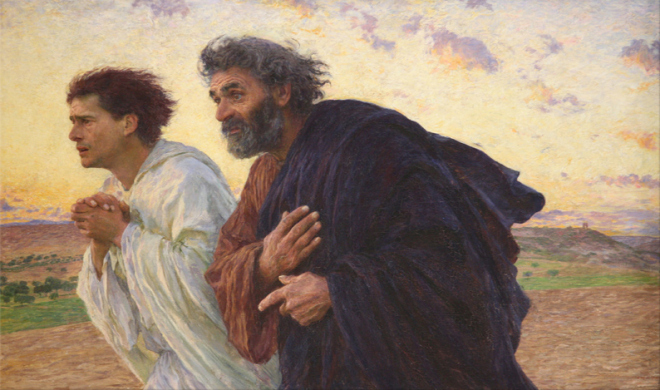
2So she came running to Simon Peter and the other disciple, the one Jesus loved, and said, “They have taken the Lord out of the tomb, and we don’t know where they have put him!”
3So Peter and the other disciple started for the tomb.
4Both were running, but the other disciple outran Peter and reached the tomb first.
5He bent over and looked in at the strips of linen lying there but did not go in.
6Then Simon Peter, who was behind him, arrived and went into the tomb. He saw the strips of linen lying there,
7 as well as the burial cloth that had been around Jesus’ head. The cloth was folded up by itself, separate from the linen.
8 Finally the other disciple, who had reached the tomb first, also went inside. He saw and believed.
9(They still did not understand from Scripture that Jesus had to rise from the dead.)
10Then the disciples went back to their homes,
11but Mary stood outside the tomb crying. As she wept, she bent over to look into the tomb
12and saw two angels in white, seated where Jesus’ body had been, one at the head and the other at the foot.
13They asked her, “Woman, why are you crying?” “They have taken my Lord away,” she said, “and I don’t know where they have put him.”
14At this, she turned around and saw Jesus standing there, but she did not realize that it was Jesus.
15″Woman,” he said, “why are you crying? Who is it you are looking for?” Thinking he was the gardener, she said, “Sir, if you have carried him away, tell me where you have put him, and I will get him.”
16Jesus said to her, “Mary.” She turned toward him and cried out in Aramaic, “Rabboni!” (which means Teacher).
17Jesus said, “Do not hold on to me, for I have not yet returned to the Father. Go instead to my brothers and tell them, `I am returning to my Father and your Father, to my God and your God.’”
18Mary Magdalene went to the disciples with the news: “I have seen the Lord!” And she told them that he had said these things to her.
19On the evening of that first day of the week, when the disciples were together, with the doors locked for fear of the Jews, Jesus came and stood among them and said, “Peace be with you!”
20After he said this, he showed them his hands and side. The disciples were overjoyed when they saw the Lord.
21Again Jesus said, “Peace be with you! As the Father has sent me, I am sending you.”
22And with that he breathed on them and said, “Receive the Holy Spirit.
23If you forgive anyone his sins, they are forgiven; if you do not forgive them, they are not forgiven.”
24Now Thomas (called Didymus), one of the Twelve, was not with the disciples when Jesus came.
25So the other disciples told him, “We have seen the Lord!” But he said to them, “Unless I see the nail marks in his hands and put my finger where the nails were, and put my hand into his side, I will not believe it.”
26A week later his disciples were in the house again, and Thomas was with them. Though the doors were locked, Jesus came and stood among them and said, “Peace be with you!”
27Then he said to Thomas, “Put your finger here; see my hands. Reach out your hand and put it into my side. Stop doubting and believe.”
28Thomas said to him, “My Lord and my God!”
29Then Jesus told him, “Because you have seen me, you have believed; blessed are those who have not seen and yet have believed.”
30Jesus did many other miraculous signs in the presence of his disciples, which are not recorded in this book.
31But these are written that you may [1] believe that Jesus is the Christ, the Son of God, and that by believing you may have life in his name.1.31 Some manuscripts “may continue to”
So the greatest of antinomies is resolved. The entirety of human kind has now been redeemed. And just like anyone unfamiliar or knowledgeable today they did not know they were redeemed. Some did not know they needed to be redeemed then, as they do not know it today. There are those who see who have not seen with the same eyes of Thomas, but with the inner light of truth, as it presents itself simply because it is the Truth and believe in that moment of revelation.
So we who have believed and yet have not seen have inherited this story as the foundation of Western culture—a foundation that may be fast crumbling, and a foundation that is having its ramparts stricken from most every side. Yet it is we who do believe who are left responsible for this message being passed on. The greatest of fallacies is that one has to be part of a graduated class in a seminary to pass this message on. People are often put to death spiritually in Seminaries and others become atheists or pantheists there. Others because of their seminary experience have had to abandon the organized Church rather than look themselves in the mirror because of the hypocrisy of one form or another they found abiding there. And many modern day religionists would charge upon pain of ecclesiastical crucifixion that one is forced to accept this system and live it and put this tradition on over Christ Jesus Himself. And yet it may be that despite all this our Seminaries are a separation process that does produce notable been and women of God.
High Pagan Rome began a precipitous but lengthy fall the day of the crucifixion. From its beginning they wanted no part in it. The religionists of the day wanted it done and done before dark and done their way and would not, could not, take in any form of mercy as an answer—they still can’t—leaving the Messiah on the Cross in the form of condemning legalism rather than loving redemption and the resurrected loving glory of a living God. The Pilate’s of this world are still here in comfortable bureaucracies agreeing to death sentences for some and long terms for others—as portions of Christ are chipped out of our culture on a daily basis in making environmental decisions based upon short term profit, at the expense long term health and human justice. Or, allowing the destiny designed by a loving God to play out in a myriad of aborted lives whose end has come for convenience and pleasures sake at the modern alter of the pagan god that requires human sacrifice for a middle-to-upper-class lifestyle. Just as the ritual and rites of pre-Christian pagan Celtic homes required the ritual sacrifice of the first born on its foundations before a structure was thought to be sound.1 The Pharisees and ruling Sanhedrin-like councils exist as parts of legislatures, courts and political parties and good ol’ boy networks and now it seems good ol’ girl networks.
So? —again, to those that aren’t convinced. Is it true? I believe with every fiber of my being that it-is-true. And not only true but the truth—the ultima veritas. And I believe this after having questioned it thoroughly and found the truth to be vital and living. God the Creator took the form of man and visited earth as humble carpenter. Here he preached the truth of love and redemption to all mankind to the holders of a covenant with Him and was then arrested, tried and killed both by the holders of that covenant and mankind in general in the form of authoritarian civilized Pagan Rome. By this act there is a final redemption for all people in all times and in all walks of life. And through this emerges all other truths and upon which all other truths depend. One adopts the creeds of Christianity not because they are mere words and the party line but because they are in essence the living truth that has been passed on for a length of time in space that surpasses the oldest living things on the planet.
Believing in the 21st Century:Chapter Two
 an exhortation..as
a lay Christian examines his faith..
By James Ross Kelly
Christian bells toll—despite the shortcomings of Christendom, Evangelic and otherwise. Adherents of a modern material-polytheistic paganism however, should at least seriously consider the real thing which illumes Christ Jesus to a planet full of believers who met Him — personally and individually in a meeting. These days that is the discounted thing. The Gospel is the story of how the living God of the universe, visiting earth in fully human form was met and treated by organized legalist, religionists, and organized, civilized, Pagan law abiding civil servants—and those who sought to proffer their favor. In a question, before anyone adopts a counter doctrine out of hand, or take present culture oriented stance seriously, or assign Jesus to mythos you must ask. At some point in your life, ‘What if, just as it is written, what if—this is true?’
John 19:1-42
New King James Version (NKJV) The Holy Bible, New King James Version Copyright © 1982 by Thomas Nelson, Inc.
The Soldiers Mock Jesus
19 So then Pilate took Jesus and scourged Him. 2 And the soldiers twisted a crown of thorns and put it on His head, and they put on Him a purple robe. 3 Then they said,[1] “Hail, King of the Jews!” And they struck Him with their hands.
4 Pilate then went out again, and said to them, “Behold, I am bringing Him out to you, that you may know that I find no fault in Him.”
Pilate’s Decision
5 Then Jesus came out, wearing the crown of thorns and the purple robe. And Pilate said to them, “Behold the Man!”
6 Therefore, when the chief priests and officers saw Him, they cried out, saying, “Crucify Him, crucifyHim!”
Pilate said to them, “You take Him and crucify Him, for I find no fault in Him.”
7 The Jews answered him, “We have a law, and according to our[2] law He ought to die, because He made Himself the Son of God.”
8 Therefore, when Pilate heard that saying, he was the more afraid, 9 and went again into the Praetorium, and said to Jesus, “Where are You from?” But Jesus gave him no answer.
10 Then Pilate said to Him, “Are You not speaking to me? Do You not know that I have power to crucify You, and power to release You?”
11 Jesus answered, “You could have no power at all against Me unless it had been given you from above. Therefore the one who delivered Me to you has the greater sin.”
12 From then on Pilate sought to release Him, but the Jews cried out, saying, “If you let this Man go, you are not Caesar’s friend. Whoever makes himself a king speaks against Caesar.”
13 When Pilate therefore heard that saying, he brought Jesus out and sat down in the judgment seat in a place that is called The Pavement, but in Hebrew, Gabbatha.* 14 Now it was the Preparation Day of the Passover, and about the sixth hour. And he said to the Jews, “Behold your King!”
15 But they cried out, “Away with Him, away with Him! Crucify Him!”
Pilate said to them, “Shall I crucify your King?”
The chief priests answered, “We have no king but Caesar!”
16 Then he delivered Him to them to be crucified. So they took Jesus and led Him away.[3]
The King on a Cross
17 And He, bearing His cross, went out to a place called the Place of a Skull, which is called in Hebrew, Golgotha, 18 where they crucified Him, and two others with Him, one on either side, and Jesus in the center. 19 Now Pilate wrote a title and put it on the cross. And the writing was:
JESUS OF NAZARETH, THE KING OF THE JEWS.
20 Then many of the Jews read this title, for the place where Jesus was crucified was near the city; and it was written in Hebrew, Greek, and Latin.
21 Therefore the chief priests of the Jews said to Pilate, “Do not write, ‘The King of the Jews,’ but, ‘He said, “I am the King of the Jews.”’”
22 Pilate answered, “What I have written, I have written.”
23 Then the soldiers, when they had crucified Jesus, took His garments and made four parts, to each soldier a part, and also the tunic. Now the tunic was without seam, woven from the top in one piece.24 They said therefore among themselves, “Let us not tear it, but cast lots for it, whose it shall be,” that the Scripture might be fulfilled which says:
“They divided My garments among them,
And for My clothing they cast lots.”[4]Therefore the soldiers did these things.
Behold Your Mother
25 Now there stood by the cross of Jesus His mother, and His mother’s sister, Mary the wife of Clopas, and Mary Magdalene. 26 When Jesus therefore saw His mother, and the disciple whom He loved standing by, He said to His mother, “Woman, behold your son!” 27 Then He said to the disciple,“Behold your mother!” And from that hour that disciple took her to his own home.
It Is Finished
28 After this, Jesus, knowing[5] that all things were now accomplished, that the Scripture might be fulfilled, said, “I thirst!” 29 Now a vessel full of sour wine was sitting there; and they filled a sponge with sour wine, put it on hyssop, and put it to His mouth. 30 So when Jesus had received the sour wine, He said, “It is finished!” And bowing His head, He gave up His spirit.
Jesus’ Side Is Pierced
31 Therefore, because it was the Preparation Day, that the bodies should not remain on the cross on the Sabbath (for that Sabbath was a high day), the Jews asked Pilate that their legs might be broken, and that they might be taken away. 32 Then the soldiers came and broke the legs of the first and of the other who was crucified with Him. 33 But when they came to Jesus and saw that He was already dead, they did not break His legs. 34 But one of the soldiers pierced His side with a spear, and immediately blood and water came out. 35 And he who has seen has testified, and his testimony is true; and he knows that he is telling the truth, so that you may believe. 36 For these things were done that the Scripture should be fulfilled, “Not one of His bones shall be broken.”[6] 37 And again another Scripture says, “They shall look on Him whom they pierced.”[7]
Jesus Buried in Joseph’s Tomb
38 After this, Joseph of Arimathea, being a disciple of Jesus, but secretly, for fear of the Jews, asked Pilate that he might take away the body of Jesus; and Pilate gave him permission. So he came and took the body of Jesus. 39 And Nicodemus, who at first came to Jesus by night, also came, bringing a mixture of myrrh and aloes, about a hundred pounds. 40 Then they took the body of Jesus, and bound it in strips of linen with the spices, as the custom of the Jews is to bury. 41 Now in the place where He was crucified there was a garden, and in the garden a new tomb in which no one had yet been laid.42 So there they laid Jesus, because of the Jews’ Preparation Day, for the tomb was nearby.
Footnotes:
- John 19:3 NU-Text reads And they came up to Him and said.
- John 19:7 NU-Text reads the law.
- John 19:16 NU-Text omits and led Him away.
- John 19:24 Psalm 22:18
- John 19:28 M-Text reads seeing.
- John 19:36 Exodus 12:46; Numbers 9:12; Psalm 34:20
- John 19:37 Zechariah 12:10
* There had never been any historical record of the court where Jesus Christ was tried by Pilate – called the “Gabbatha” or pavement in John 19:13. William F. Albright, in The Archeology of Palestine, shows that this court was the court of the Tower of Antonia, which was the Roman military headquarters of Rome in Jerusalem. The court was destroyed between 66 A.D. – 70 A.D. during the siege of Jerusalem. It was left buried when the city was rebuilt in the time of Hadrian, and not discovered until recently.
 St. John One: One