Category / Persecuted Church
American Keith Broomfield killed in Syria while fighting against the Islamic State group with Kurdish fighters
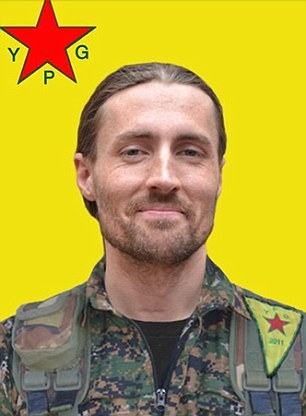
Keith-Broomfield
1979-2015
His obituary said he died “in defense of those being persecuted for their Christian faith” and that “his heart was for the protection of the innocence of Kurdish women and children.” He is survived by his parents and five siblings.
God is with us–A.D. Episode 10
Pastor Saeed Abedini–In Chains for Christ in Iran
Why Islam persecutes?–Sister Hatune Dogan’s implict account of Islamist atrocitites in Middle East
Sister Hatune Dogan is a Syrian Orthodox nun. She was born in Turkey, but her family fled to Germany to escape persecution. She now works in the field to help persecuted Christians all over the world, especially in the Middle East.
Genocide, Persecuted Christians: ETHIOPIA a FAILED STATE!
This documentary takes an extensive look at genocide, religious persecution of Orthodox Ethiopian Christians, ethnic cleansing, looting of International economic aid, land grabs by foreign governments (China, India, Saudi Arabia), and crimes against humanity by the totalitarian Ethiopian government.
Documentary:U.S Policy:ETHIOPIA A FAILED STATE!

Who are the most persecuted minorities in the world? Christians
Forty Martyrs of Sebaste
A party of soldiers who suffered a cruel death for their faith, near Sebaste, in Lesser Armenia, victims of the persecutions of Licinius, who, after the year 316, persecuted the Christians of the East. The earliest account of their martyrdom is given by St. Basil, Bishop of Caesarea (370-379), in a homily delivered on the feast of the Forty Martyrs (Hom. xix in P.G., XXXI, 507 sqq.). The feast is consequently more ancient than the episcopate of Basil, whose eulogy on them was pronounced only fifty or sixty years after martyrdom, which is thus historic beyond a doubt. According to St. Basil, forty soldiers who had openly confessed themselves Christians were condemned by the prefect to be exposed naked upon a frozen pond near Sebaste on a bitterly cold night, that they might freeze to death. Among the confessors, one yielded and, leaving his companions, sought the warm baths near the lake which had been prepared for any who might prove inconstant. One of the guards set to keep watch over the martyrs beheld at this moment a supernatural brilliancy overshadowing them and at once proclaimed himself a Christian, threw off his garments, and placed himself beside the thirty-nine soldiers of Christ. Thus the number of forty remained complete. At daybreak, the stiffened bodies of the confessors, which still showed signs of life, were burned and the ashes cast into a river. The Christians, however, collected the precious remains, and the relics were distributed through out many cities; in this way the veneration paid to the Forty Martyrs became widespread, and numerous churches were erected in their honour.
One of them was built at Caesarea, in Cappadocia, and it was in this church that St. Basil publicly delivered his homily. St. Gregory of Nyssa was a special client of these holy martyrs. Two discourses in praise of them, preached by him in the church dedicated to them, are still preserved (P. G., XLVI, 749 sqq., 773 sqq.) and upon the death of his parents, he laid them to rest beside the relics of the confessors. St. Ephraem, the Syrian, has also eulogized the forty Martyrs (Hymni in SS. 40 martyres). Sozomen, who was an eye-witness, has left us (Hist. Eccl., IX, 2) an interesting account of the finding of the relics in Constantinople through the instrumentality of the Empress Pulcheria. Special devotion to the forty martyrs of Sebaste was introduced at an early date into the West. St. Gaudentius, Bishop of Brescia in the beginning of the fifth century (d. about 410 or 427), received particles of the ashes of martyrs during a voyage in the East, and placed them with other relics in the altar of the basilica which he had erected, at the consecration of which he delivered a discourse, still extant (P. L., XX, 959 sqq.) Near the Church of Santa Maria Antiqua, in the Roman Forum, built in the fifth century, a chapel was found, built, like the church itself, on an ancient site, and consecrated to the Forty Martyrs. A picture, still preserved there, dating from the sixth or seventh century, depicts the scene of the martydom. The names of the confessors, as we find them also in later sources, were formerly inscribed on this fresco. Acts of these martyrs, written subsequently, in Greek, Syriac and Latin, are yet extant, also a “Testament” of the Forty Martyrs. Their feast is celebrated in the Greek, as well as in the Latin Church, on 9 March.
J.P. KIRSCH
Catholic Encyclopedia (1913), Volume 6


Mother of newborn to be executed in Sudan because she will not recant Christ
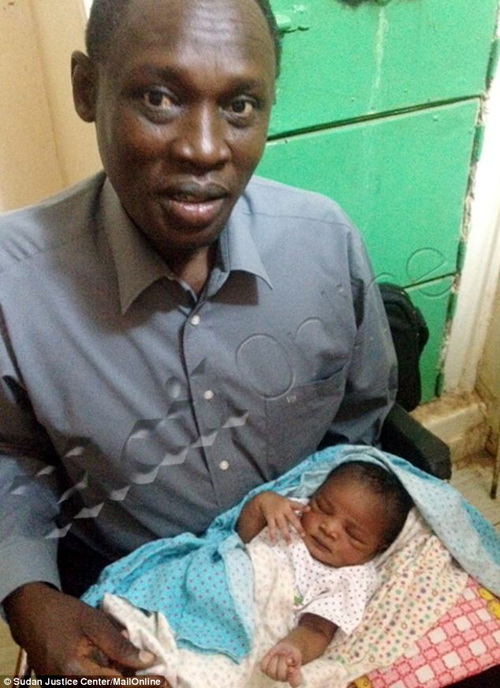
Daniel Wani holds his newborn daughter for the first time.
Persecution Blog: By Choosing Christ, Her Children Will Be Orphans.
 St. John One: One