 Attracted To Men, Pastor Feels Called To Marriage With A Woman : NPR.
Category / Orthodox Christianity
Exposing Popular Culture’s Quest to Unseat the Biblical Christ–Bock & Wallace
In 2007, Darrell L. Bock and Daniel B. Wallace wrote a ground shaking response to the popular effort to dismiss Jesus as who He said he was in the Gospels. In Dethroning Jesus: Exposing Popular Culture’s Quest to Unseat the Biblical Christ, from the Jesus Seminar to Bart Ehrman’s best selling Misquoting Jesus: The Story behind Who Changed the Bible and Why, and the truth of the Gnostic gospels which have gained favor as secular alternatives to the Gospel; Bock & Wallace deconstruct the one-sidedness of these popular arguments that have become so prevalent in secular conversations about Jesus. These two scholars show the critical thinking in the orthodox view of Christianity can be delivered with brilliant and accessible writing. Never mean-spirited, Bock and Wallace give Ehrman, Borg, and Crossan their due when they are right about inconsistencies in conservative Theology, whilst showing that two thousand years of relevant Christian doctrine is still the most viable notion about the risen Christ. Here, well into their critic of the Jesus Seminar, Bock and Wallace (Ph.Ds. and writers, Bock (Jesus According to Scripture) and Wallace, author of one of the most widely used textbooks on New Testament Greek grammar) show the importance of answering secular scholars, in a cogent manner and how ‘either, or ‘ politics dissuades the relevance Christianity has– away from Jesus Himself.
The Gospels devote much more space to Jesus’ teaching on the human heart or on religious hypocrisy because the danger in religious hypocrisy is that God’s name is misrepresented and brought to shame. The problem for Jesus is not “them” but “us.” The reform he calls for is that of our lives, every part of our lives. Change begins in the human heart. Then we are called to live out Christian values as an example to the world in any locale or context in which God places us. When Borg and Crossan say that Jesus is against egoism and injustice and for personal and political transformation (2006, 210), they are closer to being on track. However, most of what they say in their review of Jesus’ last week misses the fact that Jesus is the key to this transformation, not just his teaching. Jesus doesn’t urge us to choose virtue. He presents himself as the giver of a gift from God that solves the internal human problem. His death reveals even more about who we are and what we need, so that we, transformed from within, can serve God humbly and allow his power to enable us to con-tribute to the transformation to which God directs us. The domination Jesus seeks to free us from involves something more profound than just politics.
If there is a parable in the resurrection story, it is in the lives that Jesus’ followers are to live as they practice righteousness as a community. They are called to model the lifestyle and values Jesus taught as reflecting God’s will, values that represent real life. These values do include justice, compassion, and nonexploitation, but they also include respect for life, and a concern that liberty does not step on those who cannot defend themselves, whether they be the poor in the streets, the victims of terrorism, or the silent in the womb. Injustice surrounds us everywhere. This is why Paul declared that all sin and fall short of the glory of God (Rom. 3:21–25a). It is why the earliest followers of Jesus proclaimed that all need the new life Jesus brings through his Spirit. Forgiveness before God is not an issue for either political conservatives or liberals. It is a both-and, for sin is so pervasive that all of us have participated in it and need to seek forgiveness and also grant it to others. One of the causes of our cultural divide nowadays is that each side of the political divide has been selective in its application of the values Jesus taught.

Bock, Darrell L. and Wallace, Daniel B. (2007-11-06). Dethroning Jesus: Exposing Popular Culture’s Quest to Unseat the Biblical Christ (Kindle Locations 2434-2451). Thomas Nelson. Kindle Edition.
Orthodox Perspective on Same Sex Marriage
Why America is in Spiritual Decline: interview with Father Seraphim Cardoza
Thomas Merton from the Assent to Truth
When creation becomes the false light of concupiscence, it becomes illusion. The supreme value that cupidity seeks in created things, does not exist in them. A man who takes a tree as a ghost is in illusion. The tree is objectively real: but in his mind it is something that it is not. A man who takes a cigar coupon for a ten-dollar bill is also in illusion. When we view life, as if the multiplicity of the phenomenal universe were the criterion of all truth, and treat the world around us as if its shifting scale of values were the only measure of our own good, the world becomes an illusion. It is real in itself, but it is no longer real to us because it is not what we think it is.

Thomas Merton
The Assent to Truth
a appears in the Thomas Merton Reader, entitled “Visions and Illusions,” pp385
The Spirit of Truth (John 16:12-15)–William Barclay

Eugene Burnand
John 16:12-15 “I have many things to say to you, but you cannot bear them now. When the Spirit of Truth has come, he will lead you into all the truth. For he will not speak on his own authority and out of his own knowledge, but he will speak all that he will hear, and he will tell you of the things to come. He will glorify me, for he will take of the things which belong to me, and will tell you of them. All things that the Father has are mine. That is why I said that the Spirit will take of the things which belong to me, and tell them to you.”
To Jesus the Holy Spirit is the Spirit of Truth, whose great work is to bring God’s truth to men. We have a special name for this bringing of God’s truth to men; we call it revelation, and no passage in the New Testament shows us what we might call the principles of revelation better than this one.
(i) Revelation is bound to be a progressive process. Many things Jesus knew he could not at that moment tell his disciples, because they were not yet able to receive them. It is only possible to tell a man as much as he can understand. We do not start with the binomial theorem when we wish to teach a boy algebra; we work up to it. We do not start with advanced theorems when we wish to teach a child geometry; we approach them gradually. We do not start with difficult passages when we teach a lad Latin or Greek; we start with the easy and the simple things. God’s revelation to men is like that. He teaches men what they are able and fit to learn. This most important fact has certain consequences.
(a) It is the explanation of the parts of the Old Testament which sometimes worry and distress us. AT that stage they were all of God’s truth that men could grasp. Take an actual illustration—in the Old Testament there are many passages which call for the wiping out of men and women and children when an enemy city is taken. At the back of these passages there is the great thought that Israel must not risk the taint of any heathen and lower religion. To avoid that risk, those who do not worship the true God must be destroyed. That is to say, the Jews had at that stage grasped the fact that the purity of religion must be safeguarded; but they wished to preserve that purity by destroying the heathen. When Jesus came, men came to see that the way to preserve that purity is to convert the heathen. The people of the Old Testament times had grasped a great truth, but only one side of it. Revelation has to be that way; God can reveal only as much as a man can understand.
(b) It is the proof that there is no end to God’s revelation. One of the mistakes men sometimes make is to identify God’s revelation solely with the Bible. That would be to say that since about A.D. 120, when the latest book in the New Testament was written, God has ceased to speak. But God’s Spirit is always active; he is always revealing himself. It is true that his supreme and unsurpassable revelation came in Jesus; but Jesus is not just a figure in a book, he is a living person and in him God’s revelation goes on. God is still leading us into greater realization of what Jesus means. He is not a God who spoke up to A.D. 120 and is now silent. He is still revealing his truth to men.
(ii) God’s revelation to men is a revelation of all truth. It is quite wrong to think of it as confined to what we might call theological truth. The theologians and the preachers are not the only people who are inspired. When a poet delivers to men a great message in words which defy time, he is inspired. When H. F. Lyte wrote the words of Abide with me he had no feeling of composing them; he wrote them as to dictation. A great musician is inspired. Handel, telling of how he wrote The Hallelujah Chorus, said: “I saw the heavens opened, and the Great White God sitting on the Throne.” When a scientist discovers something which will help the world’s toil and make life better for men, when a surgeon discovers a new technique which will save men’s lives and ease their pain, when someone discovers a new treatment which will bring life and hope to suffering humanity, that is a revelation from God. All truth is God’s truth, and the revelation of all truth is the work of the Holy Spirit.
(iii) That which is revealed comes from God. He is alike the possessor and the giver of all truth. Truth is not men’s discovery; it is God’s gift. It is not something which we create; it is something already waiting to be discovered. At the back of all truth there is God.
(iv) Revelation is the taking of the things of Jesus and revealing their significance to us. Part of the greatness of Jesus is his inexhaustibleness. No man has ever grasped all that he came to say. No man has fully worked out all the significance of his teaching for life and for belief, for the individual and for the world, for society and for the nation. Revelation is a continual opening out of the meaning of Jesus.
There we have the crux of the matter. Revelation comes to us, not from any book or creed, but from a living person. The nearer we live to Jesus, the better we will know him. The more we become like him, the more he will be able to tell us. To enjoy his revelation we must accept his mastery.
Forty Martyrs of Sebaste
A party of soldiers who suffered a cruel death for their faith, near Sebaste, in Lesser Armenia, victims of the persecutions of Licinius, who, after the year 316, persecuted the Christians of the East. The earliest account of their martyrdom is given by St. Basil, Bishop of Caesarea (370-379), in a homily delivered on the feast of the Forty Martyrs (Hom. xix in P.G., XXXI, 507 sqq.). The feast is consequently more ancient than the episcopate of Basil, whose eulogy on them was pronounced only fifty or sixty years after martyrdom, which is thus historic beyond a doubt. According to St. Basil, forty soldiers who had openly confessed themselves Christians were condemned by the prefect to be exposed naked upon a frozen pond near Sebaste on a bitterly cold night, that they might freeze to death. Among the confessors, one yielded and, leaving his companions, sought the warm baths near the lake which had been prepared for any who might prove inconstant. One of the guards set to keep watch over the martyrs beheld at this moment a supernatural brilliancy overshadowing them and at once proclaimed himself a Christian, threw off his garments, and placed himself beside the thirty-nine soldiers of Christ. Thus the number of forty remained complete. At daybreak, the stiffened bodies of the confessors, which still showed signs of life, were burned and the ashes cast into a river. The Christians, however, collected the precious remains, and the relics were distributed through out many cities; in this way the veneration paid to the Forty Martyrs became widespread, and numerous churches were erected in their honour.
One of them was built at Caesarea, in Cappadocia, and it was in this church that St. Basil publicly delivered his homily. St. Gregory of Nyssa was a special client of these holy martyrs. Two discourses in praise of them, preached by him in the church dedicated to them, are still preserved (P. G., XLVI, 749 sqq., 773 sqq.) and upon the death of his parents, he laid them to rest beside the relics of the confessors. St. Ephraem, the Syrian, has also eulogized the forty Martyrs (Hymni in SS. 40 martyres). Sozomen, who was an eye-witness, has left us (Hist. Eccl., IX, 2) an interesting account of the finding of the relics in Constantinople through the instrumentality of the Empress Pulcheria. Special devotion to the forty martyrs of Sebaste was introduced at an early date into the West. St. Gaudentius, Bishop of Brescia in the beginning of the fifth century (d. about 410 or 427), received particles of the ashes of martyrs during a voyage in the East, and placed them with other relics in the altar of the basilica which he had erected, at the consecration of which he delivered a discourse, still extant (P. L., XX, 959 sqq.) Near the Church of Santa Maria Antiqua, in the Roman Forum, built in the fifth century, a chapel was found, built, like the church itself, on an ancient site, and consecrated to the Forty Martyrs. A picture, still preserved there, dating from the sixth or seventh century, depicts the scene of the martydom. The names of the confessors, as we find them also in later sources, were formerly inscribed on this fresco. Acts of these martyrs, written subsequently, in Greek, Syriac and Latin, are yet extant, also a “Testament” of the Forty Martyrs. Their feast is celebrated in the Greek, as well as in the Latin Church, on 9 March.
J.P. KIRSCH
Catholic Encyclopedia (1913), Volume 6


The Anti-Theology of the Body – The New Atlantis

The Story of the Loving Father—William Barclay
Parable of the Prodigal Son
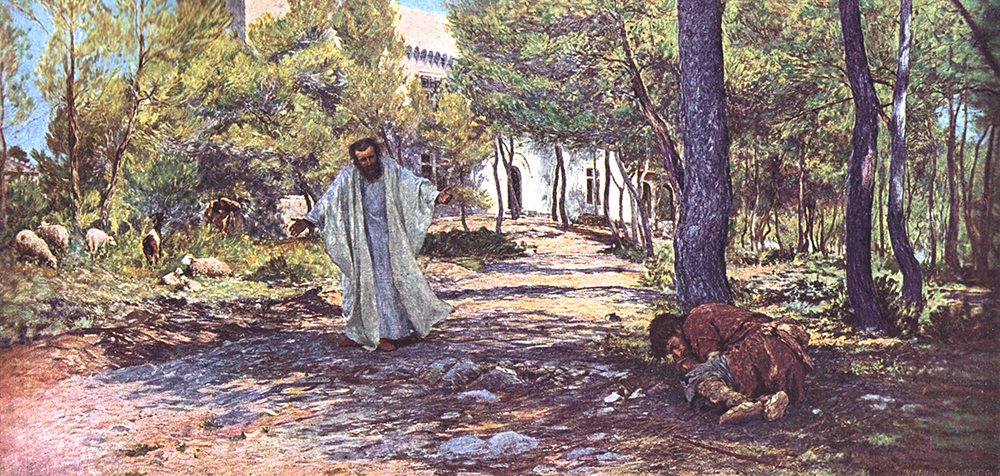
Prodigal Son by Eugene Burnand
(Luke 15:11-32)
Jesus said, “There was a man who had two sons. The younger of them said to his father, ‘Father, give me the part of the estate which falls to me.’ So his father divided his living between them. Not many days after, the son realized it all and went away to a far country, and there in wanton recklessness scattered his substance. When he had spent everything a mighty famine arose throughout that country and he began to be in want. He went and attached himself to a citizen of that country, and he sent him into his fields to feed pigs; and he had a great desire to fill himself with the husks the pigs were eating; and no one gave anything to him. When he had come to himself, he said, ‘How many of my father’s hired servants have more than enough bread, and I—I am perishing here with hunger. I will get up and I will go to my father, and I will say to him, “Father, I have sinned against heaven and before you. I am no longer fit to be called your son. Make me as one of your hired servants.”‘ So he got up and went to his father. While he was still a long way away his father saw him, and was moved to the depths of his being and ran and flung his arms round his neck and kissed him tenderly. The son said to him, ‘Father, I have sinned against heaven and before you. I am no longer fit to be called your son.’ But the father said to his servants, ‘Quick! Bring out the best robe and put it on him; put a ring on his finger; put shoes on his feet; and bring the fatted calf and kill it and let us eat and rejoice, for this my son was dead and has come back to life again; he was lost and has been found.’ And they began to rejoice.

Prodigal Son by Eugene Burnand
“Now the elder son was in the field. When he came near the house he heard the sound of music and dancing. He called one of the slaves and asked what these things could mean? He said to him, ‘Your brother has come, and your father has killed the fatted calf because he has got him back safe and sound.’ He was enraged and refused to come in. His father went out and urged him to come in. He answered his father, ‘Look you, I have served you so many years and I never transgressed your order, and to me you never gave a kid that I might have a good time with my friends. But when this son of yours—this fellow who consumed your living with harlots—came, you killed the fatted calf for him.’ ‘Child,’ he said to him, ‘you are always with me. Everything that is mine is yours. But we had to rejoice and be glad, for your brother was dead and has come back to life again; he was lost and has been found.'”**

Prodigal Son by Eugene Burnand
Not without reason this has been called the greatest short story in the world. Under Jewish law a father was not free to leave his property as he liked. The elder son must get two-thirds and the younger one-third. (Deut 21:17.) It was by no means unusual for a father to distribute his estate before he died, if he wished to retire from the actual management of affairs. But there is a certain heartless callousness in the request of the younger son. He said in effect, “Give me now the part of the estate I will get anyway when you are dead, and let me get out of this.” The father did not argue. He knew that if the son was ever to learn he must learn the hard way; and he granted his request. Without delay the son realized his share of the property and left home.
He soon ran through the money; and he finished up feeding pigs, a task that was forbidden to a Jew because the law said, “Cursed is he who feeds swine.” Then Jesus paid sinning mankind the greatest compliment it has ever been paid. “When he came to himself,” he said. Jesus believed that so long as a man was away from God he was not truly himself; he was only truly himself when he was on the way home. Beyond a doubt Jesus did not believe in total depravity. He never believed that you could glorify God by blackguarding man; he believed that man was never essentially himself until he came home to God.
So the son decided to come home and plead to be taken back not as a son but in the lowest rank of slaves, the hired servants, the men who were only day labourers. The ordinary slave was in some sense a member of the family, but the hired servant could be dismissed at a day’s notice. He was not one of the family at all. He came home; and, according to the best Greek text, his father never gave him the chance to ask to be a servant. He broke in before that. The robe stands for honour; the ring for authority, for if a man gave to another his signet ring it was the same as giving him the power of attorney; the shoes for a son as opposed to a slave, for children of the family were shod and slaves were not. (The slave’s dream in the negro spiritual is of the time when “all God’s chillun got shoes,” for shoes were the sign of freedom.) And a feast was made that all might rejoice at the wanderer’s return.
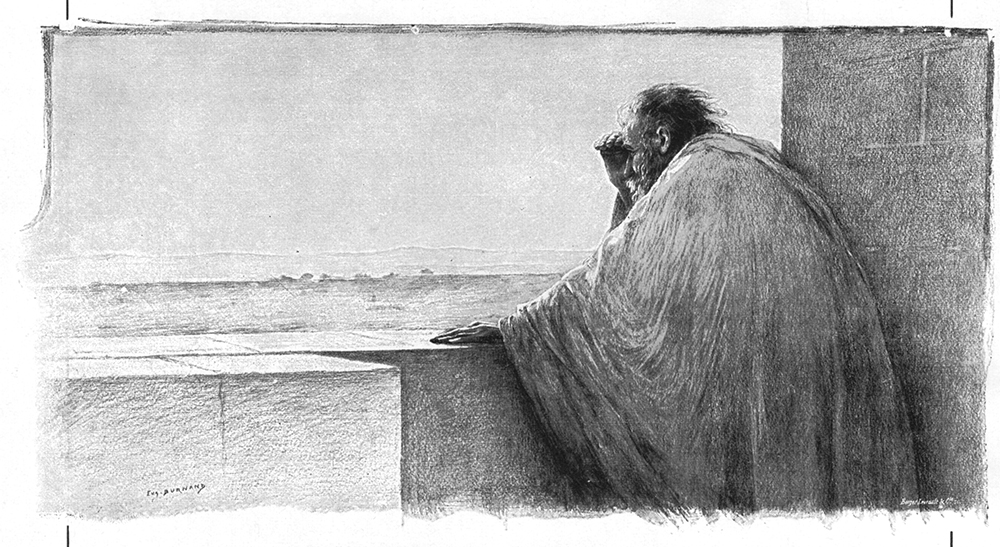
Prodigal Son by Eugene Burnand
Let us stop there and see the truth so far in this parable.
(i) It should never have been called the parable of the Prodigal Son, for the son is not the hero. It should be called the parable of the Loving Father, for it tells us rather about a father’s love than a son’s sin.
(ii) It tells us much about the forgiveness of God. The father must have been waiting and watching for the son to come home, for he saw him a long way off. When he came, he forgave him with no recriminations. There is a way of forgiving, when forgiveness is conferred as a favour. It is even worse, when someone is forgiven, but always by hint and by word and by threat his sin is held over him.
Once Lincoln was asked how he was going to treat the rebellious southerners when they had finally been defeated and had returned to the Union of the United States. The questioner expected that Lincoln would take a dire vengeance, but he answered, “I will treat them as if they had never been away.”
It is the wonder of the love of God that he treats us like that.
That is not the end of the story. There enters the elder brother who was actually sorry that his brother had come home. He stands for the self-righteous Pharisees who would rather see a sinner destroyed than saved. Certain things stand out about him.
(i) His attitude shows that his years of obedience to his father had been years of grim duty and not of loving service.
(ii) His attitude is one of utter lack of sympathy. He refers to the prodigal, not as any brother, but as your son. He was the kind of self-righteous character who would cheerfully have kicked a man farther into the gutter when he was already down.
(iii) He had a peculiarly nasty mind. There is no mention of harlots until he mentions them. He, no doubt, suspected his brother of the sins he himself would have liked to commit.
Once again we have the amazing truth that it is easier to confess to God than it is to many a man; that God is more merciful in his judgments than many an orthodox man; that the love of God is far broader than the love of man; and that God can forgive when men refuse to forgive. In face of a love like that we cannot be other than lost in wonder, love and praise.
The Gospel of Luke, Barclay’s Daily Study Bible (NT).
** William Barclay’s translation.
Greek Initials ‘XP’–What did they stand for?
| “XP“Chi-Rho | Christ – the 1st 2 letters of Christos in Greek | “P” in Greek is “r” in English |
| “Α Ω““A w”(Alpha-Omega) |
The first and last letters of the Greek alphabet, |
Represents that God is eternal – spanning the beginning and the end. |
 St. John One: One