Category / History
William Douglas on Church and State

William O. Douglas 1898-1980
On April 28, 1952, in the decision of the Supreme Court of the United States in Zorach v. Clauson, 343 U.S. 306 (1952), in which school children were allowed to be excused from public schools for religious observances and education, Justice William O. Douglas, in writing for the Court stated:
‘The First Amendment, however, does not say that in every and all respects there shall be a separation of Church and State. Rather, it studiously defines the manner, the specific ways, in which there shall be no concern or union or dependency one on the other. That is the common sense of the matter. Otherwise the State and religion would be aliens to each other – hostile, suspicious, and even unfriendly. Churches could not be required to pay even property taxes. Municipalities would not be permitted to render police or fire protection to religious groups. Policemen who helped parishioners into their places of worship would violate the Constitution. Prayers in our legislative halls; the appeals to the Almighty in the messages of the Chief Executive; the proclamations making Thanksgiving Day a holiday; “so help me God” in our courtroom oaths – these and all other references to the Almighty that run through our laws, our public rituals, our ceremonies would be flouting the First Amendment. A fastidious atheist or agnostic could even object to the supplication with which the Court opens each session: “God save the United States and this Honorable Court.”
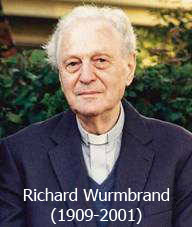
Richard Wurmbrand, “Preparing for the Underground Church”
“God is the Truth. The Bible is the truth about the Truth. Theology is the truth about the truth about the Truth. A good sermon is the truth about the truth, about the truth, about the Truth. It is not the Truth. The Truth is God alone. Around this Truth there is a scaffolding of words, of theologies, and of exposition. None of these is of any help in times of suffering. It is only the Truth Himself Who is of help, and we have to penetrate through sermons, through theological books, through everything which is ‘words’ and be bound up with the reality of God himself.
I have told in the West how Christians were tied to crosses for four days and four nights. The crosses were put on the floor and other prisoners were tortured and made to fulfill their bodily necessities upon the faces and bodies of the crucified ones. I have since been asked: “Which bible verse helped and strengthened you in those circumstances?” My answer is: “NO Bible verse was of any help.” It is sheer cant and religious hypocrisy to say, “This Bible verse strengthens me, or that Bible verse helps me.” Bible verses alone are not meant to help. We knew Psalm 23.. “The Lord is my Shepherd; I shall not want…though I walk through the valley of the shadow of death…”
When you pass through suffering you realize that it was never meant by God that Psalm 23 should strengthen you. It is the Lord who can strengthen you, not the Psalm which speaks of Him so doing. It is not enough to have the Psalm. You must have the One about whom the Psalm speaks. We also knew the verse: “My Grace is sufficient for thee.” But the verse is not sufficient. It is the Grace, which is sufficient, and not the verse.
Pastors and zealous witnesses who are handling the Word as a calling from God are in danger of giving Holy words more value than they really have. Holy words are only the means to arrive at the reality expressed by them. If you are united with the Reality, the Lord Almighty, evil loses its power over you; it cannot break the Lord Almighty. If you only have the words of the Lord almighty you can be very easily broken.” Richard Wurmbrand, “Preparing for the Underground Church”
C.S. Lewis on Who Jesus is:

C.S. Lewis
“I am trying here to prevent anyone saying the really foolish thing that people often say about Him: I’m ready to accept Jesus as a great moral teacher, but I don’t accept his claim to be God. That is the one thing we must not say. A man who was merely a man and said the sort of things Jesus said would not be a great moral teacher. He would either be a lunatic — on the level with the man who says he is a poached egg — or else he would be the Devil of Hell. You must make your choice. Either this man was, and is, the Son of God, or else a madman or something worse. You can shut him up for a fool, you can spit at him and kill him as a demon or you can fall at his feet and call him Lord and God, but let us not come with any patronising nonsense about his being a great human teacher. He has not left that open to us. He did not intend to. … Now it seems to me obvious that He was neither a lunatic nor a fiend: and consequently, however strange or terrifying or unlikely it may seem, I have to accept the view that He was and is God.” C.S. Lewis, Mere Christianity
 St. John One: One