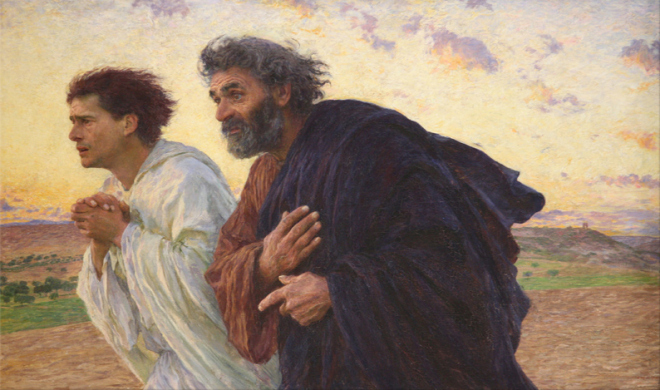
Architect and Governor of the universe


augustine

“..O Lord, to You most excellent and most good, You are Architect and Governor of the universe, thanks would be due You, O our God, even if you had not willed that I should survive my childhood.  For I existed even then; I lived and felt and was careful about my own well-being–a trace of that most mysterious unity from where I had my being.  I kept watch, by my inner sense, over the integrity of my outer senses, and even in these trifles and also in my thoughts about trifles, I learned to take pleasure in truth.  I was averse to being deceived; I had a vigorous memory; I was gifted with the power of speech, was softened by friendship, shunned sorrow, meanness, and ignorance.  Is not such an animated creature as this wonderful and praiseworthy? But all these are gifts of my God. I did not give them to myself. Moreover, they are good, and all together these gifts constitute myself. Good, then, is He that made me, and He is my God; and before Him will I rejoice exceedingly for every good gift which, even as a child, I had.  But this was my sin! That it was not in God the Creator, but in His creatures–myself and the rest–that I sought for pleasures, honors, and truths.  And I fell consequently into sorrows, troubles, and errors.  Thanks be to You, my joy, my pride, my confidence, my God–thanks be to You for Your gifts. Please preserve them in me.  For by this You will preserve me; and those things which You have given me will be developed and perfected, and I myself will be with You, for from You, comes my being.”

Augustine ca 285AD.2

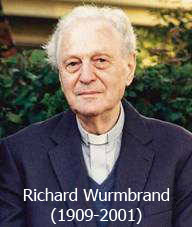
Richard Wurmbrand, “Preparing for the Underground Church”


richard

“God is the Truth. The Bible is the truth about the Truth. Theology is the truth about the truth about the Truth. A good sermon is the truth about the truth, about the truth, about the Truth. It is not the Truth. The Truth is God alone. Around this Truth there is a scaffolding of words, of theologies, and of exposition. None of these is of any help in times of suffering. It is only the Truth Himself Who is of help, and we have to penetrate through sermons, through theological books, through everything which is ‘words’ and be bound up with the reality of God himself.

I have told in the West how Christians were tied to crosses for four days and four nights. The crosses were put on the floor and other prisoners were tortured and made to fulfill their bodily necessities upon the faces and bodies of the crucified ones. I have since been asked: “Which bible verse helped and strengthened you in those circumstances?” My answer is: “NO Bible verse was of any help.” It is sheer cant and religious hypocrisy to say, “This Bible verse strengthens me, or that Bible verse helps me.” Bible verses alone are not meant to help. We knew Psalm 23.. “The Lord is my Shepherd; I shall not want…though I walk through the valley of the shadow of death…”

When you pass through suffering you realize that it was never meant by God that Psalm 23 should strengthen you. It is the Lord who can strengthen you, not the Psalm which speaks of Him so doing. It is not enough to have the Psalm. You must have the One about whom the Psalm speaks. We also knew the verse:  “My Grace is sufficient for thee.” But the verse is not sufficient. It is the Grace, which is sufficient, and not the verse.

Pastors and zealous witnesses who are handling the Word as a calling from God are in danger of giving Holy words more value than they really have. Holy words are only the means to arrive at the reality expressed by them. If you are united with the Reality, the Lord Almighty, evil loses its power over you; it cannot break the Lord Almighty. If you only have the words of the Lord almighty you can be very easily broken.” Richard Wurmbrand, “Preparing for the Underground Church”

from The Horse and His Boy by C.S.Lewis


C.S. Lewis

C.S. Lewis

And being very tired and having nothing inside him he felt so sorry for himself that the tears rolled down his cheeks.

What put a stop to all this was a sudden fright. Shasta discovered that someone or somebody was walking beside him, it was pitch dark and he could see nothing. And the Thing (or Person) was so quietly beside him he could hardly hear any footfalls. What he could hear was breathing. His invisible companion seemed to breathe on a very large scale and Shasta got the impression that it was a very large creature. And he had come to notice this breathing so gradually that he had really no idea how long it had been there, It was a horrible shock.

It darted into his mind that he heard long ago that there were Giants in these northern countries. He bit his lip in terror. But now that he really had something to cry about, he stopped crying.

The Thing (unless it was a Person) went on beside him so very quietly that Shasta began to hope he had only imagined it. But just as he was becoming quite sure of it, there suddenly came a deep, rich sigh out of the darkness beside him. That couldn’t be imagination! Anyway, he had felt the hot breath of the sigh on his chilly left hand.

If the horse had been any good—or he had known how to get any good out of the horse— he would have risked everything on a break away and a wild gallop. But he knew he couldn’t make that horse gallop.  So he went on at a walking pace and the unseen companion walked and breathed beside him. At last he could bear it no longer.

“Who are you?” he said, scarcely above a whisper.

“One who has waited long for you to speak,” said the Thing. Its voice was not loud, but very large and deep.

“Are you —a giant?” asked Shasta.

“You might call me a giant,” said the Large Voice. “But I am not like any creatures you call Giants.”

“I can’t see you at all,” said Shasta, after staring very hard, then (for an even more terrible idea had come into his head) he said, almost in a scream, “You’re not something dead, are you? Oh, please—do go away, what harm have I ever done you? Oh, I am the unluckiest person in the whole world!”

Once more he felt the warm breath of the Thing on his hand and face. “There,” it said, “that is not the breath of a ghost, tell me you sorrows.”

Shasta was a little reassured by the breath: so he told how he had never known his real father or mother and had been brought up sternly by the fisherman. And then he told the story of his escape and how they were chased by lions and forced to swim for their lives; and of all the dangers in  Tashban and about his night among the tombs and how the beasts howled at him out of the desert. And he told about the heat and the thirst of their desert journey. And he told about how they were almost at their goal when another lion chased them and wounded Aravis. And also, how very long it was since he’d had anything to eat.

“I do not call you unfortunate,” said the Large Voice.

“Don’t you think it was bad luck to meet so may lions?”  said Shasta.

“There was only one Lion, Said the Voice.

“What on earth do you mean? I’ve just told you there were at least two the first night, and..”

“There was only one: but he was swift of foot.”

“How do you know?”

“I was the lion.” And as Shasta gaped with open mouth and said nothing, the voice continued, “I was the lion who forced you to join with Aravis. I was the cat who comforted you among the houses of the dead, I was the Lion who drove the jackals from you while you slept. I was the lion who gave the horse the new strength of fear for the last mile so that you should reach King Lune in time, and I was the lion you do not remember who pushed the boat in which you lay, a child near death, so that it came to shore where a man sat, wakeful at midnight, to receive you.”

“Then it was you who wounded Aravis?”

“It was I.”

“But what for?” said Shasta.

“Child,” said the Voice “I am telling you, your story, not theirs. I tell no one any story but his own.”

“Who are you?” said Shasta.

“Myself,” said the Voice, very deep and low so that the earth shook: and again,” Myself,” loud and clear and gay: and then the third time “Myself,” whispered so softly you could hardly hear it, and yet it seemed to come from all around you as if the leaves rustled with it.

Shasta was no longer afraid that the Voice belonged to something that would eat him, nor that it was the voice of a ghost, but a new and different sort of trembling came over him, yet he felt glad too.

The mist was turning from black to gray, and from gray to white. This must have begun to happen some time ago, but while he had been talking to the Thing he had not been noticing anything else. Now, the whiteness around him became a shining whiteness; his eyes began to blink, somewhere ahead he could hear birds singing. He knew the night was over a last. He could see the mane and ears and head of his horse quite easily now. A golden light fell on them from the left. He thought it was the sun.

He turned and saw, pacing beside him, taller than the horse, a Lion. The horse did not seem to be afraid of it or else could not see it. It was from the Lion that the light came. No one ever saw anything more terrible or beautiful. Luckily Shasta had lived all his life too far south in Calormen to have heard the tales that were whispered in Tashbaan about the dreadful Narnian demon that appeared in the form of a lion. And of course he knew none of the true stores about Aslan, the great Lion, the son of the Emperor-over-the Sea, the King above all High Kings in Narnia. But after one glance at the Lion’s face, he slipped out of the saddle and fell at its feet. He couldn’t say anything but then he didn’t want to say anything, and he knew he couldn’t say anything.


The Horse and His Boy by C.S. Lewis
Two Eleven Year Old Girls Raped And Strangled


Papers have headlined
& the airwaves reported
events of last week..

Lord, this time
like many others You seem conspicuous
by your seeming absence

or is it always that
we are absent from
ourselves in such
vast numbers
you cannot make it
to all the sheep
before nightfall?
or, did you know
the events before hand
in the vast immediacy
of this universe
of yours as it travels
the speed of light
experiencing no time,
leaving that & sorrow
to our own devices,
allowing dark evils
their own course?

I don’t believe this is true..

were their Guardian Angels
napping? or taking
time out for a celestial dram?
or were they waylaid
by some other faraway pity?

or the next County?
do Angels make mistakes? & if not
how could they have watched? or,
very pointedly, who held them back?

I do not accept
an abstract drivel
about the all and everything,
in the natural course of events,
this instance being related
to cause and effect and destiny
or a hippies notion of Karma

so, this is laid at Your feet
for an answer
& as these words are written
they do seem to wheel and come back,
& bite me & maybe
an answer

in the flippant
careless thoughts and words
absently  let out
in an inattentive air
leaving gaps
in our guard
& good sense–allowing
evil its course, daily
or  something on the other side to push it on us
because every day, we forget to love..

every day…

Rastafarian Last Supper Painting by EJ Lefavour – Rastafarian Last Supper Fine Art Prints and Posters for Sale


Rastafarian Last Supper Painting by EJ Lefavour – Rastafarian Last Supper Fine Art Prints and Posters for Sale.

“Early Rasta mystical experience emphasized the immediate presence of JAH within the “dread,” God-fearer… Through union with JAH [Yahweh or Jehovah], the dread becomes who he truly is but never was, a process of self-discovery possible only through repentance. For this reason, Rastas did not proselytize, but relied on compunction sent by JAH. The mystical union was expressed by the use of the pronoun “I&I” (which can mean I, we, or even you, with JAH present) or simply “I” in contrast to the undeclined Jamaican dialect “me”.

“A Sketch Of Rastafari History” by Norman Hugh Redington, Editor, The St. Pachomius Orthodox Library

Thomas Merton—The New Man


thomas merton

Thomas Merton 1915-1968

In those who are most alive and therefore most themselves, the life of the body is subordinated to a higher life that is within them. It quietly surrenders to the far more abundant vitality of a spirit living on levels that defy measurement and observation. The mark of true life in man is therefore not turbulence but control, not effervescence but lucidity and direction, not passion but the sobriety that sublimates all passion and elevates it to the clear inebriation of mysticism. The control we mean here is not arbitrary and tyrannical control by an interior principle which can be called, variously, a “super-ego” or a pharasaical conscience: it is the harmonious coordination of man’s powers in striving for the realization of his deepest spiritual potentialities. It is not so much a control of one part of man by another, but the peaceful integration of all man’s powers into one perfect actuality which is his true self, that is to say his spiritual self. Man, then, can only fully be said to be alive when he becomes plainly conscious of the real meaning of his own existence, that is to say when he experiences something of the fulness of intelligence, freedom and spirituality that are actualized within himself. But can we really expect a man to attain to this kind of consciousness? Is it not utterly cruel to hold before his eyes the delusive hope of this “fulness” of life and of “realization?” Of course, if the nature of the hope is not understood, it is the cruelest and most mocking of delusions. It may be the worst of all spiritual mirages that torments him in his desert pilgrimage. How can a man, plunged in the agonia, the wrestling of life and death in their most elemental spiritual forms, be beguiled by the promise of self realization? His very self, his very reality, is all contradiction: a contradiction mercifully obscured by confusion. If the confusion is cleared away, and he fully “realizes” this tormented self, what will he see if not the final absurdity of the contradiction? The “real meaning of his existence” would then be precisely that it has no meaning. In a certain sense, that is true. To find life we must die to life as we know it. To find meaning we must die to meaning as we know it. The sun rises every morning and we are used to it, and because we know the sun will rise we have finally come to act as if it rose because we wanted it to. Suppose the sun should choose not to rise? Some of our mornings would then be “absurd”—or, to put it mildly, they would not meet our expectations. To find the full meaning of our existence we must find not the meaning that we expect but the meaning that is revealed to us by God. The meaning that comes to us out of the transcendent darkness of His mystery and our own. We do not know God and we do not know ourselves. How then can we imagine that it is possible for us to chart our own course toward the discovery of the meaning of our life? This meaning is not a sun that rises every morning, though we have come to think that it does, and on mornings when it does not rise we substitute some artificial light of our own so as not to admit that this morning was absurd. Meaning is then not something we discover in ourselves, or in our lives. The meanings we are capable of discovering are never sufficient. The true meaning has to be revealed. It has to be “given.” And the fact that it is given is, indeed, the greater part of its significance: for life itself is, in the end, only significant in so far as it is given. As long as we experience life and existence as suns that have to rise every morning, we are in agony. We must learn that life is a light that rises when God summons it out of darkness. For this there are no fixed times.

Merton, Thomas (1999-11-29). The New Man (Kindle Locations 72-100). Macmillan. Kindle Edition.

Karl Barth from Dogmatics in Outline


BARTH

“What man can know by his own power according to the measure of his natural powers, his understanding, his feeling, will be at most something like a supreme being, an absolute nature, the idea of an utterly free power, of a being towering over everything. This absolute and supreme being and absolute nature, the ultimate and most profound, this ‘thing in itself,’ has nothing to do with God. It is part of the intuitions and marginal possibilities of man’s thinking, man’s contrivance. Man is able to think this being; but he has not thereby thought God. God is thought and known when in His own freedom God makes Himself apprehensible.” Karl Barth Dogmatics in Outline