Unknown's avatar

Posts by James Ross Kelly

James Ross Kelly lives in Northern California next to the Sacramento River. Mr. Kelly was a long-time resident of Southern Oregon where he grew up. And the Fires We Talked About published by Uncollected Press in 2020 is Mr. Kelly’s first book of fiction. In 2024 Mr. Kelly published his third book, "Above Neil Rock," a memoir.

Pandemic removes Dead Sea Scrolls from exhibition – The Forward


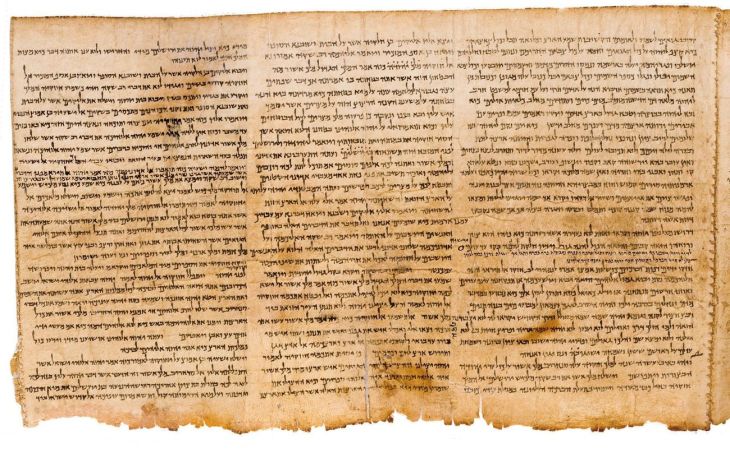
For most of their 2,000 year history, the scrolls were hidden in the Qumran Caves near the Dead Sea. Since their discovery in the 1940s and 50s, they have been on a steady path to celebrity. Before the pandemic, up to 3,000 people visited the Shrine of the Book every day. Now, no one knows exactly when the public will see the scrolls in person again. The museum’s entire trove has returned to indefinite hiding.

Source: Pandemic removes Dead Sea Scrolls from exhibition – The Forward

The Miserable People by JOHN PAVLOVITZ


These are the wildest of ironies: Their President is in the White House, their politicians commandeer the House and Senate, the Supreme Court is tilted in their favor—and yet they still manage to feel themselves oppressed, still picture the world unfair, still rage against a machine they’ve made and are part of. So many of them claim faith in Jesus, and yet live in almost polar opposition to his example.

Source: The Miserable People

The New Testament: A Translation by David Bentley Hart/Matthew 25:31-46


James Ross Kelly's avatarSt. John One: One

Matthew 25:31 And when the Son of Man comes in his
glory, and all the angels with him, then he will sit on his throne of glory; 32And
all the nations will be assembled before him, and he will separate them from
one another, as the shepherd separates the sheep from the kid goats, 33And
will set the sheep to his right, but the kid goats to the left. 34Then
the King will say to those to his right, ‘Come, you blessed by my Father,
inherit the Kingdom prepared for you from the foundation of the cosmos. 35For
I was hungry and you gave me something to eat, I was thirsty and you gave me
drink, I was a stranger and you gave me hospitality, 36Naked and you
clothed me, I was ill and you looked after me, I was in prison and you came…

View original post 281 more words

We Are Sheep-We Are Goats | Darrell Lackey


“When the Son of Man comes in his glory, and all the angels with him, then he will sit on his glorious throne. Before him will be gathered all the nations, and he will separate people one from another as a shepherd separates the sheep from the goats. And he will place the sheep on his right, but the goats on the left.”Those on the right, the sheep, are told to come and inherit the Kingdom. Those on the left do not fare as well. Or, at least this is the common understanding of these verses.  The sheep are bound for heaven, while the goats to eternal perdition.  One is either a sheep or a goat, there is no in-between. Two groups. Very simple. Very black and white.  You know, the way most of us like our theology.And yet, I wonder. So too did Sergius Bulgakov. There are alternative readings to what we call the “final judgment,” or the end times.  Bulgakov offered such a reading, which I find compelling and closer to the over-all sweep of Scripture, the Christian narrative, and of the God portrayed therein.What partly formed his reading of Matthew 25 and the sheep and the goats, was his view of what “judgment” entailed and meant.  We normally view judgment as something happening outside ourselves. We stand before an external judge who makes a decision regarding our lives, our souls.  It is something handed down to us, rendered or decreed.  It is separate from our own judgment, reflection, or internal calculus.

Source: We Are Sheep-We Are Goats | Darrell Lackey

Wm. Paul Young – Troubling Texts | Episode 16 – YouTube


The only time you’ll find God in a box is because God wants to be
where we are.

A Brief History of the Irish Orthodox Church


It was precisely because the monastic communities were like loving families that they had such a long-lasting and complete influence on the Irish people as a whole. These schools were the seedbeds of saints and scholars: literally thousands of young men and women received their formation in these communities. Some of them would stay and enter fully into monastic life, while others would return to their homes, marry, and raise their children in accordance with the profound Christian way of life that they had assimilated in the monastery. Some of the monks, either inspired by a desire for greater solitude, or by zeal to give what they had received to others, would leave the shores of their beloved homeland and set out “on pilgrimage for Christ” to other countries. Once again they would travel along paths previously trodden by their ancestors—both the pagans of long ago, and Christian pilgrims of more recent times.Because these monastic communities were centers of spiritual transformation and intense ascetic practice, they generated a dynamic environment which catalyzed the intellectual and artistic gifts of the Irish people, and laid them before the feet of Christ. In these monasteries, learning as well as sanctity was encouraged.The Irish avidly learned to write in Latin script, memorized long portions of the Scriptures (especially the Psalms), and even developed a written form for their exceedingly ancient oral traditions. When the Germanic peoples invaded the Continent (a.d. 400-550), the Gallic and Spanish scholars fled to Ireland with their books and traditions of the Greco-Roman Classical Age. In Ireland these books were zealously absorbed, treasured and passed on for centuries to come. Many Irish monks dedicated their whole lives to copying the Scriptures—the Old and New Testaments, as well as related writings—and often illuminated the manuscript pages with an intricate and beautiful art that is one of the wonders of the world.

Source: A Brief History of the Irish Orthodox Church

Easter Sneak Peak–Soon to be published by UnCollected Press: And the Fires We Talked About


And The Fires We Talked About Cover ArtEaster Sunday Afternoon

HE WAS STOOPED OVER AND ABOUT five-foot-five on a freeway entrance on I-5 northbound, with two good-sized paper grocery bags. Bundled up as he was, you could not discern by a scraggly grey-streaked beard; could have easily been fifty or older, but, stocking-capped, it was hard to tell.

“Oh thanks, oh thanks,”He said.

“I need a seven-mile ride!” He said.

Clear blue sky met us both and the twenty-year-old Ford picked up to freeway speed, and he was settling in with his bags at his feet. There were four, quart bottles of Rainer Ale.

“Warming up eh?” He said.

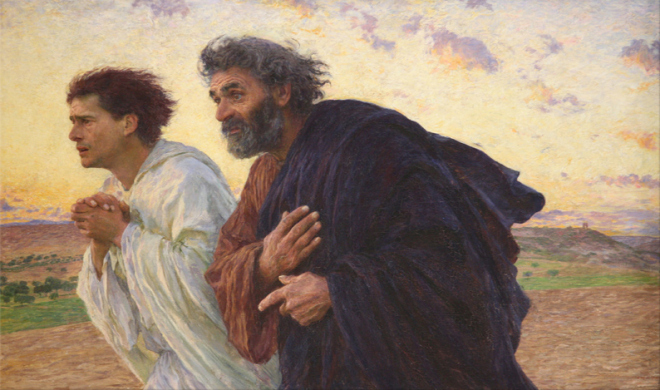
“Well yes, and its Easter,” I say, and I told him I’d just been to church, told him the Pastor preached the Road to Emmaus, and…

“Luke 24!” He said.

“They were walking with Jesus!” He said.

“Didn’t know it was Him!” He said.

I thought of stumbling over some point this Pastor had made, then I stopped. He knew scripture; I listened.

“Didn’t know, until they broke bread with him, Ha!” He said, slapping his knee.

“Got me a bridge up here I like!” He said, almost growling.

“Stays nice and dry, I can have a little fire, and nobody sees the smoke.”  He said.

“I stopped being able to live inside about fifteen years ago,” He said.

“Don’t know why, I can’t live inside. I do pretty good. I worry in the winter that my feet will freeze.”  He said.

“I do pretty good though, see my way around, find places like this bridge,” He said.

“Haven’t been rolled in two years,” He said.

“I can’t live inside.”  He said.

“Wrap my feet with paper on winter nights.” He said.

“I’m afraid in the winter my feet might freeze,” He repeated.

“My feet froze seven years ago, lost one toe.” He said.

“But it’s getting warm now.”  He said.

“I do pretty good.” He said.

When we arrived at the bridge, I got off onto the freeway shoulder with my Ford, and we talked for a while. My heart burned. I remembered I’d just bought a box of oranges. I got out and retrieved a dozen to a plastic bag from the trunk, I’d just done laundry and there were wool socks on top of the laundry basket, I put those in with the oranges and I found a twenty and gave him that too.

“He is risen!” I said.

“He is risen indeed!” He said, then vanished down under a roadbed bridge home.


For more books by Uncollected Press:

www.therawartreview.com

And the Fires We Talked About–Copyright © 2020 by James Ross Kelly

All rights reserved. No part of this book may be used reproduced in any form by electronic or mechanical means without permission in writing from the author and UnCollected Press except in the case of brief quotations embodied in critical articles and reviews.