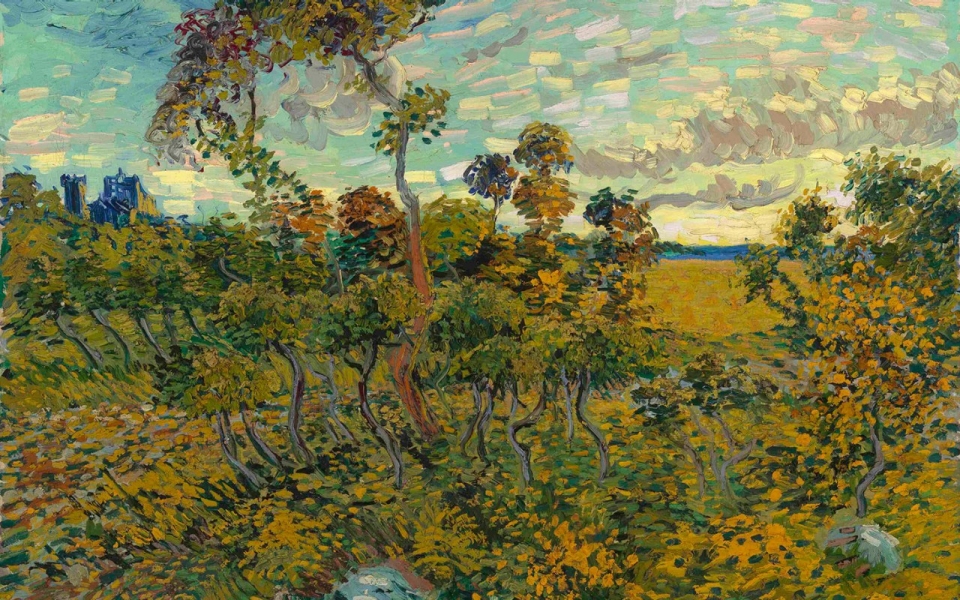
Van Gough –“Sunset at Montmajour” July 4, 1888

Van Gough –“Sunset at Montmajour” July 4, 1888

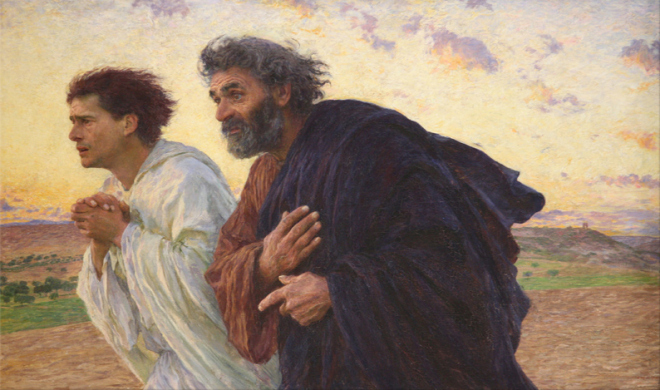
Return of the Prodigal son by Rembrandt
Luke 15 begins with Jesus speaking to the tax collectors and others, and then the religious elite happen by, and begin to grumble about the company the Saviour keeps, with the intent to disparage his authority. Jesus tells three parables that in ever ascending power demonstrates the power of God to seek the lost and forgive —culminating in the description of the loving Father that “ while he was still a long way off, his father saw him and felt compassion for him, and ran and embraced him and kissed him. ” All men are at one time or another— either the elder brother, or the prodigal son. Each have a life problem that is self inflicted, each are forgiven, and each are beckoned to their proper place—the banqueting table.
Luke 15:11-32
New American Standard Bible (NASB)
The Prodigal Son11 And He said, “A man had two sons. 12 The younger of them said to his father, ‘Father, give me the share of the estate that falls to me.’ So he divided his [a]wealth between them. 13 And not many days later, the younger son gathered everything together and went on a journey into a distant country, and there he squandered his estate with loose living. 14 Now when he had spent everything, a severe famine occurred in that country, and he began to be impoverished. 15 So he went and [b]hired himself out to one of the citizens of that country, and he sent him into his fields to feed swine. 16 And he would have gladly filled his stomach with the [c]pods that the swine were eating, and no one was giving anything to him. 17 But when he came to [d]his senses, he said, ‘How many of my father’s hired men have more than enough bread, but I am dying here with hunger! 18 I will get up and go to my father, and will say to him, “Father, I have sinned against heaven, and [e]in your sight; 19 I am no longer worthy to be called your son; make me as one of your hired men.”’ 20 So he got up and came to [f]his father. But while he was still a long way off, his father saw him and felt compassion for him, and ran and [g]embraced him and kissed him. 21 And the son said to him, ‘Father, I have sinned against heaven and in your sight; I am no longer worthy to be called your son.’ 22 But the father said to his slaves, ‘Quickly bring out the best robe and put it on him, and put a ring on his hand and sandals on his feet; 23 and bring the fattened calf, kill it, and let us eat and celebrate; 24 for this son of mine was dead and has come to life again; he was lost and has been found.’ And they began to celebrate.
25 “Now his older son was in the field, and when he came and approached the house, he heard music and dancing. 26 And he summoned one of the servants and began inquiring what these things could be. 27 And he said to him, ‘Your brother has come, and your father has killed the fattened calf because he has received him back safe and sound.’ 28 But he became angry and was not willing to go in; and his father came out and began pleading with him. 29 But he answered and said to his father, ‘Look! For so many years I have been serving you and I have never [h]neglected a command of yours; and yet you have never given me a young goat, so that I might celebrate with my friends; 30 but when this son of yours came, who has devoured your [i]wealth with prostitutes, you killed the fattened calf for him.’ 31 And he said to him, ‘Son, you [j]have always been with me, and all that is mine is yours. 32 But we had to celebrate and rejoice, for this brother of yours was dead and has begun to live, and was lost and has been found.’”
Footnotes:
Luke 15:12 Lit living
Luke 15:15 Lit was joined to
Luke 15:16 I.e. of the carob tree
Luke 15:17 Lit himself
Luke 15:18 Lit before you
Luke 15:20 Lit his own
Luke 15:20 Lit fell on his neck
Luke 15:29 Or disobeyed
Luke 15:30 Lit living
Luke 15:31 Lit are always with me
The Didache (pronounced /ˈdɪdəkiː/; Koine Greek: Διδαχή, Didachē “Teaching”; Modern Greek [ðiðaˈxi]) is the common name of an early Christian writing (dated by some scholars to the late first/early second century although John Robinson argues that it is first generation, dating it c. 40-60 AD). The Didache is an anonymous work that was virtually lost until a Greek manuscript of the Didache was rediscovered in 1873 by Philotheos Bryennios, Metropolitan of Nicomedia in the Codex Hierosolymitanus.
The Teaching of the Lord by the Twelve Apostles to the Gentiles (or Nations).
I.
1. There are two Ways, one of Life and one of Death; but there is a great difference between the two Ways.
2. Now the Way of Life is this: First, Thou shalt love God who made thee; secondly, thy neighbor as thyself; and all things whatsoever thou wouldst not have done to thee, neither do thou to another.
3. Now the teaching of these [two] words [of the Lord] is this: Bless those who curse you, and pray for your enemies, and fast for those who persecute you; for what thank is there if ye love those who love you? Do not even Gentiles the same? But love ye those who hate you, and ye shall not have an enemy.
4. Abstain from fleshly and bodily [worldly] lusts. If any one give thee a blow on the right cheek turn to him the other also, and thou shalt be perfect. If any one press thee to go with him one mile, go with him two; if any one take away thy cloak, give him also thy tunic; if any one take from thee what is thine, ask it not back, as indeed thou canst not.
5. Give to every one that asketh thee, and ask not back, for the Father wills that from our own blessings we should give to all. Blessed is he that gives according to the commandment, for he is guiltless. Woe to him that receives; for if any one receives, having need, he shall be guiltless, but he that has not need shall give account, why he received and for what purpose, and coming into distress he shall be strictly examined concerning his deeds, and he shall not come out thence till he have paid the last farthing.
6. But concerning this also it hath been said, “Let thine alms sweat (drop like sweat) into thy hands till thou know to whom thou shouldst give.”
II.
1. And the second commandment of the Teaching is:
2. Thou shalt not kill. Thou shalt not commit adultery; thou shalt not corrupt boys; thou shalt not commit fornication. Thou shalt not steal. Thou shalt not use witchcraft; thou shalt not practice sorcery. Thou shalt not procure abortion, nor shalt thou kill the new-born child. Thou shalt not covet thy neighbor’s goods.
3. Thou shalt not forswear thyself (swear falsely). Thou shalt not bear false witness. Thou shalt not speak evil; thou shalt not bear malice.
4. Thou shalt not be double-minded nor double-tongued; for duplicity of tongue is a snare of death.
5. Thy speech shall not be false, nor vain, but fulfilled by deed.
6. Thou shalt not be covetous, nor rapacious, nor a hypocrite, nor malignant, nor haughty. Thou shalt not take evil counsel against thy neighbor.
7. Thou shalt not hate any one, but some thou shalt rebuke and for some thou shalt pray, and some thou shalt love above thine own soul (or, life).
III.
1. My child, flee from every evil, and from every thing that is like unto it.
2. Be not prone to anger, for anger leadeth to murder; nor given to party spirit, nor contentious, nor quick-tempered (or, passionate); for from all these things murders are generated.
3. My child, be not lustful, for lust leadeth to fornication; neither be a filthy talker, nor an eager gazer, for from all these are generated adulteries.
4. My child, be not an observer of birds [for divination] for it leads to idolatry; nor a charmer (enchanter), nor an astrologer, nor a purifier (a user of purifications or expiations), nor be thou willing to look on those things; for from all these is generated idolatry.
5. My child, be not a liar, for lying leads to theft; nor avaricious, nor vainglorious, for from all these things are generated thefts.
6. My child, be not a murmurer, for it leads to blasphemy; neither self-willed (presumptuous), nor evil-minded, for from all these things are generated blasphemies.
7. But be thou meek, for the meek shall inherit the earth.
8. Be thou long-suffering, and merciful, and harmless, and quiet, and good, and trembling continually at the words which thou hast heard.
9. Thou shalt not exalt thyself, nor shalt thou give audacity (presumption) to thy soul. Thy soul shall not be joined to the lofty, but with the just and lowly shalt thou converse.
10. The events that befall thee thou shalt accept as good, knowing that nothing happens without God.
IV.
1. My child, thou shalt remember night and day him that speaks to thee the word of God, and thou shalt honor him as the Lord, for where the Lordship is spoken of, there is the Lord.
2. And thou shalt seek out day by day the faces of the saints, that thou mayest rest upon their words.
3. Thou shalt not desire (make) division, but shalt make peace between those at strife. Thou shalt judge justly; thou shalt not respect a person (or, show partiality) in rebuking for transgressions.
4. Thou shalt not be double-minded (doubtful in thy mind) whether it shall be or not.
5. Be not one that stretches out his hands for receiving, but draws them in for giving.
6. If thou hast [anything], thou shalt give with thy hands a ransom for thy sins.
7. Thou shalt not hesitate to give, nor in giving shalt thou murmur, for thou shalt know who is the good recompenser of the reward.
8. Thou shalt not turn away him that needeth, but shalt share all things with thy brother, and shalt not say that they are thine own; for if you are fellow-sharers in that which is imperishable (immortal), how much more in perishable (mortal) things?
9. Thou shalt not take away thy hand from thy son or from thy daughter, but from [their] youth up thou shalt teach [them] the fear of God.
10. Thou shalt not in thy bitterness lay commands on thy man-servant (bondman), or thy maid-servant (bondwoman), who hope in the same God, lest they should not fear Him who is God over [you] both; for He comes not to call [men] according to the outward appearance (condition), but [he comes] on those whom the Spirit has prepared.
11. But ye, bondmen, shall be subject to our (your) masters as to the image of God in reverence (modesty) and fear.
12. Thou shalt hate all hypocrisy, and everything that is not pleasing to the Lord.
13. Thou shalt not forsake the commandments of the Lord, but thou shalt keep what thou hast received, neither adding [thereto] nor taking away [therefrom].
14. In the congregation (in church) thou shalt confess thy transgressions, and thou shalt not come to thy prayer (or, place of prayer) with an evil conscience.
This is the way of life.
V.
1. But the way of death is this. First of all it is evil and full of curse; murders, adulteries, lusts, fornications, thefts, idolatries, witchcrafts, sorceries, robberies, false-witnessings, hypocrisies, double-heartedness, deceit, pride, wickedness, self-will, covetousness, filthy-talking, jealousy, presumption, haughtiness, boastfulness.
2. Persecutors of the good, hating truth, loving a lie, not knowing the reward of righteousness, not cleaving to that which is good nor to righteous judgment, watchful not for that which is good but for that which is evil; far from whom is meekness and endurance, loving vanity, seeking after reward, not pitying the poor, not toiling with him who is vexed with toil, not knowing Him that made them, murderers of children, destroyers of the handiwork of God, turning away from the needy, vexing the afflicted, advocates of the rich, lawless judges of the poor, wholly sinful.
May ye, children, be delivered from all these.
VI.
1. Take heed that no one lead thee astray from this way of teaching, since he teacheth thee apart from God.
2. For if indeed thou art able to bear the whole yoke of the Lord thou shalt be perfect; but if thou art not able, do what thou canst.
3. And as regards food, bear what thou canst, but against idol-offerings be exceedingly on thy guard, for it is a service of dead gods.
VII.
1. Now concerning baptism, baptize thus: Having first taught all these things, baptize ye into the name of the Father, and of the Son, and of the Holy Spirit, in living water.
2. And if thou hast not living water, baptize into other water; and if thou canst not in cold, then in warm (water).
3. But if thou hast neither, pour [water] thrice upon the head in the name of the Father, and of the Son, and of the Holy Spirit.
4. But before Baptism let the baptizer and the baptized fast, and any others who can; but thou shalt command the baptized to fast for one or two days before.
VIII.
1. Let not your fasts be with the hypocrites, for they fast on the second and fifth day of the week; but ye shall fast on the fourth day, and the preparation day (Friday).
2. Neither pray ye as the hypocrites, but as the Lord commanded in His Gospel, so pray ye: “Our Father, who art in heaven, hallowed be Thy Name. Thy Kingdom come. Thy will be done, as in heaven, so on earth. Give us this day our daily (needful) bread. And forgive us our debt as we also forgive our debtors. And bring us not into temptation, but deliver us from the evil one (or, from evil). For Thine is the power and the glory for ever.”
3. Pray thus thrice a day.
IX.
1. Now as regards the Eucharist (the Thank-offering), give thanks after this manner:
2. First for the cup: “We give thanks to Thee, our Father, for the holy vine of David Thy servant, which thou hast made known to us through Jesus, Thy servant: to Thee be the glory for ever.”
3. And for the broken bread: “We give thanks to Thee, our Father, for the life and knowledge which Thou hast made known to us through Jesus, Thy servant: to Thee be the glory for ever.
4. “As this broken bread was scattered upon the mountains and gathered together became one, so let Thy church be gathered together from the ends of the earth into Thy kingdom, for Thine is the glory and the power through Jesus Christ for ever.”
5. But let no one eat or drink of your Eucharist, except those baptized into the name of the Lord; for as regards this also the Lord has said: “Give not that which is holy to the dogs.”
X.
1. Now after being filled, give thanks after this manner:
2. “We thank Thee, Holy Father, for Thy Holy Name, which Thou hast caused to dwell (tabernacle) in our hearts, and for the knowledge and faith and immortality which Thou hast made known to us through Jesus Thy Servant, to Thee be the glory for ever.
3. “Thou, O, Almighty Sovereign, didst make all things for Thy Name’s sake; Thou gavest food and drink to men for enjoyment that they might give thanks to Thee; but to us Thou didst freely give spiritual food and drink and eternal life through Thy Servant.
4. “Before all things we give thanks to Thee that Thou art mighty; to Thee be the glory for ever.
5. “Remember, O Lord, Thy Church to deliver her from all evil and to perfect her in Thy love; and gather her together from the four winds, sanctified for Thy kingdom which Thou didst prepare for her; for Thine is the power and the glory for ever.
6. “Let grace come, and let this world pass away. Hosanna to the God of David. If any one is holy let him come, if any one is not holy let him repent. Maranatha. Amen.”
7. But permit the Prophets to give thanks as much as [in what words] they wish.
XI.
1. Whosoever then comes and teaches you all the things aforesaid, receive him.
2. But if the teacher himself being perverted teaches another teaching to the destruction [of this], hear him not, but if [he teach] to the increase of righteousness and the knowledge of the Lord, receive him as the Lord.
3. Now with regard to the Apostles and Prophets, according to the decree (command) of the gospel, so do ye.
4. Let every Apostle that cometh to you be received as the Lord.
5. But he shall not remain [longer than] one day; and, if need be, another [day] also; but if he remain three [days] he is a false prophet.
6. And when the Apostle departeth, let him take nothing except bread [enough] till he reach his lodging (night-quarters). But if he ask for money, he is a false prophet.
7. And every prophet who speaks in the spirit ye shall not try or prove; for every sin shall be forgiven, but this sin shall not be forgiven.
8. Not every one that speaks in the spirit is a Prophet, but only if he has the behavior (the ways) of the Lord. By their behavior then shall the false prophet and the [true] Prophet be known.
9. And no Prophet that orders a table in the spirit eats of it [himself], unless he is a false prophet.
10. And every Prophet who teaches the truth if he does not practice what he teaches, is a false prophet.
11. And every approved, genuine Prophet, who makes assemblies for a worldly mystery, but does not teach [others] to do what he himself does, shall not be judged by you; for he has his judgment with God (or, his judgment is in the hands of God); for so did also the ancient Prophets.
12. But whosoever says in the spirit: Give me money or any other thing, ye shall not listen to him; but if he bid you to give for others that lack, let no one judge him.
XII.
1. Let every one that comes in the name of the Lord be received, and then proving him ye shall know him; for ye shall have understanding right and left.
2. If indeed he who comes is a wayfarer, help him as much as ye can; but he shall not remain with you longer than two or three days, unless there be necessity.
3. If he wishes to settle among you, being a craftsman (artisan), let him work and eat (earn his living by work).
4. But if he has not handicraft (trade), provide according to your understanding that no Christian shall live idle among you.
5. And if he will not act thus he is a Christ-trafficker. Beware of such.
XIII.
1. But every true Prophet who wishes to settle among you is worthy of his food (or, support).
2. Likewise a true Teacher is himself worthy, like the workman, of his food.
3. Therefore thou shalt take and give all the first-fruit of the produce of the wine-press and threshing-floor, of oxen and sheep, to the Prophets; for they are your chief-priests.
4. But if ye have no Prophet, give to the poor.
5. If thou preparest bread, take the first fruit and give according to the commandment.
6. Likewise when thou openest a jar of wine or of oil, take the first-fruit and give to the Prophets.
7. And of silver, and raiment, and every possession, take the first-fruit, as may seem good to thee, and give according to the commandment.
XIV.
1. And on the Lord’s Day of the Lord come together, and break bread, and give thanks, having before confessed your transgressions, that your sacrifice may be pure.
2. Let no one who has a dispute with his fellow come together with you until they are reconciled, that your sacrifice may not be defiled.
3. For this is that which was spoken by the Lord: “In every place and time offer me a pure sacrifice, for I am a great King, saith the Lord, and my name is wonderful among the Gentiles.”
XV.
1. Elect therefore for yourselves Bishops and Deacons worthy of the Lord, men meek, and not lovers of money, and truthful, and approved; for they too minister to you the ministry of the Prophets and Teachers.
2. Therefore despise them not, for they are those that are the honored [men] among you with the Prophets and Teachers.
3. And reprove one another not in wrath, but in peace, as ye have [it] in the gospel; and with every one that transgresses against another let no one speak, nor let him hear [a word] from you until he repents.
4. But so do your prayers and alms and all your actions as ye have [it] in the gospel of our Lord.
XVI.
1. Watch over your life; let not your lamps be quenched and let not your loins be unloosed, but be ye ready; for ye know not the hour in which our Lord comes.
2. But be ye frequently gathered together, seeking the things that are profitable for your souls; for the whole time of your faith shall not profit you except in the last season ye be found perfect.
3. For in the last days the false prophets and destroyers shall be multiplied, and the sheep shall be turned into wolves, and love shall be turned into hate.
4. For when lawlessness increases, they shall hate and persecute, and deliver up one another; and then shall appear the world-deceiver as Son of God, and shall do signs and wonders, and the earth shall be delivered into his hands, and he shall commit iniquities which have never yet come to pass from the beginning of the world.
5. And then shall the race of men come into the fire of trial, and many shall be offended and shall perish; but they who endure in their faith shall be saved from under the curse itself.
6. And then shall appear the signs of the truth: first the sign of opening in heaven; then the sign of the voice of the trumpet; and the third, the resurrection of the dead.
7. Not, however, of all, but as was said, “The Lord shall come, and all the saints with him.”
8. Then shall the world see the Lord coming upon the clouds of heaven.
This version of The Didache was originally published in 1885 by Funk & Wagnalls, Publishers (New York). The translation was made by Philip Schaff from the Jerusalem Manuscript of the Didache. The copyright has expired, so that this translation is now in the public domain. Anyone may freely copy, print and republish this document. No permission is needed.
It seems to be characteristic of the human mind that when it sees a black box in action, it imagines that the contents of the box are simple. A happy example is seen in the comic strip “Calvin and Hobbes”. Calvin is always jumping in a box with his stuffed tiger, Hobbes, and traveling back in time, or “transmogrifying” himself into animal shapes, or using it as a “duplicator” and making clones of himself. A little boy like Calvin easily imagines that a box can fly like an airplane (or something), because Calvin doesn’t know how airplanes work. In some ways, grown-up scientists are just as prone to wishful thinking as little boys like Calvin. For example, centuries ago it was thought that insects and other small animals arose directly from spoiled food. This was easy to believe, because small animals were thought to be very simple (before the invention of the microscope, naturalists thought that insects had no internal organs.) But as biology progressed and careful experiments showed that protected food did not breed life, the theory of spontaneous generation retreated to the limits beyond which science could not detect what was really happening. In the nineteenth century that meant the cell. When beer, milk, or urine were allowed to sit for several days in containers, even closed ones, they always became cloudy from something growing in them. The microscopes of the eighteenth and nineteenth centuries showed that the growth was very small, apparently living cells. So it seemed reasonable that simple living organisms could arise spontaneously from liquids. The key to persuading people was the portrayal of the cells as “simple.” One of the chief advocates of the theory of spontaneous generation during the middle of the nineteenth century was Ernst Haeckel, a great admirer of Darwin and an eager popularizer of Darwin’s theory. From the limited view of cells that microscopes provided, Haeckel believed that a cell was a “simple little lump of albuminous combination of carbon,” not much different from a piece of microscopic Jell-O. So it seemed to Haeckel that such simple life, with no internal organs, could be produced easily from inanimate material. Now, of course, we know better. Here is a simple analogy: Darwin is to our understanding of the origin of vision as Haeckel is to our understanding of the origin of life. In both cases brilliant nineteenth-century scientists tried to explain Lilliputian biology that was hidden from them, and both did so by assuming that the inside of the black box must be simple. Time has proven them wrong. In the first half of the twentieth century, the many branches of biology did not often communicate with each other. As a result genetics, systematics, paleontology, comparative anatomy, embryology, and other areas developed their own views of what evolution meant. Inevitably, evolutionary theory began to mean different things to different disciplines; a coherent view of Darwinian evolution was being lost. In the middle of the century, however, leaders of the fields organized a series of interdisciplinary meetings to combine their views into a coherent theory of evolution based on Darwinian principles. The result has been called the “evolutionary synthesis,” and the theory called neo-Darwinism. Neo-Darwinism is the basis of modern evolutionary thought. One branch of science was not invited to the meetings, and for good reason: it did not yet exist. The beginnings of modern biochemistry came only after neo-Darwinism had been officially launched. Thus, just as biology had to be reinterpreted after the complexity of microscopic life was discovered, neo-Darwinism must be reconsidered in light of advances in biochemistry. The scientific disciplines that were part of the evolutionary synthesis are all nonmolecular. Yet for the Darwinian theory of evolution to be true, it has to account for the molecular structure of life. It is the purpose of this book to show that it does not.
Behe, Michael J. (2001-04-04). Darwin’s Black Box (Kindle Locations 408-437). Simon & Schuster, Inc.. Kindle Edition.
from The Devil’s Delusion: Atheism and its Scientific Pretensions (p. 192-197). Perseus Books Group. Kindle Edition.

In the summer of 2007, Eugene Koonin, of the National Center for Biotechnology Information at the National Institutes of Health, published a paper entitled “The Biological Big Bang Model for the Major Transitions in Evolution.” The paper is refreshing in its candor; it is alarming in its consequences. “Major transitions in biological evolution,” Koonin writes, “show the same pattern of sudden emergence of diverse forms at a new level of complexity” (italics added). Major transitions in biological evolution? These are precisely the transitions that Darwin’s theory was intended to explain. If those “major transitions” represent a “sudden emergence of new forms,” the obvious conclusion to draw is not that nature is perverse but that Darwin was wrong. “The relationships between major groups within an emergent new class of biological entities,” Koonin goes on to say, “are hard to decipher and do not seem to fit the tree pattern that, following Darwin’s original proposal, remains the dominant description of biological evolution.” The facts that fall outside the margins of Darwin’s theory include “the origin of complex RNA molecules and protein folds; major groups of viruses; archaea and bacteria, and the principal lineages within each of these prokaryotic domains; eukaryotic supergroups; and animal phyla.” That is, pretty much everything. Koonin is hardly finished. He has just started to warm up. “In each of these pivotal nexuses in life’s history,” he goes on to say, “the principal ‘types’ seem to appear rapidly and fully equipped with the signature features of the respective new level of biological organization. No intermediate ‘grades’ or intermediate forms between different types are detectable.” The phrase intermediate forms has a particular poignancy in context. It has been by an appeal to those intermediate forms that a very considerable ideology has been created. To doubt their existence is to stand self-accused. To go further and suggest that they are, in fact, imaginary evokes a frenzy of fearful contempt so considerable as to make civilized discourse impossible. Koonin’s views do not represent the views of the Darwinian establishment. If they did, there would be no Darwinian establishment. They are not uncontested. And it may well be that they are exaggerated. Koonin is nonetheless both a serious biologist and a man not well known for a disposition to self-immolation. And in a much more significant sense, his views are simply part of a much more serious pattern of intellectual discontent with Darwinian doctrine. Writing in the 1960s and 1970s, the Japanese mathematical biologist Motoo Kimura argued that on the genetic level—the place where mutations take place—most changes are selectively neutral. They do nothing to help an organism survive; they may even be deleterious. A competent mathematician and a fastidious English prose stylist, Kimura was perfectly aware that he was advancing a powerful argument against Darwin’s theory of natural selection. “The neutral theory asserts,” he wrote in the introduction to his masterpiece, The Neutral Theory of Molecular Evolution, “that the great majority of evolutionary changes at the molecular level, as revealed by comparative studies of protein and DNA sequences, are caused not by Darwinian selection but by random drift of selectively neutral or nearly neutral mutations” (italics added). This is radical doctrine. Waves of probability ebb and flow throughout the molecular structure of a living organism. Invisible to the scrutinizing force of natural selection, mutations drift through the currents of time. Whether a mutation is fixed within a population or whether it is simply washed away is a matter of chance. The neutral theory of molecular evolution was never destined to achieve wide favor among Darwinian biologists. Kimura’s treatise is framed as a powerful but difficult mathematical argument. But population geneticists understood its importance, even if they disagreed in some of its details. To the extent that the neutral theory is true, Darwin’s theory is not. This has prompted at least certain population geneticists to deplore in print the sheer effrontery that is so conspicuous a feature of the popular literature devoted to Darwin’s theory. Richard Dawkins has appeared as tempting a squab within the tent of population genetics as he has long seemed without. Writing in the Proceedings of the National Academy of Sciences, the evolutionary biologist Michael Lynch observed that “Dawkins’s agenda has been to spread the word on the awesome power of natural selection.” The view that results, Lynch remarks, is incomplete and therefore “profoundly misleading.” Lest there be any question about Lynch’s critique, he makes the point explicitly: “What is in question is whether natural selection is a necessary or sufficient force to explain the emergence of the genomic and cellular features central to the building of complex organisms.” But if it is quite possible that natural selection is neither necessary nor sufficient to account for the complexity of living systems, then it is also possible that it is of no relevance to living systems whatsoever. The demotion of natural selection from biological superpower to ideological sad sack throws into bright relief an obvious question: How to explain on the basis of a random walk the startling coherence and complexity of living organisms? If the question is obvious, so, too, is its answer: We have no idea. “The general foundations for the evolution of ‘higher’ from ‘lower’ organisms,” Emile Zuckerkandl has written, “seems so far to have largely eluded analysis ” (italics added). This is surely true. But the phrase eluded analysis conveys a current of intellectual optimism at odds with the facts. Something that has so far eluded analysis can hardly be assigned to a force that has so far eluded demonstration. It is in this context that Daniel Dennett’s assertion that natural selection has been demonstrated “beyond all reasonable doubt” must be judged for what it is: It is the ecclesiastical bull of a most peculiar church, a cousin in kind to an ecclesiastical bluff. When Steven Pinker affirms that “natural selection is the only explanation we have of how complex life can evolve,” he is very much in the inadvertent position of the apostles. Much against his will, he is bearing witness. In all this, it is the reaction among the faithful that provokes no surprise. Within minutes of the publication of Koonin’s paper, a call for censorship went up over the Internet. “Well,” one solemn donkey wrote, “since it is clear that this paper will be on every ID/creationist blog on the planet in under 12 hours, I might as well put in my 2 cents early.” He might as well. And those two cents? What did they amount to? One cent was devoted to a counsel of caution: “I think Koonin should give a little credit where credit is due to gradual, stepwise evolution.” The second cent was spent on a cry of alarm: “Sometimes you’ve got to wonder how many hangovers (i.e., creationist quote-mining and general confusion over the status of evolution outside of the specialist community, and needless wrangling within the specialist community) could be avoided if scientists would exercise just a little caution during the party (i.e., spending a little time soberly comparing their revolutionary ideas with more prosaic explanations).” The words if scientists would exercise just a little caution have a meaning all their own. They are written in code. They convey the need, apparently imperative, for biologists to keep bad news to themselves. What is left is the “general confusion” that the public so often suffers when it comes to Darwin and Darwinism. On this matter, biologists are not at all confused. Whatever the degree to which Darwin may have “misled science into a dead end,” the biologist Shi V. Liu observed in commenting on Koonin’s paper, “we may still appreciate the role of Darwin in helping scientists [win an] upper hand in fighting against the creationists.” It is hard to be less confused than that.
Berlinski, David (2009-08-26). The Devil’s Delusion: Atheism and its Scientific Pretensions (p. 192-197). Perseus Books Group. Kindle Edition.
Prophets in the Old Testament spoke of a coming Kingdom that would endure forever and grow until it filled the earth (see 1 Chron. 17:12; Dan. 2:44) this was contrary to the thinking of all the ancient kingdoms, such as the Persian, Greek, or Roman, where people fatalistically believed that kingdoms rise and fall.
Jesus walked the streets of Israel declaring, “The kingdom of God is at hand”— which meant that the reign of God in the earth had begun. In several parables Jesus explained how the Kingdom of God is growing like seeds in the earth: first they sprout, then they develop roots, then they push upward, and finally they develop into mature plants (see Mark 4:2- 8; 26-29). In another parable He explained how the Kingdom of God continually growing in the earth like seeds in soil or yeast in dough. They believed the Kingdom of God would grow as the Church grows until it fills the whole earth.
Christianity Unshackled, Harold Eberle p.129-130
(see also Eberle and Trench, Victorious Eschatology, World Cast Publishing 2006)

 St. John One: One