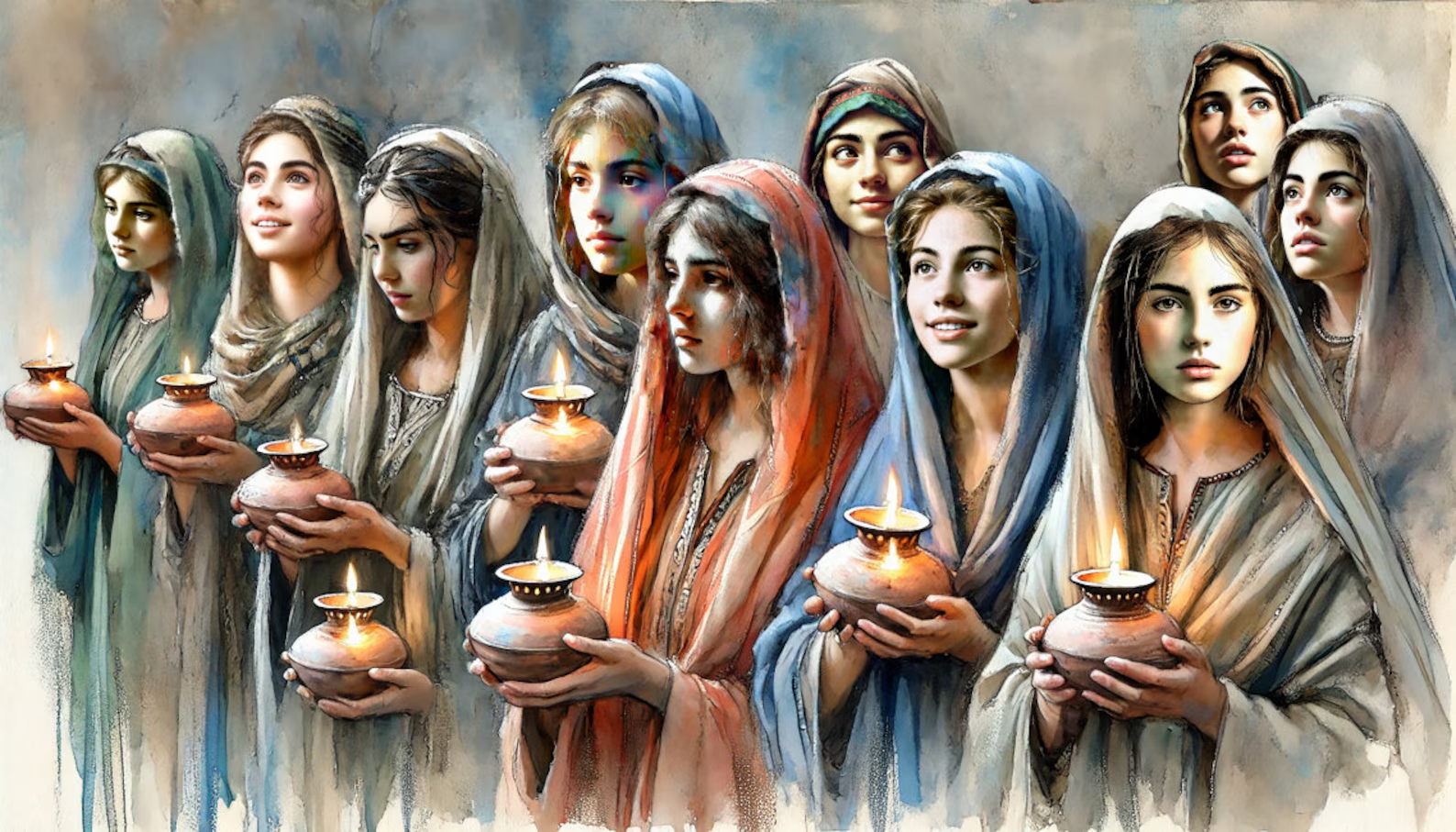
43 And ye shall be like the wise virgins which watched and slept not but went forth unto the Lord into the bridechamber but the foolish virgins were not able to watch, but slumbered. And we said unto him Lord, who are the wise and who are the foolish? He said unto us Five wise and five foolish6 for these are they of whom the prophet hath spoken Sons of God are they. Hear now their names.
But we wept and were troubled for them that slumbered. He said unto us the five wise are Faith and Love and Grace and Peace and Hope. Now they of the faithful which possess this (these) shall be guides unto them that have believed on me and on him that sent me. For I am the Lord and I am the bridegroom whom they have received, and they have entered in to the house of the bridegroom and are laid down with me in the bridal chamber rejoicing. But the five foolish, when they had slept and had awaked, came unto the door of the bridal chamber and knocked, for the doors were shut. Then did they weep and lament that no man opened unto them.
We said unto him Lord, and their wise sisters that were within in the bridegroom’s house, did they continue without opening unto them, and did they not sorrow for their sakes nor entreat the bridegroom to open unto them? He answered us, saying They were not yet able to obtain favour for them. We said unto him Lord, on what day shall they enter in for their sisters’ sake? Then said he unto us He that is shut out, is shut out. And we said unto him Lord, is this word (determined?). Who then are the foolish? He said unto us Hear their names. They are Knowledge, Understanding (Perception), Obedience, Patience, and Compassion. These are they that slumbered in them that have believed and confessed me but have not fulfilled my commandments.[1]
[1] from The Epistle of the Apostles §43, trans. M. R. James, in The Apocryphal New Testament (Oxford: Clarendon Press, 1924).
The Epistle of the Apostles was preserved by the oldest continuous Christian cultures on earth — the tradition of the Ethiopian Orthodox Tewahedo Church, which preserves the largest biblical canon in Christianity. The Epistle of the Apostles appeared in this version ca 180 AD approximately before the canonizing of New Testament scripture. While there is plenty derision of the text being NOT from the first Century Apostles themselves, much has been lost from that era including ALL of the original texts of the Gospels, and Epistles. That this ancient writing preserved in Ethiopia sheds light on the meaning of Matthew’s Gospel should not be dismissed. The text as it exists was translated from Ge’ez an archaic Ethiopic language not spoken today (it is sang in hymn however) and was likely originally in Greek. nb The Epistle of the Apostles is not a canonical book in the Ethiopian Church.
Key to the Parable by Jesus in Matthew 25
The passage is based on the canonical parable of the Gospel of Matthew 25:1–13 — the ten virgins waiting for the bridegroom.
In Matthew:
- Five wise virgins bring oil.
- Five foolish ones run low on oil and run out to buy more oil and are locked out of the wedding.
The canonical moral: be spiritually prepared.
But the Epistle of the Apostles turns the parable into a symbolic list of virtues and unlocks the meaning.
The “Wise Virgins” = Core Christian Virtues
The text identifies the wise as:
- Faith
- Love
- Grace
- Peace
- Hope
It is the oil of virtue the 10 foolish virgins neglected to bring. These line up very closely with early Christian virtue lists, especially those in the letters of Paul the Apostle.
For example:
- Faith
- Hope
- Love
appear repeatedly in the First Epistle to the Corinthians and other Pauline texts.
So the Epistle thereby anchors the teaching in apostolic orthodoxy.
The Shock: “Knowledge” Is One of the Foolish Virgins
The foolish are named:
- Knowledge
- Understanding
- Obedience
- Patience
- Compassion
At first glance this seems bizarre. Why would patience or compassion be foolish?
But here’s the key: “knowledge” was the central claim of Gnosticism.
The word Gnostic itself comes from the Greek gnosis — knowledge.
Groups associated with teachers like Valentinus and Basilides taught that:
- salvation came through secret knowledge
- only the spiritually elite possessed it
- Christ came mainly to reveal hidden truths
The other names of the Foolish Virgins seem like virtues as well— but without the oil of wise virgins they are not. Not limited to this explanation: Understanding without Faith is hollow, its perception is not scintillating with Grace and could be useless. Obedience blind to Love is dangerous and deadly. Patience without peace is decidedly dull and perhaps meaningless. Compassion void of the consciousness of hope and love leads to a vile notion of hopelessness without the ability to care. Knowledge without the oil of all the wise virgins and the knowledge of Christ’s teachings becomes faithless and loveless, rigid religiosity.
Orthodox Christians then and now see this as a distortion of the Gospel. Gnostics taught that Jesus came as a spirit in the form of a man and not as the fully human Anointed One. The apostles taught that they lived with Jesus, ate with him, drank with him, and touched him with their hands. Gnosticism then became a vile heresy to them. In Irenaeus, Against Heresies, Book III, chapter 3, section 4.“There are also those who heard from Polycarp [a direct Disciple of John the Apostle] that John the disciple of the Lord [when he was an old man in what is now Turkey], going to bathe at Ephesus and perceiving Cerinthus within, rushed out of the bathhouse without bathing, saying, ‘Let us flee, lest the bathhouse fall down, for Cerinthus the enemy of the truth is within.’”
A Controversial Assertion
By putting “Knowledge” among the foolish virgins, the Epistle through Jesus is saying:
Knowledge alone does not save.
Instead salvation belongs to those who possess faith and love.
The point is not that knowledge itself is bad.
The point is that knowledge without obedience to the teaching (Commandments) of Jesus the Anointed One and faith that proceeds through love leads to exclusion from the kingdom.
This is why the text says: “they have believed and confessed me but have not fulfilled my commandments”
The Two Great Commandments (The Core)
Jesus himself summarizes the law in the Gospel of Matthew:
- Love God with all your heart, soul, and mind.
- Love your neighbor as yourself.
Everything else flows from these.
The “New Commandment”
In the Gospel of John 13:34, Jesus deepens the second command:
“A new commandment I give to you, that you love one another, even as I have loved you, that you also love one another.”
The difference is important.
The measure of love becomes the self-giving example of Christ.
Commands from the Sermon on the Mount
One of the most concentrated collections of Christ’s commands appears in the Gospel of Matthew, chapters 5–7.
Key ones include:
- Love your enemies.
- Bless those who curse you.
- Do good to those who hate you.
- Forgive others.
- Do not store up treasures on earth.
- Seek first the kingdom of God.
- Do not judge hypocritically.
- Treat others as you would be treated (the Golden Rule).
These move beyond simple moral rules and into a transformed way of living.
Commands About Mercy
The judgment scene in Matthew 25—sheep and goats passage—turns compassion into a direct command.
Care for:
- the hungry
- the thirsty
- the stranger
- the sick
- the prisoner
- the naked
The implication is that love of neighbor must take practical form.
Commands About Humility
Jesus repeatedly teaches:
- The greatest must be the servant.
- Whoever exalts himself will be humbled.
- Whoever humbles himself will be exalted.
Leadership in the kingdom is service, not domination.
Commands About Forgiveness
In the Gospel of Matthew, Jesus tells Peter forgiveness must be limitless—“seventy times seven.”
Forgiveness becomes a defining mark of the disciple.
The Mission Command
After the resurrection Jesus instructs the apostles to:
- proclaim the gospel
- make disciples
- teach others to observe everything he commanded
This appears in the closing chapter of Matthew and forms the basis of Christian mission.
What the Epistle of the Apostles Likely Means
When that text criticizes believers who “confessed me but did not fulfill my commandments,” it is likely referring to this entire moral framework.
Early Christianity consistently held that:
Faith in Christ must produce a life shaped by Christ’s teachings.
Confession without obedience was seen as incomplete.
Why This Was a Big Issue in the Second Century
Many movements in the second century emphasized knowledge or mystical insight.
The mainstream church insisted instead that the test of discipleship was: faith expressed through love and obedience.
That’s why texts like the Epistle of the Apostles keep returning to commandments of Jesus the Anointed One rather than secret doctrines.
The Shortest Possible Summary
If all the commands of Christ are compressed into one line, the early church often summarized them this way:
Love God completely.
Love others sacrificially.
Live humbly.
Forgive freely.
Care for the vulnerable.
Everything else flows outward from those roots.
So the critique is aimed at intellectual Christianity divorced from moral life.
1. The Ten Virgins – Inner Readiness
The first story asks a question of watchfulness.
Are you spiritually awake when the bridegroom arrives?
The imagery focuses on the inner condition of the disciple.
Faith, hope, and love—the virtues the Epistle of the Apostles assigns to the wise virgins—fit naturally here.
2. The Talents – Stewardship
Then comes the parable of the talents.
A master entrusts money to servants before leaving. When he returns, he judges them based on what they did with what they were given.
The key issue here is responsibility.
Not readiness.
Not compassion yet.
But faithful use of what has been entrusted.
In first-century language, a “talent” was a large amount of money, but the story quickly became understood more broadly:
abilities
opportunities
resources
influence
Everything entrusted to a person by God.
3. The Sheep and the Goats – Compassion
The final scene shifts from parable to direct judgment imagery.
Now the question becomes:
What did you do for the vulnerable?
Did you feed the hungry?
Visit prisoners?
Care for the sick?
Here the focus is mercy in action.
4. The Three Together
If you read Matthew 25 as one continuous teaching, the pattern looks like this:
| Section | Theme | Question |
|---|---|---|
| Ten Virgins | readiness | Were you spiritually awake? |
| Talents | stewardship | Did you use what was entrusted to you? |
| Sheep & Goats | compassion | Did you love the vulnerable? |
So the full picture of discipleship becomes:
watchfulness + responsibility + mercy
5. Where the Epistle of the Apostles Fits
The Epistle of the Apostles does not explicitly retell the talents story the way it does the virgins, but its concern is similar.
When the text criticizes believers who:
“believed and confessed me but have not fulfilled my commandments”
it is addressing the same issue the talents parable raises.
The servant who buried the talent believed in the master’s authority but failed to act faithfully.
In both cases the problem is passivity.
6. The Deeper Connection
Taken together, the themes align like this:
The wise virgins possess virtue.
The faithful servants exercise stewardship.
The sheep practice mercy.
These form a progression from inward character to outward action.
The early church writers were very concerned about this progression because they were responding to movements that emphasized belief or knowledge alone.
Their response was essentially:
True faith must produce a transformed life.
7. Why the Talents Parable Is Often Misread
In modern discussions the talents story sometimes gets interpreted through an economic lens—entrepreneurship, productivity, and so on.
But in its original setting it is less about profit and more about faithful participation in the master’s mission.
The servant who buried the talent withdrew from the work altogether.
The problem is not failure.
The problem is refusal to engage.
8. Bringing It Back to the Epistle
When the author of the Epistle of the Apostles warns that some believers have confessed Christ but failed to keep his commandments, the warning echoes the same concern found in the talents story.
Faith that never becomes action remains unfinished.
That’s why the Matthew 25 sequence moves steadily outward:
 St. John One: One