The Red Gate


That last time I was to the farm
where running through creeks, chasing
small birds and my imagination,
I had grown up
there was a red gate my Grandfather had built

Much of the paint had blistered and peeled
as its weight had pulled the corner post
forward toward the earth that it also
had leaned for, still functional but barely so

Fashioned with boards and bolts that
had gone through hand augured holes by
brace and bit—I still remember
that tools’ shininess from years of use

The gate separated the farm from
an adjacent well-to do horse ranch
where fine Arabians pawed at the
sawdust in tight functional stalls

North of the gate had been our barn
that burned several winters before the funeral
all the animals had gotten out & though
the gate was only five feet away it stood,
a bit charred still, & latched to the fence

It had swung open mostly for bartered loads
of hay and occasionally for myself, to get closer
to a fox or deer in the next field and sometimes
to deliver Christmas cakes to affluent neighbors

The farm changed hands to distant relations
by marriage; who after the funeral came offering
condolences and money — I stood there looking
at its form as the content of memories, of ghosts,
of the distance of wealth, of long ago laughter
of a presence of sorrow the screeched
like a rusty hinge

We were criminals


Willard’s great Uncle Carl had died the night before
& that same night my own Aunt Pat
Who had raised me from nine years on, passed..
Willard’s great uncle Carl had raised
Willard’s Dad & his Uncle Buck,
Both of these men had dropped from black night sky
Into Normandy, as paratroopers to liberate France

Thirteen days later my father drove a tank
onto the Norman beach for same purpose

& they all made it back, after putting fear
In the hearts of Hitler’s supermen,
Willard senior to fall timber all his life
& Buck to run his cows every summer
In the High Cascades, my father drilled oil wells

We’d somehow met up that night &
With differently the same kind of memories
& grief in our hearts we drank beer,
With our pizza at a parlor, that had been a pasture
Back in high school

Cops came in later & thought
Our demeanor somehow unfit
& being new & not knowing us as locals decided
We were criminals,
This decision struck both of us
As remarkable & when
The cops followed us into the restroom
As we were departing
We had words with them..
& we were not kind
& left them bristling as we
Got into Willard’s old ’59 Chevy
With its sideways teardrop tail lights

I told Will, ‘ We’ve not seen the last of these pricks,’
We were 70s hippies then, & I hid our pot deep
Under the car seat when we left the parking lot

One mile out of town they pulled us over,
Spot-light on us & a bullhorn
Ordering us out of the car..
I could hear the tremolo of a wavering voice
Behind the blinding light & over the
Baseness of the bull horn &
Over the roof of the car,
I loudly told Will to move slowly..
As I knew they had guns on us..
& they did..

Twenty years later I’d been hunting ducks
With Willard’s brother Greg on Nygren’s Reservoir
& afterwards we went to the old homestead,
That his Uncle Carl had left
Only shortly before His death
& the old family farm had since sold to a cattle company,
& cattle men had not gotten around to razing the place
& no one had lived there in that time
Pots & pans still hung on a wall
Above the wood cook stove, & the old man’s long johns
Creased with 20 years of gravity hung in the bedroom
From the hook in the wall
& a dusky-footed wood rat had mounded
A large four-foot high stick nest
That covered all of Greg & Willard’s old Uncle Carl’s bed
Golden light diffused through the old house that fall afternoon
& the long empty bedroom, with a few pictures &
A calendar on the wall from 1965 &
I found this sight hauntingly beautiful

& yes, the cops were afraid of us that night
Thirty-six years ago..

A Psalm


I’ve been excited by women
in libraries
followed movements with
my eyes as a sail fills
with wind and felt the jolt
like a prow taking
its cut through a wave

I’ve been excited by women
in libraries
whose slow surreptitious movements,
the turn of an ankle
short measured steps in high heels
a twist of mouth
a glance at a book shelf
or through it

I’ve been excited by women
in libraries
whose silent voices echo chapters
of humility and respect
as peasant dresses
and pigtails flow by with ghosts
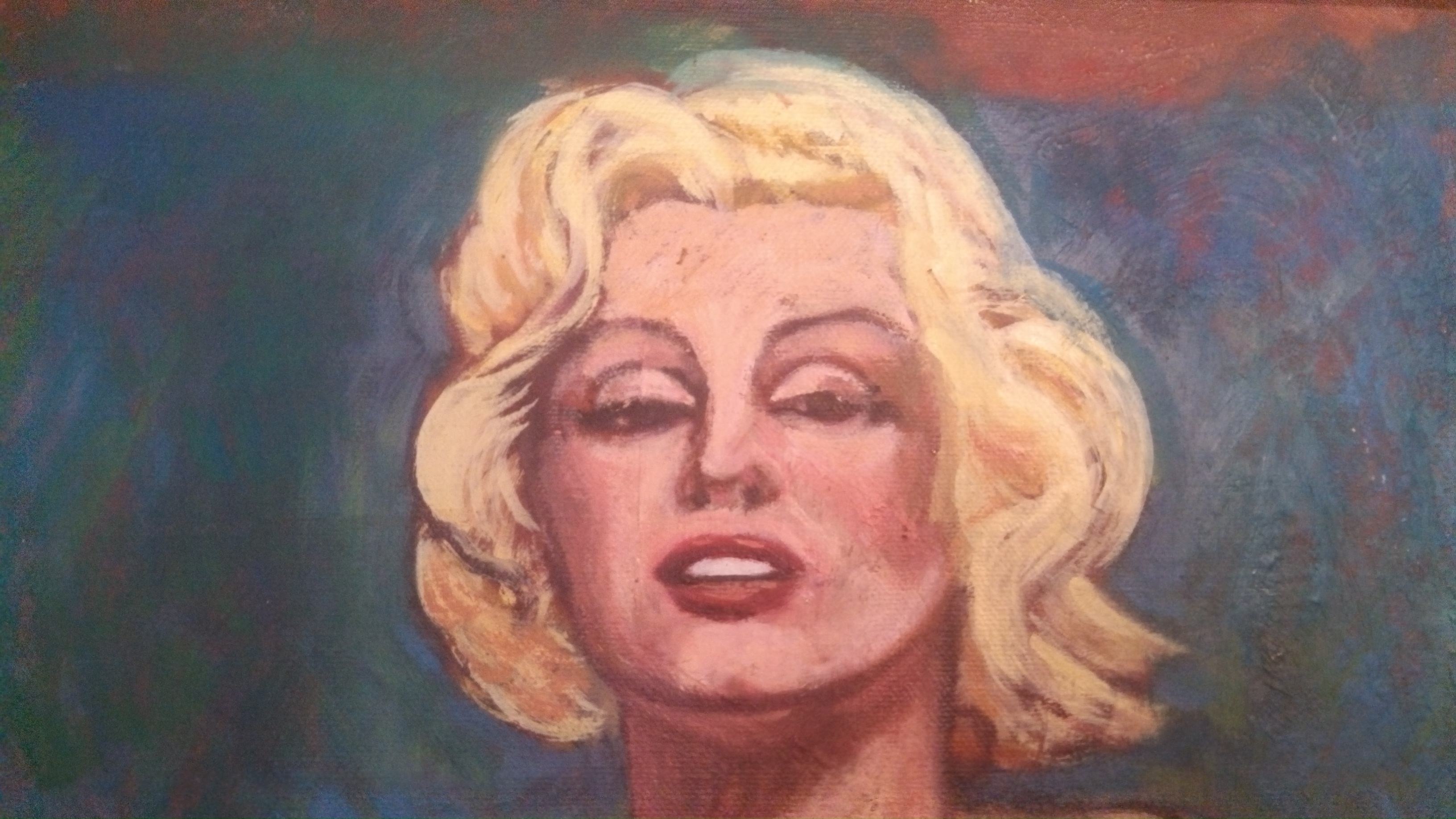
of Marilyn Monroe movie memories
and placid book cover art

"Marilyn at Forty" Oil painting by Ted Barr

“Marilyn at Forty” Oil painting (1986) by Ted Barr
James Kelly Collection

I’ve been excited by women
in libraries
rolling book carts to proper shelves
cataloging history and
time and gossip and art

I’ve been excited by women
in libraries
crossing legs out of terry cloth dresses with
rouged cheeks and
red elevated lips
taking a book inward
with focus and cognition
while red hair
and white thighs exude
auras of creation

I’ve been excited by women
in libraries
as if Sapphos’ lost poems
appeared while I wait for
a tall dark haired woman
to find me here between
stolid wooden shelves
where dreams meet the sea
and hearts have tried
to expose the sky

I’ve been excited by women
in libraries
and have turned pages
of desire toward islands of thought
where there are
rose petaled shores
of sure goodness
and love

Bear kill on deer hunt


Talk softly to the Bear
in his dying, apologize
profusely–commend him
his courage as he stood
before you–stood! mind you
stood upright as you
before his death,
your own self,
you who pulled the trigger
and sent the bullet
meant for venison
that ripped out his throat,
five yards from your own.

Talk softly to the Bear
in his dying, apologize
remorsefully, commend him
his life as connected
to your own
& from your perspective
in a lasting way,
for he would have killed you
or left many scars.

Talk softly to the Bear
in his dying, apologize
with wry humor
make a fine rug of his brown hide,
commend him his courage of life & spirit,
every time you walk by;
but disparage his intellect,
tell him he should have kept
running from your partner
who stumbled through
the manzanita brush patch
that was his hiding place
with an unloaded gun.

Talk softly to the Bear
in his dying, apologize
sincerely, commend him
his spirit–send it back
to where it came,
as he lays next to
the knic-ki-knick leaves,
know the sound he makes..,
“UHHNNNUUUUUUU!”
Remember this all your life.

A Long Road


Looking down
a long road where
there could be
a place we all belong
beginning each day again
our lives becoming alive
to each other & it is
where we go
on this way to be,
despite a rampant call of noise,
between laughter we could
be roses, or white white
poppies amidst what we
call to be ourselves, alive
beautiful and blended
with time & sorrow
it should be that our
days are long spinning
turns toward light
and that brightness of
& in only ourselves togethered
& amazed with the day as a point of light
& night’s black rest amid these other points of light…

from The Horse and His Boy by C.S.Lewis


C.S. Lewis

C.S. Lewis

And being very tired and having nothing inside him he felt so sorry for himself that the tears rolled down his cheeks.

What put a stop to all this was a sudden fright. Shasta discovered that someone or somebody was walking beside him, it was pitch dark and he could see nothing. And the Thing (or Person) was so quietly beside him he could hardly hear any footfalls. What he could hear was breathing. His invisible companion seemed to breathe on a very large scale and Shasta got the impression that it was a very large creature. And he had come to notice this breathing so gradually that he had really no idea how long it had been there, It was a horrible shock.

It darted into his mind that he heard long ago that there were Giants in these northern countries. He bit his lip in terror. But now that he really had something to cry about, he stopped crying.

The Thing (unless it was a Person) went on beside him so very quietly that Shasta began to hope he had only imagined it. But just as he was becoming quite sure of it, there suddenly came a deep, rich sigh out of the darkness beside him. That couldn’t be imagination! Anyway, he had felt the hot breath of the sigh on his chilly left hand.

If the horse had been any good—or he had known how to get any good out of the horse— he would have risked everything on a break away and a wild gallop. But he knew he couldn’t make that horse gallop.  So he went on at a walking pace and the unseen companion walked and breathed beside him. At last he could bear it no longer.

“Who are you?” he said, scarcely above a whisper.

“One who has waited long for you to speak,” said the Thing. Its voice was not loud, but very large and deep.

“Are you —a giant?” asked Shasta.

“You might call me a giant,” said the Large Voice. “But I am not like any creatures you call Giants.”

“I can’t see you at all,” said Shasta, after staring very hard, then (for an even more terrible idea had come into his head) he said, almost in a scream, “You’re not something dead, are you? Oh, please—do go away, what harm have I ever done you? Oh, I am the unluckiest person in the whole world!”

Once more he felt the warm breath of the Thing on his hand and face. “There,” it said, “that is not the breath of a ghost, tell me you sorrows.”

Shasta was a little reassured by the breath: so he told how he had never known his real father or mother and had been brought up sternly by the fisherman. And then he told the story of his escape and how they were chased by lions and forced to swim for their lives; and of all the dangers in  Tashban and about his night among the tombs and how the beasts howled at him out of the desert. And he told about the heat and the thirst of their desert journey. And he told about how they were almost at their goal when another lion chased them and wounded Aravis. And also, how very long it was since he’d had anything to eat.

“I do not call you unfortunate,” said the Large Voice.

“Don’t you think it was bad luck to meet so may lions?”  said Shasta.

“There was only one Lion, Said the Voice.

“What on earth do you mean? I’ve just told you there were at least two the first night, and..”

“There was only one: but he was swift of foot.”

“How do you know?”

“I was the lion.” And as Shasta gaped with open mouth and said nothing, the voice continued, “I was the lion who forced you to join with Aravis. I was the cat who comforted you among the houses of the dead, I was the Lion who drove the jackals from you while you slept. I was the lion who gave the horse the new strength of fear for the last mile so that you should reach King Lune in time, and I was the lion you do not remember who pushed the boat in which you lay, a child near death, so that it came to shore where a man sat, wakeful at midnight, to receive you.”

“Then it was you who wounded Aravis?”

“It was I.”

“But what for?” said Shasta.

“Child,” said the Voice “I am telling you, your story, not theirs. I tell no one any story but his own.”

“Who are you?” said Shasta.

“Myself,” said the Voice, very deep and low so that the earth shook: and again,” Myself,” loud and clear and gay: and then the third time “Myself,” whispered so softly you could hardly hear it, and yet it seemed to come from all around you as if the leaves rustled with it.

Shasta was no longer afraid that the Voice belonged to something that would eat him, nor that it was the voice of a ghost, but a new and different sort of trembling came over him, yet he felt glad too.

The mist was turning from black to gray, and from gray to white. This must have begun to happen some time ago, but while he had been talking to the Thing he had not been noticing anything else. Now, the whiteness around him became a shining whiteness; his eyes began to blink, somewhere ahead he could hear birds singing. He knew the night was over a last. He could see the mane and ears and head of his horse quite easily now. A golden light fell on them from the left. He thought it was the sun.

He turned and saw, pacing beside him, taller than the horse, a Lion. The horse did not seem to be afraid of it or else could not see it. It was from the Lion that the light came. No one ever saw anything more terrible or beautiful. Luckily Shasta had lived all his life too far south in Calormen to have heard the tales that were whispered in Tashbaan about the dreadful Narnian demon that appeared in the form of a lion. And of course he knew none of the true stores about Aslan, the great Lion, the son of the Emperor-over-the Sea, the King above all High Kings in Narnia. But after one glance at the Lion’s face, he slipped out of the saddle and fell at its feet. He couldn’t say anything but then he didn’t want to say anything, and he knew he couldn’t say anything.


The Horse and His Boy by C.S. Lewis
Picking up the pieces


Well see— he’d already named the animals!
I didn’t really have anything to do, yes we did
Walk in the garden every evening..
I must admit maybe I was bored & the serpent
Was an intellectual & he made me laugh & I was laughing when I tasted it.
I wanted to change names of some of the animals,
I must admit I never asked if I could,
Neither of them said I couldn’t..
Just seemed like it was a bargain already made, oh he would do anything for me!
& well I didn’t even know that he hadn’t named all the animals
Didn’t find that out til, well
after we were outside & some of these other animals seemed to be intent on eating us
Oh this surprised me, this thing called fear, but I like eating meat!
& now I’m not bored with him any more I must admit
He protects & takes care of me, but these children, oh if I didn’t
Have him, as much as I love them, it would be impossible..
But you know I think someday one of them will kill the other
&  I cannot imagine this..
I do miss those walks
When it was that love was as constant as air..
Now there are only times when I look at him & vaguely remember..
Still he can be bad
Now he growls & once after drinking he hit me & this was not like him &
I bled, & now I bleed regularly &
What have we done?
I killed the snake last week & after I did
I heard him laugh from the grove in the garden we can’t go into any more,
But then again maybe it was from the forest beyond,
& I’m afraid of that place..
I couldn’t tell & anyway I saw the snake again the next day
I know where there are flowers by a quiet pool
Perhaps I could go there and come back?
If I leave him it will be dangerous
Perhaps I’ll go there and come back..
Oh, my heart breaks when he screams in the middle of the night!

Love may be


Love may be a greybearded old man
giving great belly laughs out of
a tobacco stained yellow shirt
while small birds light and perch
and small children play in vacant
lots and an osprey fishes in cold
northwest waters with its aerial
view of trout making headway against
currents & we in complacency
think of all the sane reasons not
to watch the six o’clock news as
three women in Puerto Vallarta wrap
crayfish with cornmeal in husks
to steam into tamales for their
children to sell on the beach, all
for what we have to have..

C.S. Lewis – from Atheism to Theism – YouTube


from Theism to Christianity

Above Lyman’s riffle


Above Lyman’s riffle
At the old man’s house,
Falling down a little more a year
After his death, in the
Hot August now cooling dusk
I waited for the red glow
Down river &
Swallows… swallows in the evening light!
I can see to my right the
100 year old black walnut
& cherry orchard
Across the road, up the hill Ernie’s hard rock mine
& Sardine Creek trickling
In through the willows upstream
That held specimen nuggets as big as your thumb!
I’m watching the old chimney’s brick
That juts upward from the tin roof
Below Lyman mountain,
The old man wasn’t born in this house
They built it when he was two, he was born
Across the road near where
I tore the apple packing shed down two years before,
Full of 19th Century artifacts, a “Coolerator
Icebox, with  only three  bullet holes &
Behind the siding on the inside wall
Written in pencil, was a scribe from 80 years ago,
“Amen, Brother Ben,
Shot at a Rooster and hit a hen!”
From a ladder I sided my cabin
With those old Douglas fir lap boards,
While my own children squealed
& ran across my side hill
& now the wary Table Rock Black-tail deer
Are waiting on after dusk for a drink of river,
& now swallows begin to draw close
& for one minute come together
In ever tightening circles & swirl together
Then as one & into whirling black-funnel-down-cloud
Fifty feet in height above the house
& they are into-the-chimney
In one second &
Full of this days hatch
Settling for brick gripped sleep
This is what I waited for..
All pretty much at once it happens
On these August evenings
& the thirsty bucks stop their pant
& began to move & will slake their thirst
& I have taken a 10 pound steelhead from the riffle
On wet fly, a Teeter’s weighted-woolly-worm,
Ernie, gone about a year–had told me it was an evening riffle
Returning to my cabin  I fed my family steelhead fillets
& read the Gospel of John
One more time..