Karl Barth – On Revelation – YouTube.
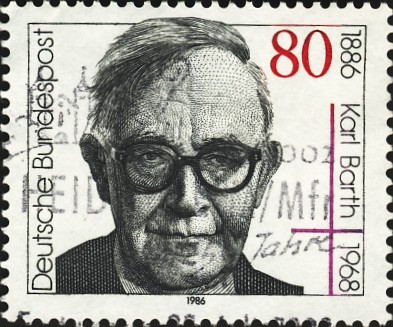
He started out life conventionally enough: he was born in Basel, Switzerland, the son of Fritz Barth (pronounced “bart”), a professor of New Testament and early church history at Bern, and Anna Sartorius. He studied at some of the best universities: Bern, Berlin, Tübingen, and Marburg. At Berlin he sat under the famous liberals of the day (like historian Adolph von Harnack), most of whom taught an optimistic Christianity that focused not so much on Jesus Christ and the Cross as the fatherhood of God and the brotherhood of man. After serving a Geneva curacy from 1909 to 1911, Barth was appointed to a working-class parish in Switzerland, and in 1913 he married Nell Hoffman, a talented violinist (they eventually had one daughter and four sons). As he pastored, he noted with alarm that Germany was becoming increasingly militaristic and that his former professors were supportive of this. Barth, dismayed with the moral weakness of liberal theology, plunged into a study of the Bible, especially Paul’s Epistle to the Romans. He also visited Moravian preacher Christoph Frederick Blumhardt and came away with an overwhelming conviction about the victorious reality of Christ’s resurrection—which deeply influenced his theology. Out of this emerged his Commentary on the Epistle to the Romans (1919). He sounded themes that had been muted in liberal theology. Liberal theology had domesticated God into the patron saint of human institutions and values. Instead, Barth wrote of the “crisis,” that is, God’s judgment under which all the world stood; he pounded on the theme of God’s absolute sovereignty, of his complete freedom in initiating his revelation in Jesus Christ. He spoke dialectically, in paradox, to shock readers into seeing the radicalness of the gospel: “Faith is awe in the presence of the divine incognito; it is the love of God that is aware of the qualitative difference between God and man and God and the world.” The first of six heavily revised editions followed in 1922. It rocked the theological community. Barth later wrote, “AsI look back upon my course, I seem to myself as one who, ascending the dark staircase of a church tower and trying to steady himself, reached for the banister, but got hold of the bell rope instead. To his horror he had then to listen to what the great bell had sounded over him and not over him alone.” Liberal theologians gasped in horror and attacked Barth furiously. But Barth had given that form of liberalism a mortal wound. His theology came to be known as “dialectical theology,” or “the theology of crisis”; it initiated a trend toward neo-orthodoxy in Protestant theology. In 1921 Barth was appointed professor of Reformed theology at the University of Göttingen, and later to chairs at Münster (1925) and Bonn (1930). He published works critiquing nineteenth-century Protestant theology and produced a celebrated study of Anselm. In 1931 he began the first book of his massive Church Dogmatics. It grew year by year out of his class lectures; though incomplete, it eventually filled four volumes in 12 parts, printed with 500 to 700 pages each. Many pastors in the 1930s, ’40s, and ’50s, desperate for an antidote to liberalism, eagerly awaited the publication of each book.
Fascist idolatry
Barth fought not just with liberals but allies who challenged some of his extreme conclusions. When Emil Brunner proposed that God revealed himself not just in the Bible but in nature as well (though not in a saving way), Barth replied in 1934 with an article titled, “No! An Answer to Emil Brunner.” Barth believed that such a “natural theology” was the root of the religious syncretism and anti-Semitism of the “German Christians”—those who supported Hitler’s national socialism. By this time, Barth was immersed in the German church struggle. He was a founder of the so-called Confessing Church, which reacted vigorously against the ideology of “blood and soil” and the Nazis’ attempt to create a “German Christian” church. The 1934 Barmen Declaration, largely written by Barth, pitted the revelation of Jesus Christ against the “truth” of Hitler and national socialism: “Jesus Christ…is the one Word of God…. We reject the false doctrine, as though the Church could and would have to acknowledge as a source of its proclamation, apart from and beside this one Word of God, still other events and powers, figures and truths, as God’s revelation.” When Barth refused to take the oath of unconditional allegiance to the Führer, he was fired. He was offered the chair of theology in his native Basel, however, and from there he continued to champion the causes of the Confessing Church, the Jews, and oppressed people everywhere.
After the war, Barth engaged in controversies regarding baptism (though a Reformed theologian, he rejected infant baptism), hermeneutics, and the demythologizing program of Rudolf Bultmann (which denied the historical nature of Scripture, instead believing it a myth whose meaning could heal spiritual anxiety). Barth also made regular visits to the prison in Basel, and his sermons to the prisoners, Deliverance to the Captives, reveal his unique combination of evangelical passion and social concern that characterized all his life. When asked in 1962 (on his one visit to America) how he would summarize the essence of the millions of words he had published, he replied, “Jesus loves me this I know, for the Bible tells me so.” Though Barth made it possible for theologians again to take the Bible seriously, American evangelicals have been skeptical of Barth because he refused to consider the written Word “infallible” (he believed only Jesus was).
Galli, Mark (2010-07-19). 131 Christians Everyone Should Know (pp. 46-48). Holman Reference. Kindle Edition.

 St. John One: One