
The Suffering Servant of Second Isaiah: A Non-Penal Consideration | Matthew Distefano


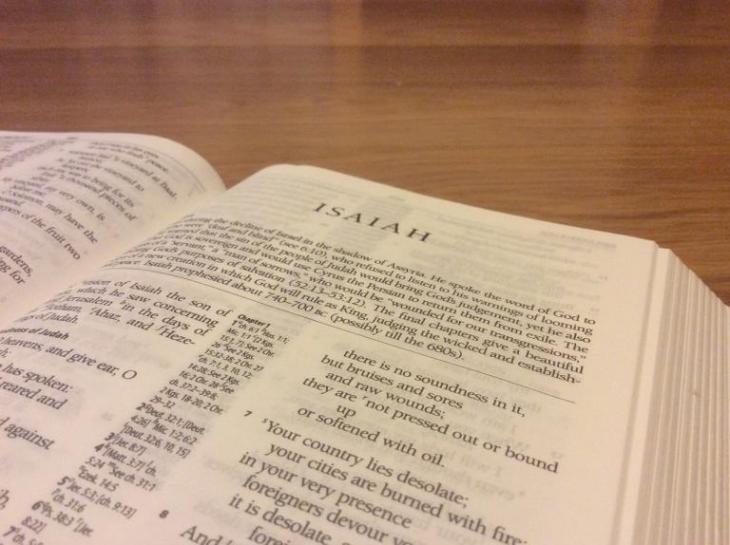
With our sacrificial glasses put to the side for a moment, what seems fairly clear here is not that the servant gives up his life to satisfy the wrath of God—that would have to be read into the text—rather, the servant willingly gives up his life (nefesh) non-violently (Isaiah 53:9) for the very people who put him to death. He sees the profundity of what he is suffering through and so, gains an understanding and a knowledge that makes “many” righteous (Isaiah 53:11). The knowledge that the servant earns is a recognition of both God’s desires and of what it means to be human. Anthony Bartlett calls it a “new theological-anthropological truth.” To be righteous—that is to say, to be like God—is to be like the suffering servant, the one who has no violence in him (Isaiah 53:9). James G. Williams drives this point further home in the following: “It wasn’t God who caused suffering, it was the oppressors. As the divine voice says in an oracle found in chapter 54: ‘If any one stirs up strife, it is not from me; whoever stirs up strife with you shall fall because of you.’ ‘Strife’—the conflict of mimetic rivalry that results in violence—does not come from God.”

Source: The Suffering Servant of Second Isaiah: A Non-Penal Consideration | Matthew Distefano

Our Interactive Good Friday Service | Keith Giles


For the last few years, our family would host an interactive and meditative Good Friday experience in our home. We’d spend the day setting up […]

Source: Our Interactive Good Friday Service | Keith Giles

That our glassy sea be mingled with fire— by William Graham Scroggie


James Ross Kelly's avatarSt. John One: One

“A sea of glass mingled with fire” (Rev. 15:2).

 William Graham Scroggie William Graham Scroggie

Peace and energy do not always go together, though they should. Energy need be none the less energetic if it be peaceful, nor peace the less peaceful if it be energetic. Peace without energy may be only stagnation; and energy without peace may be but a form of panic. What we need is that our glassy sea be mingled with fire, and that our fire shall have for its home a glassy sea. Too often the water puts out the fire, or the fire dries up the water; but in every true life these dwell helpfully together. Why should peace exclude passion, and why should passion destroy peace? Why should one moral quality triumph at the expense of another? Yet, too often it is so. Sometimes our sea is not glassy, but tempest tossed; and sometimes…

View original post 62 more words

Heaven Will Solve Our Problems–C.S. Lewis


C.S. Lewis

C.S. Lewis

“Heaven will solve our problems, but not, I think, by showing us subtle reconciliations between all our apparently contradictory notions. The notions will all be knocked from under our feet. We shall see that there never was any problem.

And, more than once, that impression which I can’t describe except by saying it’s like the sound of a chuckle in the darkness. The sense that some shattering and disarming simplicity is the real answer.”

C.S. Lewis, from A Grief Observed

7 Assumptions About Universalism That Are So Often Wrong | Matthew Distefano


Patristic Universalism

Source: 7 Assumptions About Universalism That Are So Often Wrong | Matthew Distefano

Jordan Peterson: The Story of Christ as the Foundation of Western Culture–& why in 10 minutes