Category / Christianty
from Hagia Sophia — English Othodox chants
Orthodox Chants
#ThursdayTheologyBlogs :Why Did You Have So Many Kids?

 After the birth of our fourth child, Michael and I struggled to understand exactly how we were meant to live our lives. We were discussing an article by an author whose main premise was that letting go of control and trusting in God was not some abstract principle but a day-to-day practical call that included the surrender of our fertility. Of course, we practised natural family planning but I was one of those rare people who could conceive long before ovulation.
As my doctor said once, “Ah, I remember reading about a woman in New Zealand, two years ago, who conceived five days before ovulation.”
I raised my hand and chirped, “Well, you can add me to that list!”
Although we could not imagine how large our family would become, the words of that article resonated within both my husband and I. Guilt lifted off us and a surge of excitement…
View original post 269 more words
Jesus, a Unique Savior (Parts 1& 2) Ravi Zacharias

Ethnic Images of Mary
We are accustom to beautiful images of Mary picturing her as a white, European. However, she was from the Middle East and most likely looked Middle Eastern. Artist’s models and concepts of beauty are influenced by their culture. Now artists are emerging who are painting Mary as if she was born in their country because they can relate and connect better to the living Mary when their prayer is triggered by an image they are familiar with. The results are stunning, opening our hearts and souls to different qualities and graces of Mary.
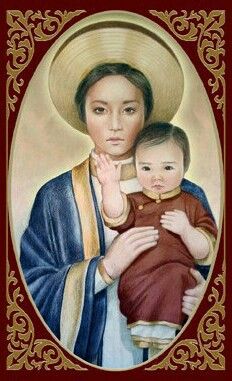 Our Lady of LaVang

Our Lady of the Philippines

The Holy Family, India

Protestant’s Reactions to a Catholic Writer
Please read our Sister in Christ’s observation and plea. I lived in a small community in Alaska for almost a decade and I spoke up for Catholics and periodically would ask the Priest to forgive me for what my Protestant brother’s and sisters in Christ would say about Catholic brothers and sisters. Catholics, Eastern Orthodox, Protestants form a “pale of Orthodoxy,” despite any of our doctorial differences we are one body and I know Catholics are to be the Bride of Christ as well. I came to Christ 41 years ago and it started by reading Thomas Merton’s Poetry. Despite doctrine the Catholic Church and Eastern Orthodox Church is our Mother. I don’t want anyone saying anything bad about our Mother. Jesus Christ, Son of the Living God we beseech you to have mercy on us all as we reach out to you.
I am proud to proclaim
I am a Catholic.
A saved, born again, Spirit filled, lover of Jesus
who expects to be accepted
by Protestant lovers of Jesus
because I am a sister in Christ.
BUT, my culture and way of expressions seems odd to Protestant ears,
So I am misunderstood.
Perhaps in the Body, the Protestants are the feet and mouth carrying the Good News
and as a Catholic I am an ear.
I might not look like I belong but trust me,
although I look foreign I AM part of the same Body.
May my small acts of unity reverberate throughout the entire Mystical Body of Christ.
 Before I discovered Catholic sites, I posted on secular and Protestant sites. I felt I had to hide my Catholicism. When I finally wrote about my Catholic faith, I was immediately grilled and interrogated by shocked readers and co-authors. Yet God had His…
View original post 246 more words
from The Unfolding Drama of Redemption: William Graham Scroggie
 “In the Beginning God created the heavens and the earth.”
The first verse of the Bible has no parallel for sublimity and comprehensiveness. In scope it is declarative, not demonstrative; affirmative, not argumentative; and historical not philosophical. There is no attempt to prove the Being of God. He is the unprovable Fact upon which all else is built, and only “the fool’ will say, ‘there is no God.’
Here the uncreated God is seen creating, and in such a manner that, as Andrew Fuller declared, a child can learn in five minutes from this verse more than all the ancient sages ever knew.
In character the verse is entirely positive, but it rules out all that is false in the thoughts and theories of men about God and the universe.
The simple statement denies at least six false doctrines.
[1]It denies the Eternity of Matter. ‘in the beginning’. There was, then, a commencement; ’the heavens and the earth’ had a ‘beginning’; they were not eternal. The antiquity of the universe is beyond human computation; but there was a time when it did not exist.
[2]It denies Atheism. The atheist says there is no god, but the Bible begins by declaring His Being. Geology and astronomy may claim a hundred million years for the existence of the universe, but whenever it began God was there; He did not begin; He eternally is. Atheism creates a crop of problems, and solves none.
[3]It denies Polytheism. If creation were the work of many gods, the unity of the universe would have to be accounted for, and it can be accounted for only on the hypothesis that God, the one Eternal Mind, created all. ‘God created’.
‘God’, Elohim. This designation, which is plural, occurs 35 times in Chapters 1:1, 2 , 3, and in The Old Testament over 2,000 times. It certainly does not mean gods, and must be something more than plural of majesty. In the light of the entire revelation in the Bible we must regard this designation of God to be a fore gleam of the Divine Trinity (cf. ver. 26).
“Created’. In Genesis 1-2 three words are used which must be distinguished. Bara, which occurs in 1:1; 1:21, 1:27; 2:3; is used exclusively of God, and signifies a distinctively creative act. ‘Made’, asah, and ‘formed”, yatzar, which occurred in 1:7; 1:16; 1:25; 1:31; 2:2;2:3;2:7; 2:8;2:19; signify to construct out of pre-existing materials. This distinction is of the utmost importance of an understanding of the first two chapters of the Bible. The idea of evolution can be in make and form, but not in create; so that the bringing in to existence of the universe, of animal life, and of human life, was by successive creative acts of God (1:1;1:21;1:27). By the word of his power a cosmos was created of orders material, sentient, and moral.
[4]It denies Pantheism. This teaches that God and Nature are the same, and so fails to distinguish between mind and matter, right and wrong, good and bad, and utterly confuses things which lie far apart. But this pernicious error finds its answer here: ‘God created the heavens and the earth,’ and as He could not create Himself, He, and the heavens and the earth’, cannot be the same.
[5] It denies Agnosticism. This affirms that it cannot be known whether there is a God or not. But the universe is an effect, and must have had a sufficient Cause; this building must have had an Architect; this design must have had a Designer; this Kingdom must have a King; and this family must have a Father. Legitimate inference challenges and discredits agnosticism.
[6] It denies Fatalism. Reason is against fate and chance. This wonderful universe could not just ‘happen.’ God has acted in the freedom of His eternal Being, and according to His infinite Mind, and what He willed was and is, and can be nothing else, unless He should will it.
The Unfolding Drama of Redemption; William Graham Scroggie
Obama Calls for End to Gay ‘conversion’ Therapy for Youth
Convince Me There’s A God – Archaeology 22

“And the Lord God of their fathers sent warnings to them by His messengers, rising up early and sending them, because He had compassion on His people and on His dwelling place. But they mocked the messengers of God, despised His words, and scoffed at His prophets, until the wrath of the Lord arose against His people, till there was no remedy. Therefore He brought against them the king of the Chaldeans, who killed their young men with the sword in the house of their sanctuary, and had no compassion on young man or virgin, on the aged or the weak; He gave them all into his hand. And all the articles from the house of God, great and small, the treasures of the house of the Lord, and the treasures of the king and of his leaders, all these he took to Babylon. Then they burned…
View original post 1,335 more words

