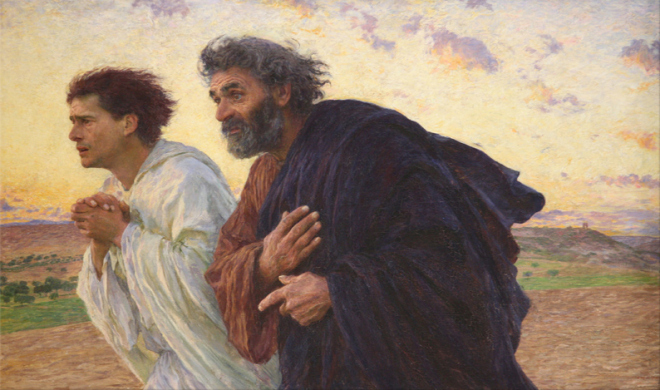
an exhortation..as
a lay Christian examines his faith..
By James Ross Kelly
The assertion of the crucifixion of Jesus of Nazareth as truth is accepted by most all accounts historically, but it is the next Chapter of John’s Gospel that Christ becomes the risen Savior of mankind—and when Christianity is presented to mankind as a Supernatural visitation by the Creator of the Universe. What may go against the humanist grain is that it must be asked given Christianity’s assertion of this truth— it must be seriously asked, ‘What do you say of a group of beings that would torture and kill their own Creator? Who kindly and humbly appeared to them preaching love and forgiveness and supreme fellowship with the whole of Creation of the universe? Given that this is true, if you accept that Jesus of Nazareth was exactly Who he said he was according to scripture previous to Chapter 19 of John’s Gospel—there is now a change that must take place in our essential view of humanity. And it must be said to all, that if Christendom’s message is true as the faithful proclaim it, that this event is the greatest definition of mankind! That humanity killed its Creator and proved itself inhuman for all time—juxtaposed with the Creator offering Himself as a sacrifice that all people might come into a relationship with Him and make themselves, with His divine help, at last truly humane! The greatest anguish turning into greatest joy! This the most important event in all of history—all previous scripture leads toward this event as prophesy and type. All subsequent scripture is then driven by this event, as is all commentary, preaching, doctrines and creeds. The saddest day brings forth the most happy day both then rapt into an inter-dimensional cleft that will guide the coiling of history toward its ultimate destiny. It is the death knell for the god of this world when the sentence, ‘It is finished.’ was uttered. But—it would be most likely not even a foot note in history, lost long ago in human memory if it were not for the following supernatural event that the caused all of paganism to begin a world-wide decent. But then again we must suspend and consider the rest of the story because the former is accepted fact even in an unbelieving world, now again, ‘what if just—as it is written’—this also is true?
John–Chapter 20 (NIV)
1Early on the first day of the week, while it was still dark, Mary Magdalene went to the tomb and saw that the stone had been removed from the entrance.
2So she came running to Simon Peter and the other disciple, the one Jesus loved, and said, “They have taken the Lord out of the tomb, and we don’t know where they have put him!”
3So Peter and the other disciple started for the tomb.
4Both were running, but the other disciple outran Peter and reached the tomb first.
5He bent over and looked in at the strips of linen lying there but did not go in.
6Then Simon Peter, who was behind him, arrived and went into the tomb. He saw the strips of linen lying there,
7 as well as the burial cloth that had been around Jesus’ head. The cloth was folded up by itself, separate from the linen.
8 Finally the other disciple, who had reached the tomb first, also went inside. He saw and believed.
9(They still did not understand from Scripture that Jesus had to rise from the dead.)
10Then the disciples went back to their homes,
11but Mary stood outside the tomb crying. As she wept, she bent over to look into the tomb
12and saw two angels in white, seated where Jesus’ body had been, one at the head and the other at the foot.
13They asked her, “Woman, why are you crying?” “They have taken my Lord away,” she said, “and I don’t know where they have put him.”
14At this, she turned around and saw Jesus standing there, but she did not realize that it was Jesus.
15″Woman,” he said, “why are you crying? Who is it you are looking for?” Thinking he was the gardener, she said, “Sir, if you have carried him away, tell me where you have put him, and I will get him.”
16Jesus said to her, “Mary.” She turned toward him and cried out in Aramaic, “Rabboni!” (which means Teacher).
17Jesus said, “Do not hold on to me, for I have not yet returned to the Father. Go instead to my brothers and tell them, `I am returning to my Father and your Father, to my God and your God.’”
18Mary Magdalene went to the disciples with the news: “I have seen the Lord!” And she told them that he had said these things to her.
19On the evening of that first day of the week, when the disciples were together, with the doors locked for fear of the Jews, Jesus came and stood among them and said, “Peace be with you!”
20After he said this, he showed them his hands and side. The disciples were overjoyed when they saw the Lord.
21Again Jesus said, “Peace be with you! As the Father has sent me, I am sending you.”
22And with that he breathed on them and said, “Receive the Holy Spirit.
23If you forgive anyone his sins, they are forgiven; if you do not forgive them, they are not forgiven.”
24Now Thomas (called Didymus), one of the Twelve, was not with the disciples when Jesus came.
25So the other disciples told him, “We have seen the Lord!” But he said to them, “Unless I see the nail marks in his hands and put my finger where the nails were, and put my hand into his side, I will not believe it.”
26A week later his disciples were in the house again, and Thomas was with them. Though the doors were locked, Jesus came and stood among them and said, “Peace be with you!”
27Then he said to Thomas, “Put your finger here; see my hands. Reach out your hand and put it into my side. Stop doubting and believe.”
28Thomas said to him, “My Lord and my God!”
29Then Jesus told him, “Because you have seen me, you have believed; blessed are those who have not seen and yet have believed.”
30Jesus did many other miraculous signs in the presence of his disciples, which are not recorded in this book.
31But these are written that you may [1] believe that Jesus is the Christ, the Son of God, and that by believing you may have life in his name.1.31 Some manuscripts “may continue to”
So the greatest of antinomies is resolved. The entirety of human kind has now been redeemed. And just like anyone unfamiliar or knowledgeable today they did not know they were redeemed. Some did not know they needed to be redeemed then, as they do not know it today. There are those who see who have not seen with the same eyes of Thomas, but with the inner light of truth, as it presents itself simply because it is the Truth and believe in that moment of revelation.
So we who have believed and yet have not seen have inherited this story as the foundation of Western culture—a foundation that may be fast crumbling, and a foundation that is having its ramparts stricken from most every side. Yet it is we who do believe who are left responsible for this message being passed on. The greatest of fallacies is that one has to be part of a graduated class in a seminary to pass this message on. People are often put to death spiritually in Seminaries and others become atheists or pantheists there. Others because of their seminary experience have had to abandon the organized Church rather than look themselves in the mirror because of the hypocrisy of one form or another they found abiding there. And many modern day religionists would charge upon pain of ecclesiastical crucifixion that one is forced to accept this system and live it and put this tradition on over Christ Jesus Himself. And yet it may be that despite all this our Seminaries are a separation process that does produce notable been and women of God.
High Pagan Rome began a precipitous but lengthy fall the day of the crucifixion. From its beginning they wanted no part in it. The religionists of the day wanted it done and done before dark and done their way and would not, could not, take in any form of mercy as an answer—they still can’t—leaving the Messiah on the Cross in the form of condemning legalism rather than loving redemption and the resurrected loving glory of a living God. The Pilate’s of this world are still here in comfortable bureaucracies agreeing to death sentences for some and long terms for others—as portions of Christ are chipped out of our culture on a daily basis in making environmental decisions based upon short term profit, at the expense long term health and human justice. Or, allowing the destiny designed by a loving God to play out in a myriad of aborted lives whose end has come for convenience and pleasures sake at the modern alter of the pagan god that requires human sacrifice for a middle-to-upper-class lifestyle. Just as the ritual and rites of pre-Christian pagan Celtic homes required the ritual sacrifice of the first born on its foundations before a structure was thought to be sound.1 The Pharisees and ruling Sanhedrin-like councils exist as parts of legislatures, courts and political parties and good ol’ boy networks and now it seems good ol’ girl networks.
So? —again, to those that aren’t convinced. Is it true? I believe with every fiber of my being that it-is-true. And not only true but the truth—the ultima veritas. And I believe this after having questioned it thoroughly and found the truth to be vital and living. God the Creator took the form of man and visited earth as humble carpenter. Here he preached the truth of love and redemption to all mankind to the holders of a covenant with Him and was then arrested, tried and killed both by the holders of that covenant and mankind in general in the form of authoritarian civilized Pagan Rome. By this act there is a final redemption for all people in all times and in all walks of life. And through this emerges all other truths and upon which all other truths depend. One adopts the creeds of Christianity not because they are mere words and the party line but because they are in essence the living truth that has been passed on for a length of time in space that surpasses the oldest living things on the planet.
 St. John One: One